Enomatic rewards New Yorkers

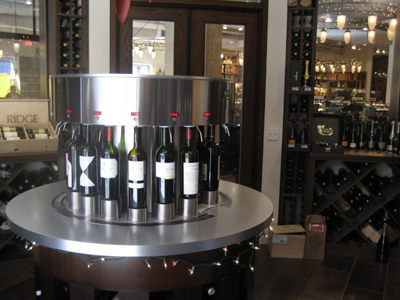
The fact that the enomatic, a $10,000 machine that spits out wine pours, has landed in New York is not news (unlike in Fairfax, VA): Union Square Wines installed six of the machines when they moved to their new location (map it) last summer. What’s news is that it is the only store in New York to do so. Why?

You can largely thank New York’s confusing laws on wine retailing, which prevent charging for wine samples among other things. In states with more permissive laws on tasting, enomatic machines can be spotted in wine shops that charge for samples. But in New York, charging anything for drinking on premises requires a different license. Thus it’s hard to make for a retailer to make economically viable the expensive piece of burnished stainless steel that is the enomatic. (But it does mean a lot of free wine for consumers around town.)

But Union Square Wines took the plunge and I decided to put them to the test. I strode in last weekend and asked for a card. Not so easy, it turns out. You have to be an existing customer–it’s structured as a “reward” system. Well, I’ve bought wine at the store before, I replied. “But do you have the card?” Ah, no. A purchase is required and each dollar spent accumulates 5 points, which can be deducted from the card at the enomatics.

So seeing that 40 points could get me a couple of tastes, I splurged on an $8 wine. Then I had to take my receipt to another desk across the store (no plans for streamlining this at one register) where a staffer mercifully took pity on me and gave me 200 points instead of the 40 I was due.

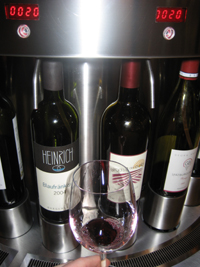
Then I hit the machines. The pours were SMALL. But they were FRESH. It only took me a shot of riesling, gewurztraminer, some rustic French red, and a bonarda from Argentina to realize that the number of points deducted was the equivalent to the price in dollars of the whole bottle. Too bad I didn’t have enough for the 225 point Barolo in the front room. Net-net the enomatic is a way to get fresh, free wine served on demand. Just, for the sake of the NY regulators, don’t think of it as a bar!

* * *
On a related note, the WSJ had a story yesterday about the potential demise of the bar car on Metro-North trains. Installing enomatics on the trains could be an excellent use of the machine that substitutes capital for labor.

tags: | |

Tasting sized pours — cellar, wagyu, koshu, and EU

Vote it up
Voting ends today in the inaugural edition of the American Wine Blog Awards. Consider Dr. Vino in two categories! You can vote here.

Vote it down
Mariann Fischer Boel, the EU Commissioner for Agriculture, was dealt a setback in her reform for the wine sector. The EU Parliament voted 484 – 129 against her proposal to uproot almost 1 million acres of vines. The Parliament is a consultative body so the reform is not dead but it may be wounded given the lopsided nature of the vote. [Bloomberg]

Cellar time
Park B. Smith, the eminent wine collector featured along with this cellar (check out the slide show!) in this week’s NYT, invited Eric Asimov to lunch in the cellar. On his grand cru blog, Asimov recounts the “parade of Chateauneufs.” [The Pour]

La vache qui boit
Kobe beef cows are a pampered lot since they are seranaded with Mozart, massaged and fed beer to make their meat succulent. But their analogues in Australia, where it is known as wagyu, are being fed red — a premium red wine blend that is, costing A$20 (16 USD) a bottle! “The addition of a litre of premium wine to each animal’s feed for the last 60 days of its life is said to give the meat a sweetness that lifts the quality even further. The antioxidants in the wine are also thought to improve the colour and shelf life of the beef.” [Daily Telegraph, via Uncorked]

Koshu, nice to meet you?
Who’s heard of indigenous grape varieties in Japan? Well, first class travelers on Japan Air Lines will be getting to know the koshu grape variety better as it will be poured in their cabin. [JAL, thanks, Mark!]

Drink inside the box
According to this story, the French are discovering bag-in-a-box wine. Now we can too with the next edition of Wine Blogging Wednesday, scheduled for March 14. [Box Wine Blog]

tags: | |

A warming whisky on a wintry day

On a frigid day last week, I traversed the frozen tundra bundled in a coat, scarf, hat and gloves to attend a tasting. It wasn’t the ordinary type of tasting I attend: a man with a kilt greeted me. I didn’t ask him if he was, um, wearing the proper insulation given the fact that it was 20 degrees below freezing. But since he was a Scot and his bare knees were visible, I doubt it. [shudder]

The tundra was actually mid-town Manhattan and, fortunately for me, the tasting was of warming single malt whisky. The producer Bowmore is introducing some new packaging, new single malts and extended an invitation to me. Even though my bailiwick is wine, I figured it was worth a shot to check it out in the name of exploration. After all, I just went to cognac so why not explore another of the oak-aged spirits?
Bowmore, fully-owned by Suntory since 1994, is a top 10 whisky brand and has experienced 222 percent growth in recent years compared to a five percent growth for whisky overall. Despite this torrid growth, management is preparing a 20 million pound advertising campaign in the next few years.

I sat through a powerpoint slide show of of the island of Islay, the distillery, and the labels to David Bowie’s “Changes.” On the topic of the island, I always love to improve my English so I was pleased to learn how to pronounce it correctly: eye-luh, not iss-lay the way I had said in numerous duty-free stores. The floor-malted barley will stay but the distillery and surrounding buildings have undergone some changes. Some cottages available for tourists while locals and tourists alike can enjoy a new swimming pool heated with excess heat from the distillery.

On the labels and packaging, not exactly a riveting topic for consumers, the arching Bowmore has been retained, the label is less cluttered, and they have substituted copper for gold to be more reminiscent of the stills.

There’s also a noticeable shift in the style. Wine lovers might be amused that whisky producers rejoice in using other people’s old barrels. A favorite has been the previously used bourbon barrel. But the trend now seems to be finishing the aging in old sherry barrels of 500 liters. This type of barrel adds greater aromatic intensity and shifts the aromas from the briney, peaty overtones to sweeter, more complex notes of dried fruits. More cognac-like, in fact, now that I have experience with ‘yak. Why are they doing this? In part, one representative said, it’s the Americans who like it sweet.

That reminded me not only of Yellow Tail and its 30 grams of residual sugar but of a great quote I read in the NYT last week. “When I go back to the U.S.A. everything seems sweet,” Brian Silva, an American who has tended bar in London for 25 years said. “Flavored vodkas, flowers and bits and pieces — pinkie-raising drinks. No. All my cocktails are made with alcohol.”

This stylistic shift also makes Bowmore more Macallan-like. Similarly, Bowmore is also retiring their 17 year old and replacing it with what is now the more standard 18 year old complete with extended sherry barrel aging.

Turning to the whiskys themselves, the introductory Legend (find this whisky) with eight years aging is easy drinking and a good value for $25. The Bowmore people even said it was OK serve this one on the rocks. But all I could think about mid-winter was a hot toddy.

The 12 year old (about $45; find this whisky) has more depth and almost honeyed richness to accompany the signature smokiness and peat notes. A peppery burn kicks in on the warming finish.

The “Darkest” 15 year old is indeed dark as we enter into the sherry cask zone with three years in sherry casks. More smokiness, but mellow under a toffeed richness. (find the Darkest)

The 18 year old, brand new to the market, was the most alluring thus far exhibiting wonderful peaty, smoky richness complemented with aromas of dried sultanas, toffee, and a subtle chocolatey-ness. Hugely warming and smooth finish. Darker in color, this blend saw 50-50 bouron-sherry casks. Despite the $85 price tag, this is probably the one I would buy since I drink whisky at the rate of one bottle per decade. Might as well make it good. (find this whisky)

The bad news is that not all the whiskys are available right now but will be arriving in the coming weeks. The producer splits the product line into a “core range” available in shops and a “duty free range” that is only available where the name implies. At the request of the influential duty free shops, the bottle sizes and ages available at duty free shops are different form the stores to prevent easy price comparisons. Those crafty duty free people…But I preferred the “core range” anyway.

Check for the latest at the Bowmore web site.

tags:

Discussing rustic

Rustic, is it good or bad for a wine?

Charlie, a participant in my last NYU class, cited it as the reason for his taking the class. He said that a friend had served him some wine recently and described the wine as rustic. Charlie had to find out what that meant.

I heard the word again yesterday at a tasting of wines from the Alto Adige region of Italy. One producer described lagrein, a grape variety, as rustic. So what is “rustic”?

I think of rustic mostly as a good thing. When discussing good value wines, I think of it as off-the-beaten-path varieties or regions that maybe have some quirks or rough edges but also have a certain undeniable charm, particularly in the face of a pasteurized, homogenized wine in an “international” style. One importer used the term “rustic authenticity” to underscore this difference. For varieties I think of connonau, aglianico, falanghina, pinot d’aunis, carignane, or moschofilero. For regions I think of Fitou, Cahors, Basilicata, Sardinia, or the Halkidiki among others. Few of these wines are meant for cellaring–they’re meant to be enjoyed soon, with a good meal.

I suppose if the term were applied to high end wines, such as Burgundies, it would be interpreted as a bad thing or a flaw. But in the context of good value, everyday drinking wines, it’s something to seek out even if it does mix in some clunkers with the charm.

What are your favorite “rustic” wines? Can a new world wine be rustic?

tags: |

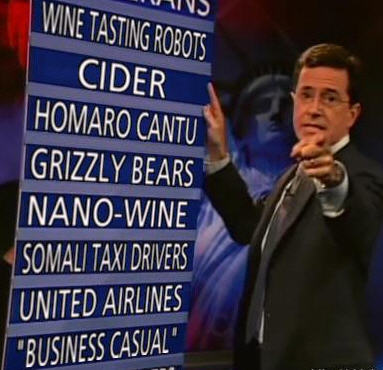
Who’s threatening us now: nanotechnology!

Tired of high alcohol levels in your wine? Want to tone down the “fresh cut grass” in your sauvignon blanc? Heck, want to turn your red wine into white?

Behold the future is here! Kraft brings you “programmable” food and beverages. Roll the tape from The Observer (UK):

The processed-food giant Kraft and a group of research laboratories are busy working towards ‘programmable food’. One product they are working on is a colourless, tasteless drink that you, the consumer, will design after you’ve bought it. You’ll decide what colour and flavour you’d like the drink to be, and what nutrients it will have in it, once you get home. You’ll zap the product with a correctly-tuned microwave transmitter – presumably Kraft will sell you that, too.

This will activate nano-capsules – each one about 2,000 times smaller than the width of a hair – containing the necessary chemicals for your choice of drink: green-hued, blackcurrant-flavoured with a touch of caffeine and omega-3 oil, say. They will dissolve while all the other possible ingredients will pass unused through your body, in their nano-capsules.

While the Observer article only mentions nanotechnolgy as being able to “turn red wine into white,” Neil Pendock cranks it up on wine.co.za

Goodbye cork taint, hello programmable alcohol levels – nanotechnology can deliver solutions to the age-old problems of wine… Feel like a glass of Sauvignon Blanc? Switch on the green peppers (capsicum if you feel in an Aussie or pretentious South African mood). Syrah? Dial up some wood smoke, sweaty saddles and spice.

I’ve had wines that express the terroir and wines designed for focus groups. But I’ve never tried a do-it-almost-yourself (with-the-help-of-microwave) “wine”! Nano-wine, I’m putting you on notice!

Related: “Who’s threatening us now: United Airlines!

tags: |

Tasting sized pours — Valentines, sports, politics and warming Eiswine

Wine and Valentines
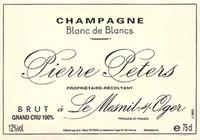
US News & World Report emailed, asking for some wine picks and I told them something I have neglected to tell you: Pierre Peters champagne is excellent! I have enjoyed it on the deck as an aperitif, at dinner, but not, however, in the jacuzzi. Send me your notes if you do! (find this champagne) [US News]

Wine and politics
Wine and cheese? No, wine and corruption is perhaps a more common pairing in Texas according to member of a committee examining the regulation of the wine biz. [Houston Chron, thanks Tom!]

Wine and sports
Did you spend $14.60 on wine all of 2005? And last year did you spend $81.40? Then you might just be a fan sports fan! Ladies golf comes in at the top of the heap of couch potatoes with $125 of spending. [Reuters, thanks Jeff!]

Wine and sports, part 2
Indy Colts fan Jeff at Goodgrape.com took me up on my betting wine for football. Fortunately for his sake, since I took da Bears, I couldn’t find any Illinois wine to send him. So I am adding a $25 bottle of his choosing (Tulocay Napa zinfandel 2000) to his cellar. Hey I’m almost a third of the way to the average expenditure of a sports fan!

Wine and weather
The Economist discusses German wine and climate change. But they fail to mention the economists who already did! (Slate even thoroughly discussed the paper) For more detail on the broader trend, see a recent LA Times story [Economist]

UPDATE:
Wine and blogs
Looking for a new world syrah tip? Tim wraps up his WBW with 50 of them. [Winecast]

…and finally, I forgot to include a link to Tony Bourdain’s hilarious rant against every show on the Food Network. [Ruhlman]

Related: “This Valentine’s Day, don’t have pinot envy

tags: |

Meet the masters

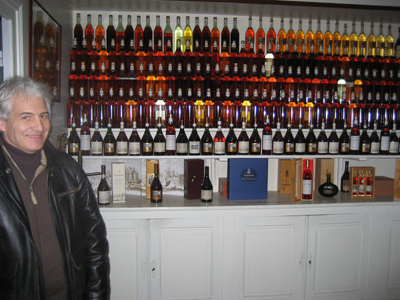
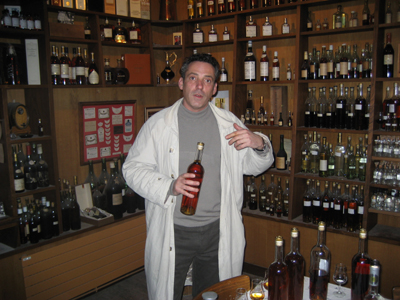
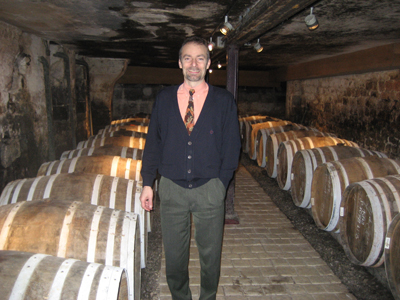
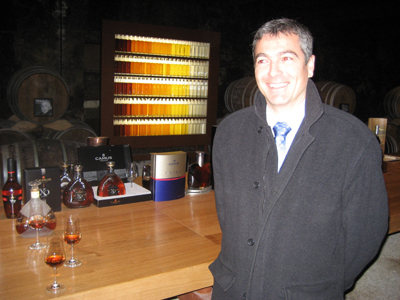
Cellar masters in cognac comprise a small, elite, de facto club of men–but they don’t wear smoking jackets as you can see below. The top four producers make 84 percent of the volume of cognac and there are only a few dozen smaller producers. Here are the cellar masters I met on my recent trip.


Cellar master: Dominique Touteau
House: Delamain
Tenure: 27 years
House specialty: aged cognacs, some vintage
Highest priced cognac he makes: $500 Reserve de la famille (search for it)


Cellar master: Olivier Paultes
Estate: Chateau Frapin
Tenure: 20 years
House specialty: Owns 542 acres of vineyards; uses exclusively own fruit, stills and cellars
Highest priced cognac he makes: $5,000 for the 1888 from their “paradise” (search for it)


Cellar master: Eric Forget
House: Hine
Tenure: eight years
House specialty: only old cognacs, extensive vintage program, some aged in Bristol
Highest priced cognac he makes: Hine, Talent de Tomas, $6500 sold in wood box and customized Baccarat crystal decanter (search for it)


Cellar master: Patrick Leger
House: Camus
Tenure: 4 months
House specialty: This, the fifth biggest house, has some young cognacs from the Ile de Re, other old cognacs
The most expensive cognac he makes: $800 Camus Jubilee (search for it)


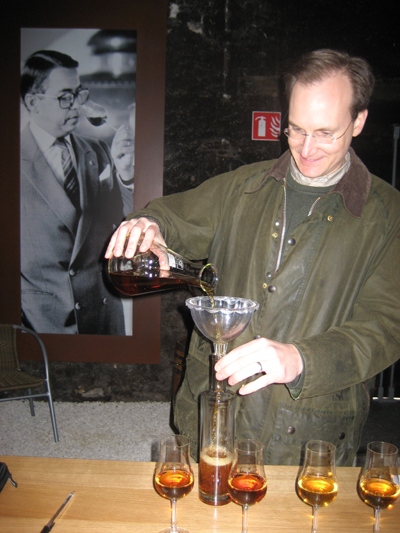
Celler master (impersonator): Dr. Vino
House: visiting at Camus where I tapped some old barrels and started blending
Tenure: 5 minutes
Specialty: sipping cognac
Highest priced cognac he makes: priceless

tags: |

Wined Up, summed up

Another couple of dozen of us met up at Wined Up early Friday evening. It was great to see many new people at the meetup including one site reader from Colorado. He was in town for work and decided to stop for a flight of wine before his flight from Laguardia (wise man).

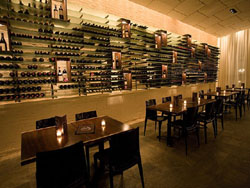
Everyone agreed that Wined Up has a great aesthetic. The one long wall with backlit bottles is a great look. Another wall has some gnarly grape vine cuttings running up it.

And it was good for us that the venue remains somewhat “undiscovered” since we were able not only to hear each other but also to grab some seats at the bar. Many wine bars in NYC are often too cramped or too full so talking and sipping with ease should not go unrecognized.

The wine list has a couple of pages of red, white and bubbly by the glass. The selections are solid (if somewhat ho-hum for die-hard wine geeks) and affordable since the glasses run from $6-$12. Interestingly, there are no flights on the list but if you want one they will make one for you. One among us told the bar tender that he wanted a flight of “big reds.” The friendly bartender asked him how many to which he replied four. And voila four reds were poured into Riedel O glasses and the bottles lined up behind them. Nice display.

Another in our party wanted to pick out her own wines so she selected a flight of five whites. Presto, five whites in the “O” glasses with the bottles behind them. I tried a glass of white, the Don David Torrontes from Argentina (find it), to go with a small cheese platter (they have Jasper Hill “constant bliss”–a must try!) but found it to be too cold especially given the wintry weather. But in the glorified tumbler that is the “O” glass, I was able to warm it up quickly in my hand. Other cured meats, cheeses, and small bites are available.

Here’s how to find Wined Up:
913 Broadway, nr. 20th St. Map it
Second floor above the restaurant Punch (signage is not great but it’s upstairs)
Flatiron District. Tel: 212-673-6333

And stay tuned for our next stop on the NYC wine bar crawl, probably next month. I’ll post the details here with hopefully enough notice so that you can join us if you haven’t already…

tags: | |


winepoliticsamz

Wine Maps


Monthly Archives

Categories


Blog posts via email

@drvino on Instagram

@drvino on Twitter


winesearcher

quotes

One of the “fresh voices taking wine journalism in new and important directions.” -World of Fine Wine

“His reporting over the past six months has had seismic consequences, which is a hell of an accomplishment for a blog.” -Forbes.com

"News of such activities, reported last month on a wine blog called Dr. Vino, have captivated wine enthusiasts and triggered a fierce online debate…" The Wall Street Journal

"...well-written, well-researched, calm and, dare we use the word, sober." -Dorothy Gaiter & John Brecher, WSJ

jbf07James Beard Foundation awards

Saveur, best drinks blog, finalist 2012.

Winner, Best Wine Blog

One of the "seven best wine blogs." Food & Wine,

One of the three best wine blogs, Fast Company

See more media...

ayow150buy

Wine books on Amazon: