Music, oak chips, tickers, three tiers – sipped and spit

SIPPED: Mozart and Merlot!
Clark Smith, wine industry revolutionary, insists that they music playing can affect your evaluation of a wine. I demand that the Wine Advocate and Wine Spectator release their playlists along with scores!! [SF Chron]

SIPPED: NASDAQ move over, here comes Sotheby’s!?

The auction house announces a real-time ticker for wine auction prices. But will the data be archived, free and searchable?

SPIT: oak barrels
More California winemakers are using oak alternatives, such as oak staves (planks) and chips. Derrick Schneider goes inside the barrel–er, bag o’ chips. [SF Chron]

SIPPED: Crossover wines
Rob Kasper emailed me about wines that go both ways. That sure got my attention. Then I realized he was talking about food-friendly wines. I make some picks for wines that go will with fish and meat and can keep a table happy. [Baltimore Sun]

SPIT: the three tier system
Tom Wark has started a new blog for the Specialty Wine Retailers Association. He’s no fan of the legally mandated three tier system, which all too frequently limits consumer wine choices, raises prices, and, of course, prevents the specialty retailers from expanding their business. Good message, Tom, but please ditch the black background behind the white text! [Wine without borders]

SPIT: Apfelwein
New EU laws may restrict “wine” to only coming from grapes. Auf wiedersehen, apple wine? “We will not allow our traditional name to be sacrificed to regulatory madness in Brussels,” says the Hesse state governor. [IHT]
Dr Vino Underground: Moore Brothers!

mobro1.jpg
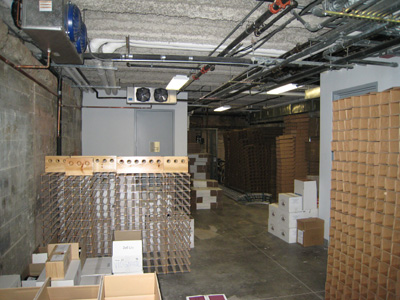
Where does a wine shop store its wine? I take you behind the scenes in “Dr. Vino underground!

First up, Moore Brothers. The chill-hounds at Mo Bro keep the entire store at 56 degrees. So how cold is their basement storage? I asked them if I could see it–and…wait for it…it’s 56 degrees too!

Bill, an employee of the store who happened to work in refrigeration for 16 years before getting into wine, explained that they have four cooling units split into several zones to cool the three stories.

Does it cost Mo’ money? Yes, to the tune of 50 cents a bottle, Bill said.

The basement storage area consisted of cardboard shipping boxes ready to go be filled. Shipping is hard for these folks given their cold fetish. Bill said they basically don’t ship during the summer.

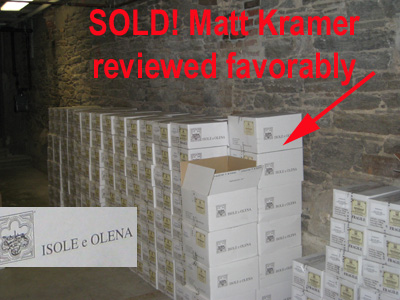
They also had, as you would imagine, cases of wines imported more or less directly from boutique producers in France, Italy and Germany. They get all of their wine from one importer, Fleet Street, who is as fanatical about 56 degrees as they are.

mobro2.jpg
Moore Brothers , 33 E. 20th Street (the block informally known as “wine alley”), 866-986-6673
NYC wine shop map

Hammer time! The auction fraud story heats up

The pace of events in the best wine story of the year has just quickened. Earlier in the year, the Wall Street Journal had a page one story revealing the billionaire Bill Koch had assembled evidence of fraud in the auction market and was preparing to turn it over to the FBI. The New Yorker followed with a fascinating story of “The Jefferson Bottles,” which laid out even more details about the story, which included such characters as Koch, described as a billionaire sheriff trying to right wrongs, an elder statesman in the world of auctions who was either culpable or gullible, and a fraudster named Hardy Rodenstock who was known fro throwing elaborate parties and perhaps being a superb blender of old wines into fraudulent bottles.

Now, the WSJ goes back to the well and reported on p. A16 on yesterday that Bill Koch has sued Zachys and collector Eric Greenberg in federal court in New York. Koch bought $3.7 million from a Zachys auction on October 28, 2005 that was sourced to Greenberg’s cellar and now alleges that 11 of those bottles were fakes. Zachys declined to comment and Greenberg’s attorney called the allegations “absolutely false.”

But now Howard “wine under $20” Goldberg rides in with the revelation on Decanter.com that it was Eric Greenberg’s cellar that was auctioned this past weekend by Acker, Merrall. Acker had previously not named the collector who was selling, instead referring to it as “the man with the golden cellar.” It fetched $15.6 million including commissions.

Related: “Has the wine auction market peaked?” [Dr. V]
See the official court papers via scribd.com

Verbatim: Parker and Nossiter

“[Winemaking] parameters are dictated by an international taste and by champions of this taste – including Robert Parker, The Wine Spectator and certain Spanish critics like José Peñin. They are then produced by taste bureaucrats like Michel Rolland and hundreds of indigenous enologists like Telmo Rodriguez,” says Mondovino-director Jonathan Nossiter in his new book, Le Goût et le Pouvoir (Taste and Power). Link

“I guess everyone is getting frazzled by higher and higher wine prices and WMDs(wines of massive deliciousness)…..but seriously… anyone with half a chimp’s brain can see through Nossiter’s transparency easier than a J.J.Prum riesling…it is Nossiter and his ilk(call them the scary wine gestapo)chanting the same stupid hymn that demand wines be produced in only one narrow style…..but bring on the suckers and fools….some one will certainly buy into his propaganda as they did that migraine-inducing disingenuous film……” eBob

Related: “Mondovino: shaky not stirring” [Dr. V]

Calculating the carbon footprint of wine: my research findings

istock1.jpg
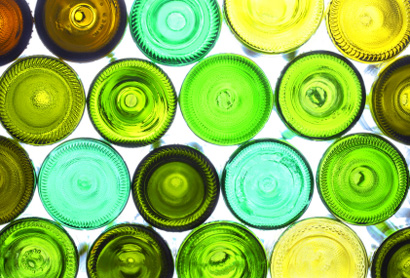
Is that a whiff of raspberries and leather you get from that red wine–or a whiff of petroleum? With some premium wines consuming three times their weight in petroleum, don’t be surprised if it is the latter.

My previous postings on the carbon footprint of wine made me want to determine just how much carbon is involved in the making and transporting of our favorite beverage. So I collaborated with Pablo Paster, a sustainability metrics specialist, and we ran the numbers. Our findings have just been published as a working paper for the American Association of Wine Economists, available here as a pdf.

While I welcome your comments on the whole paper, I’ll post some of the key findings here:

* Organic farming has lower greenhouse gas (GHG) intensity than conventional farming but I was surprised that the difference wasn’t greater. Clearly there may be other differences in a local ecosystem but the GHG difference was surprisingly small. But on the whole, it was the transportation that played a more significant role from a GHG perspective.

* Regarding the “food miles” debate, we find that distance does matter.

* But not all miles that a bottle travels are the same. Efficiencies in transportation make container ships better than trucks, which in turn are better than planes.

* Shipping premium wine, bottled at the winery, around the world mostly involves shipping glass with some wine in it. In this regard, drinking wine from a magnum is the more carbon-friendly choice since the glass-to-wine ratio is less. Half-bottles, by contrast, worsen the ratio.

* Shipping wine in bulk from the source and bottling closer to the point of consumption lowers carbon intensity.

* Light packaging material such as Tetra-Pak or bag-in-a-box has much less carbon intensity.

* Using oak chips is a more carbon friendly alternative than oak barrels, particularly those that are shipped assembled and empty around the world

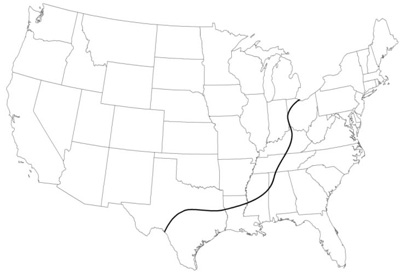
* There’s a “green line” that runs down the middle of Ohio. For points to the West of that line, it is more carbon efficient to consume wine trucked from California. To the East of that line, it’s more efficient to consume the same sized bottle of wine from Bordeaux, which has had benefited from the efficiencies of container shipping, followed by a shorter truck trip. In the event that a carbon tax were ever imposed, it would thus have a decidedly un-nationalistic impact.

What does this mean for the green wine consumer? Drinking a wine made without agrichemicals, from larger format bottles, or wine that has traveled fewer miles is the more “green” option. Beyond these points (or in addition to them), you could perform your own carbon offsets, for example, by giving up one bottle for another and saying no to bottled water.

greenline.jpg

Red, White and “Green”: The Cost of Carbon In the Global Wine Trade,” By Tyler Colman and Pablo Paster

UODATE: This paper was been published in the March 2009 issue of the Journal of Wine Research
image 1: istockphoto.com

The Red Sox spray selves, locker room with Domaine Ste Michelle

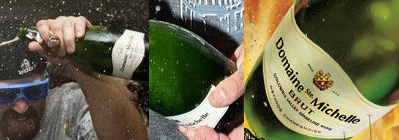
Just what was the “champagne” that the Red Sox sprayed all over their goggled and giddy selves yesterday? A reader wants to know. Fortunately, the Dr. Vino cam was in the locker room at Coors Field (Coors? As if the Rockies even had a chance in a venue like that according to the wine theory of sports champions). To the photos:

redsoxbubbly.jpg

Photo one provides a glimpse of the left front label, photo two, the right, photo three, the actual label for your spy cam comparisons. Put them together and what does it spell? Domaine Ste Michelle! Is it the finest “handcrafted” bubbly that $6.99 can buy? You decide! Oddly, the Sox changed since they popped Korbel back when they won the first round of the playoffs. But why no Red Sox charity wine?

Federally funded grape research? It’s peanuts

A “CBS Evening News with Katie Couric” story is shocked, shocked! to learn that $11 million of “your tax dollars” have been allocated to conduct research on wine grapes including a $2.6 million research facility at Cornell.

But they have it wrong: it’s not shockingly bad news, it’s new news. And it’s good news.

Ever since the repeal of Prohibition, the federal government has been reluctant to fund grape research. In fact, in the 1930s, after Repeal, FDR’s Department of Agriculture proposed a wine research facility to be funded with federal funds and help the industry get back on its feet. However, an influential Dry congressman unilaterally vetoed the project wanting to prevent the evil “fermentation.” Since then the federal government has been reluctant to fund wine grape research.

So this $11 million should be seen as a real breakthrough, evidence that the federal government is actually doing something to support wine. With over 5,000 licensed wineries now in the US according to Wine Business Monthly, wine and related grape growing is a rapidly growing sector of American agriculture. For what it’s worth, the industry is very consolidated with the top 30 wine producers making over 90% of the wine. If this funding is going to support the proverbial 4,970 “little guys,” then that is something that would be hard to oppose. CBS, however, does not discuss who will benefit most from this research funding.

In the name of fair and balanced reporting, CBS News should look at other research facilities, such as the National Research Peanut Laboratory. Or how much in federal funds are used in subsidies to field crops such as wheat and corn in the $280 billion (five year) Farm Bill. Or the federal budget overall, now $3 trillion. A subsidy of $11 million in this age of private equity chieftains even seems small by some individual standards. In the federal budget, it’s smaller than a rounding error.

Related: “Groundbreaking for Cornell University’s western New York grape laboratory: Oct. 29

Who’s your god-daddy? Hanna Agostini, Robert Parker and the question of influence

Alain Raynaud, owner of Parker-fave Chateau Quinault L’Enclos, asked Robert Parker to be the godfather of his child. Parker told Elin McCoy in Emperor of Wine “he didn’t see how he could refuse.” Why is the world’s leading wine critic on such close terms with the people whose products he says he independently evaluates? Or, as the saying goes, who’s your daddy?

These questions and more will be publicly aired with a new tell-all book from his former assistant in Bordeaux, Hanna Agostini. Agostini helped Parker with translations from 1995 – 2003 and controlled his calendar while he was in the region, often twice a year. Late in her tenure with Parker, she became embroiled with scandal of influence peddling, trying to cash in on her control of Parker’s schedule and sending out invoices for her consulting on his letterhead. After standing by her for a time, he let her go.

Now she’s fighting back with her own book, Robert Parker: Anatomie d’un Mythe, just published in France (and just purchased via amazon.fr by Dr. Vino). While she has respect for his palate, she accuses Parker of recycling his tasting notes, pokes fun at his prose, and even evaluating wines in print that he hasn’t even tasted. Here’s an excerpt from her interview with the Bordeaux paper, Sud-Ouest (link to cache; my translation):

In bringing up his relations with the winemaker Michel Rolland, and the négociants Archibald Johnston, Jeffrey Davies, Bill Blatch and Dominique Renard, his friendship with Jean-Bernard Delmas, the former head of grand cru haut Brion and the Moueix family, I’m not saying anything that’s not already widely known…I only want to show that there’s a yawning gap between his rhetoric and his actions.

The situation does raise the larger question of how close should a journalist be with his or her subjects? On the one hand, distance maintains journalistic independence. On the other hand, proximity and access make for a more nuanced understanding of what’s at stake and the players involved. Oh wait! Parker doesn’t even claim to be a journalist, but a critic–THE critic–so there’s no scoop for him to get. Just wines and tannic barrel samples, by the hundreds.

And, by the way, Alain Raynaud tried to block the book’s publication because he says Parker is not godfather to his daughter. A court in the region ruled against him last week.


winepoliticsamz

Wine Maps


Monthly Archives

Categories


Blog posts via email

@drvino on Instagram

@drvino on Twitter


winesearcher

quotes

One of the “fresh voices taking wine journalism in new and important directions.” -World of Fine Wine

“His reporting over the past six months has had seismic consequences, which is a hell of an accomplishment for a blog.” -Forbes.com

"News of such activities, reported last month on a wine blog called Dr. Vino, have captivated wine enthusiasts and triggered a fierce online debate…" The Wall Street Journal

"...well-written, well-researched, calm and, dare we use the word, sober." -Dorothy Gaiter & John Brecher, WSJ

jbf07James Beard Foundation awards

Saveur, best drinks blog, finalist 2012.

Winner, Best Wine Blog

One of the "seven best wine blogs." Food & Wine,

One of the three best wine blogs, Fast Company

See more media...

ayow150buy

Wine books on Amazon: