Value vino list number twelve

Hefty red

Vinedos de El Seque, Alicante, 2003, $9.79
Find this wine
Alicante is more known for the beach life and golf courses than the wine. But Artadi, the respected wine producer from the Rioja, is setting out make value-conscious enthusiasts look twice at the region with this wine. Juan-Carlos Lopez de la Call, the owner of Artadi, purchased the old estate a few years ago mainly for its old vines and his renovations are bearing fruit. The Monastrell (Mouvèdre) grape gives this wine a dark color and a full bodied quality with notes of leather, blackberry and tar with a pleasant finish. If only more top Spanish producers would provide US consumers such an innovative way to maintain good values in face of the rising euro. Eric Solomon Selections, importer.

Crisp whites

Alamos, Viognier, 2003. $9.
Find
this wine

Viognier, the fickle white grape at its most expressive in the
Rhone’s Condrieu, has become a jet setter recently popping up
in California, Australia, and now Argentina. The adopted homes
of the grape have yet to capture the excellence and concentration
of Condrieu and many have yielded uneven results at

best. But this offering from the high-altitude (5,000 ft) vineyards
of Catena, the steady Mendoza producer, represents at least a good
value. Notes of peach and flowers prevail and the wine as good acidity
and a clean finish that would make it a good accompaniment to Indian
food. As I’ve said before, remember the Alamos! Billington Imports.

Mas Carlot, white, Costieres de Nimes, 2003. $7 Find
this wine

Marsanne and Roussanne frequently play the part of the supporting
cast. However, even though their names rarely appear as the leading
lights of the front label, these white grapes make the often formidable
wines of the Hermitage appellation in the Rhone valley. Since
grape varietals to date have not been permitted on appellation
labels, Marsanne and Roussanne have an “undiscovered” discount
built into them. But this bottle from a small and worthy producer
in the the Nimes region is worth discovering. Stainless steel tank
fermentation preserves the freshness of the fruit flavors and aromas,
with peaches and melons notable. Try with pecorino sheep cheese
and fig spread. Yummy! Imported by Robert Kacher.

Veramonte, Maipo Valley, Cabernet Sauvignon,
2001, $8. Find
this wine

I was recently in a jam in upstate New York where I needed to
find a bottle to bring over to a relative. When I found a wine
(but mostly spirits) shop I skipped the cases of soulless Shiraz
from Australia and hit upon this bargain. Sure, it’s not artisinal
production since Veramonte is part of the global empire of Constellation
Brands, but it is widely available and affordable and those
count for something. Dark almost like a Bordeaux, but soft tannins
and blackberry aromas that make it easy drinking, this Cab is
better than many California Cabs that cost more than twice the
price. The 2004 Casablanca Valley Sauvignon Blanc (“en screw”
as Randall Graham would say) is also a refreshing blast of grapefruit
that goes well with seafood. Franciscan Estates, importer.

Sparkler

Mionetto, “Il,” Prosecco, NV. $9.99 ($6
for 375 ml) Find
this wine

Why not pop a top this new year’s eve instead of a cork? This
gently sparkling wine, aka prosecco, from the hills of the Veneto
region north of Venice has a sleek, stout bottle with a beer
cap on top. Straw in color with a thin bead and weighing in
at a mere 10.5% alcohol, this dry wine has notes of melon and
apple. But its versatility and fun packaging mean that it can
be enjoyed throughout the year and not just to ring in the new
one. Importer, Mionetto USA.

Sweetish white

Valckenberg, Gewurztraminer, Pfalz, 2003, $10.49
Find
this wine

Some casual wine drinkers have a knee-jerk reaction against Riesling.
If you want to trick one of these non-believers, then try serving
this Gewurztraminer instead. Crisp and clean the wine has notes
of white peach, citrus, litchi and faint spice. The Pfalz region
produces some standout whites (indeed, this wine is so good it could
be considered without “Pfalz”!) and the hot 2003 summer shows them
at an excellent quality level. This value vino is a terrific pairing
with stir fry and would make a great match with pork tenderloin
as well. Add some spice to your sweetie. Valckenberg Imports, US
Importer.

Sweetest white!

R. L. Buller premium fine Muscat, NV, Australia.
375ml, $12. Find
this wine

Is ending a sumptuous holiday feast with a fortified wine a little
too much? If yes, then try this one on a non-feast night this winter
for a decadent treat. It’s not a port but instead an even sweeter
Australian “sticky,” an intense blend of cask-aged, decades-old
vintages of Muscat from Victoria. Amber in color, you can practically
wring the molasses and maple syrup out of this wine. It will probably
be too concentrated for most people who enjoy table wines, so wine
geeks can unite with grandparents and those who are just getting
into wine to enjoy this affordable sticky—or try it with a cheese
course of Roquefort or Bleu d’Auvergne. The finish is so long that
it will linger well after the dishes are gone.

Light reds

Mondo del Vino, Tre Uve. NV. $8 Find
this wine

With three grape varietals from three different growing areas of
Italy, no vintage, and the humble table wine designation this wine
may seem like a recipe for homogenized and pasteurized blandness.
In fact it is a compelling value. The “three grapes” of the wine
comprise a Sangiovese, bulked up by Nero d’Avola, and Primitivo.
Black fruits and dried herbs are present aromas washed down on the
palate by an Italian acidity. An excellent quaffer for pasta and
pizza. Readers in the UK can enjoy the Tre Uve Ultima, not available
in the US. James G. Stock, importer.

Cusumano, Nero d’Avola, IGT Sicily, 2003. $8.49
Find
this wine

Southern Italy in general and Sicily in particular is emerging as
a great center for excellent value wines. This wine is a good example
of how wines from the region often defy the conventional Old World-New
World stylistic split. From 10 year old vines of the indigenous
grape, the Nero d’Avola, the wine is made in a fruit forward style
that makes it easily accessible. Young, fruity, and approachable—it’s
definitely a new Sicilian. Fairly high in acid, though balanced
with a wad of cherry and blackberry, this wine is a great match
for pizza. Importer: Vin DiVino.

San Gregorio, Tres Ojos, Calatayud,
2003. $6.79 Find
this wine

This old vine Grenache is like a Gregorian chant with a thumping
bass. Light in color but with hearty aromas of earth, berries
and pepper and a delicate sweetness characteristic of the grape,
this wine from the Northern Spanish of D.O. Calatayud provides
further evidence that cooperatives can make great, affordable
wines. Romans, Moors, and now the Aragonese have settled in
the region and the limestone and slate soils have proved an
excellent home to these Grenache vines for the last 50 years.
Snap up this bargain by the case to enjoy over the next year
or two. Kysela Pere et Fils, importer.

Beyond the grade (but worth it):
Quinta do Vale Meao, Duoro, 2000. $40 Find
this wine

Veramonte, Primus, Casablanca Valley, 2001. $14 Find
this wine

Chalone, Pinot Noir, 2002. $25 Find
this wine

La Fleur Petrus, 1999, $44 Find
this wine

Best wine list for 2003

Best wine list for 2003

As 2003 rolls into 2004, I, once again, offer a year-end best list. Moving beyond my usual lists of 10 wines under $10, this list suggests the best wines in various price points and categories. The trouble with regularly recommending value vino is that there is so much excellent wine at higher price points that is worth the urge to splurge. So here is a parsimonious list that not only provides some stars of the past year (bearing bargains in mind) but also integrates some of the key words and phrases from 2003. Of course the major theme for 2003 was war, so I use military ranks as grades for the different price categories. Bargain hounds can remember to shop at sale times to expand their wine dollar and rise in the ranks. Cheers! -Dr. Vino
Also see the 2004 best wine list and 2002

Best wine, Privates
In the movies, Privates may be for "saving" (e.g. Ryan) but in this schema they are for drinking. ASAP. Great wines in this category are two wines from Spain: the Osborne Solaz ($5.50), a flavorful red, and the Cuvee RS ($6), a refreshing white, perfect for sipping under the summer (or desert) sun.

Best wine, Sergeants
Sergeants have many choices. From Spain, the Higueruela 2001 ($7) a great value with rich, dark fruit is an excellent choice, as is the Chateau Pesquié Les Terrasses 2001 ($10). But the Castano Solanera 2001 ($10.46) is the clear winner in this category with its complexity and long finish—and an almost unheard of ability at this price point to remain excellent the next day without even being corked. Sergeants who prefer whites can take comfort in the chardonnay from Alamos ($10)—who can forget that?

Best wine, Colonels
Colonels can benefit from nay choices for their expanded, officer’s budget but the best colonel wine this year as a group came from Australia (appropriately enough, a member of the coalition of the swilling). The 2002 vintage produced some gems, not only for fans of "big reds" but also those looking for some refinement as well. Torbreck Woodcutter’s Red, Mitolo Jester, Thorne-Clarke Shotfire Shiraz, D’Arenberg’s Footbolt, are all strong examples of syrah’s adaptation to the southern hemisphere. To score some exotic points, those colonels wishing to impress with the breadth of their knowledge rather than pure firepower should look to the floral notes of Crios Torrontes 2001 ($13) from Argentina. Those looking for a food friendly white should turn to the Maison Rijckaert, Macon Villages 2001 ($16).

Best wines, Generals
Those with the dough have been picking up Bordeaux 2000 but those in the know have been buying the 1999s and futures on the 2002s, both overlooked vintages. The Léoville Barton 1999 ($40), for example, has sufficient flash and finesse to impress 4 star generals. Those more inclined for fruits of the American vine can demonstrate their savvy with the L’Ecole no. 41, Cabernet Sauvignon 2000 ($30) from Washington’s Columbia Valley or the excellent Beaux Freres Pinot Noir ($60) from Oregon. American wineries with French names will show much needed rapprochement. Gruner Veltliner from Austria is the white of the year since at this higher end its voluptuousness approaches Chardonnay but without all the excessive oaking that is unfortunately so common. Weingut Prager has a very food-friendly "Gru V," the Smarags 1998 Weissenkirchner Weitenberg ($38).


Best wine for shock and awe
What better than the "hedonistic fruit bomb" that is Turley Juvenile 2000? Clocking in at 16% alcohol, this Hummer will crush your palate—and leave you and your dining companions in shock and awe at how this American Zinfandel made you forget your meal.

Best wine for the spider-hole
1982 Léoville Las Cases ($260). It’s drinking beautifully right now and doesn’t need any more cellaring (although the spider hole would make a good cellar). Live it up and pull a cork while you’re six feet under.

Best wine for Metrosexuals
Riesling. Pampered, massaged, and waxed urban males have undoubtedly discovered Rieslings (especially the excellent 2001 vintage from Germany), which are not only openly discussed in polite wine society now but actually desired by the cognoscenti. I’m surprised Riesling hasn’t appeared on Queer Eye for the Straight Guy. (Why are the wines recommended on the show always terrible?)

Best wine for LOL (internet parlance for "laughing out loud")
Any new Napa winery that attempts to charge over $100 a bottle.

Best wine for the bling-bling lifestyle
Clearly, Cristal 1996 is the ne plus ultra for those dressed to impress. But the rest of us can be quite satisfied with the same Champagne house’s Louis Roederer NV or even the vintage l’Ermitage from their Lake County California arm.

Best wine for "Mission accomplished"
Gibson’s BarossaVale, sparkling merlot ($24). For a celebration, tradition dictates that the wine must be sparkling. But for this (premature) celebration, move beyond Champagne and impress with this double-fermented red wine from down under that has
a "dosage" of port added at the last minute. A wine for contemplation….

Best wine that is a weapon of mass destruction (WMD)
Charles Shaw ($2). Although "Two Buck Chuck" can easily be found, with 5 million cases sold, how many wine palates have been ruined?

Value vino list number six

Sparklers
Marquis de Perlade, Crémant d’Alsace, NV. $7
“In victory you deserve champagne, in defeat you need it,” said Napoleon. With such a view of sparkling wines for every occasion, perhaps Napoleon meant the more affordable crémant? With it difficult to find champagne under $25, crémant—or a sparkling wine from France ex Champagne—is an affordable alternative. This bubbly is a blanc de blancs, or from exclusively white grapes, which here are Pinot Blanc, Chardonnay, and Chenin Blanc (no Riesling!). Crisp and refreshing, it is an excellent aperitif for a big party. And hey, if you don’t like it, it makes a great base for mimosas! W.J. Deutsch & Son, importer.

Bernard-Massard, Luxembourg sparkling rosé, $10.50
While there are so many well-priced sparkling wines from Spain and France (crémants) the Bernard-Massard is probably my only chance to ever review a wine from Luxembourg. The Grand Duchy, known more for its banking than its wine-making has produced a crackling, dry rosé that sparkles. The firm acidity makes it a great complement to food, particularly seafood, and it would also make a great aperitif on the deck in the summer. With a price of €7, which converts poorly to over $10 in the US, there’s no need to save this one for New Year’s Eve (or, being a rosé, the heart-shaped tub).

White
Weingut F.K. Schmitt 2001 Niersteiner Kranzberg Riesling Kabinett $7.99
Rieslings aren’t just for grandmothers any more. Asian foods have become very popular here in the US and in a combination that must surprise the older producers along the Rhine, Riesling is a great complement to many Asian foods. This wine from the excellent 2001 vintage is no exception. From Nierstein, the wine has a straw color, floral aromas, and on the palate it has a nice balance of sweet with an acid base of tart fruits. Good on its own, this wine is greatly enhanced by your favorite stir-fry. Imported by Winesellers, Ltd.

Reds
Santa Duc Selections, les vieilles vignes, Cotes du Rhone, 2000. $9 (sale)
When you order a glass of red wine at a Parisian bistro, it will most likely be a fairly ho-hum Cotes du Rhone. This wine, also labeled as a CDR, puts the others to shame with its fat, lush, leathery complexity, soft tannins and long finish. From the excellent Rhone producer Domaine Santa Duc, this mostly grenache blend is actually a Chateauneuf in disguise since that is where the vineyard lies. Bottling under their lesser label makes it easy on the palate and on the wallet, especially during the October sales! Look for similar overstocks and reductions now at your local retailer. Robert Kacher, importer.

the three sisters & coDomaine les Grands Bois, Cuvée les Trois Soeurs, Cotes du Rhone, 2001. $8

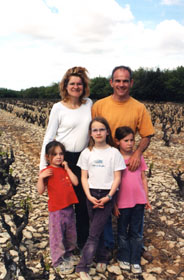
Marc Besnardeau was a sommelier in Paris when he met Mireille Farjon, whose family had a winery in the Rhone. A decade ago they married, moved to the Rhone, and Marc became the winemaker. Having honed his palate, Marc knew what to make from his old-vines and the result is a range of wines that should be on every bargain hunter’s wine list. This particular cuvee, called the three sisters after their girls (photo right), is a medium-bodied and fruit-forward blend of mostly grenache and syrah that may not be age-worthy but certainly will impress your friends—and daughters over 21?—now. Weygandt-Metzer, importer.

Chateau Mourgues du Gres, Les Galets Rouges, AOC Costieres de Nimes, 2001. $9
Denim, the original product “de Nimes,” helps to remember this up-and-coming growing area. With such a high percentage of excellent small growers, this pebbly growing area just south of chateauneuf deserves close attention, particularly from us bargain hounds. And the 2001 vintage has grown in importance since in 2002 the region was flooded shortly prior to the harvest. Anne and François Collard (who also make an excellent rosé) have crafted this gem called galets rouges, or “red roof tiles,” from a mostly syrah blend to resemble a classy Cote Rotie. The supple tannins and dark fruits make it a real winner. Get it while you can!

Apollonio, Terragnolo, Primitivo, 2000. $9.99
This luscious wine is not your typical Italian red. Grown well outside of the main wine areas, this wine comes from Puglia in the “heel” of Italian boot. And it’s not a sangiovese as are so many Italian reds, this one is made with the primitive grape, a distant relative of zinfandel. Not peppery as are many American zins, dark cherry and truffles are instead the main notes on the palate, and it is velvety and smooth with a pleasant finish. Try to pair this one with a risotto. Salute! Imported by Vin Divino.

Tres Picos, Garnacha, D.O. Campo de Borja, Spain, 2002, $8.
Tres Picos is back! This cooperative from the remote Campo de Borja region of Spain returns with another excellent vintage of old-vine Grenache. The varietal, common in the Rhone, often assumes a supporting role to syrah but is excellent as a lead performer as well. Slightly sweeter than syrah, this medium-bodied red has gobs of dark fruits including black cherry, a dash of white pepper, and a long finish. The excellent packaging of the sturdy bottle and sleek label makes it a gift whose recipient will assume it is at least double the price. Enjoy with foods ranging from pork to paella.

Excelsior, Cabernet Sauvignon, 2002. $8
When South Africa burst on to the international wine scene with democratization in the mid-1990s, many of the acres under vine produced the local pinotage grape. But now more vineyard owners are planting international varietals and this is a great value example. A deep, rich red in color, aromas of blackcurrant leap from the glass and the full-bodied texture of the wine will make it a favorite for those who like big reds. And with an October sale price of $5.21, how can you go wrong?

Thorn-Clarke, Shiraz, Barossa, 2002. $9.49
If you have heard the word “jammy” used to describe a wine and have not understood it, you need look no further. The wine practically coats the side of the glass as if it were spread on there with a knife. Fans of big, muscular reds may find this as good as it gets under $10. The earthy notes and dark fruits of this vintage make for a pleasant complexity (although those able to get the Shotfire Shiraz 2002 $16 will find it similarly big but more refined). The winery is family-owned, which is not actually rare in Oz, but hard to find in the US among all the imports from the enormous Oz producers. Imported by Kysela Pere et Fils. www.thornclarkewines.com

Beyond the $10 grade (but worth it):
Maison Rijckaert, Macon Villages white 2001 $14
Artadi Vinas de Gain, Rioja, 2001, $16
Thorn-Clarke, Shotfire Shiraz, 2002, $16
Torbreck, Woodcutter’s Red, 2002, $15 Read more…

Wherefore art thou, California?

California’s stunning absence from the under $10 category of quality wines—and why that may become even more important to consumers.

“Muscleman put in charge of world’s fifth largest economy” read a recent headline about Governor Schwarzenegger in The Onion. Sadly, the satirical newspaper found truth funnier than its usual fictitious headlines that week. For bargain wine lovers, the news coming out of California has a similar tragi-comic tone. Nothing, it seems, can prod California producers into making good, interesting and affordable wines. And the worst part is that as the clouds seem to be lifting, not only have the lessons of the recent storm have not been learned but regulatory changes stand to reduce the quality of wines on retailers’ shelves even more.

While many California wines are excellent, they are not good values. My value wine recommendations display a stunning lack of wine picks from California. Spanish and French producers make much more exciting wines at lower price points. And fortunately there are plenty of those around.

But you don’t have to take it from a pseudo-critic like me: Robert Parker, the world’s foremost wine critic, has a similar conclusion. In the June 2003 issue of his newsletter, he recommended 153 value wines (for this hedonist, value means $20 and under). Of these, 79 were French, 25 from each the US and Australia and 21 from Spain. (For those keeping count, the other three were from Portugal.) Handfuls of these selections from France and Spain are under $10. From California, there is only one.

The California producers are obstinate in their unwillingness to produce good cheap wines. Land is expensive in the north coast, but grapes are cheap. Labor may be more expensive than Argentina, but the workers are not exactly overpaid. The crises of the past three years should have sent them a message. But apparently they have not.

To recap what has happened over the recent past in California is a sad tale. Three consecutive booming harvests have driven wine grape prices to their lowest levels since the mid-1990s (see data). This has led many growers to let the grapes rot on the vine rather than harvest or even to uproot vines and replant other fruits. The abundant supply has also led to bankruptcies in the quality growing areas (De Loach, Liparita Cellars, Sonoma Creek Winery and Buchanan Cellars are a few from the north coast). Some merger and acquisition activity has also occurred as a leading industry analyst reckons 5% of the state’s 1300 wineries are economically “distressed.”

But with so much bulk “juice” sloshing around, the biggest impact of the glut for consumers has probably been “two-buck Chuck.” Charles Shaw, as the wine from the bulk producer Franzia is officially known, retails for $2 a bottle at Trader Joe’s grocery stores in California (and $3 at TJ’s outside of California thanks to mandatory distributor intervention). Two-buck Chuck comes in a few different styles that are perhaps best described as “flavors”: Cabernet Sauvignon, Chardonnay, etc. And it is forecast to sell over 5 million cases this year. If Darrell Issa was really intent on starting a recall of something for being bad, starting with Two Buck Chuck would have been a better use of his money than Gray Davis.

Other factors beyond the control of the California producers have contributed to the storm clouds over the industry. The slow economy that coincided with the three big harvests has meant decreased business travel and entertainment, a big component of high-end wines from California (and elsewhere). And beyond the flood of “juice,” a pest has threatened the vineyards, although the glassy winged sharpshooter would have helped reduce the oversupply.

Imports represent, of course, another big factor. Those lush, cheap shiraz and chardonnay imports from Australia have now made Australia then second largest provider of imported wines behind Italy. Yellow Tail is Australia’s answer to Two-Buck Chuck. Complete with kangaroo on the label, it sells for $5 a bottle and is forecast to sell 5 million cases this year, a staggering figure given its launch just two years ago. The producers have now added a “reserve” wine for $9.

But the storm clouds are lifting over California. The economy appears to be turning around, which should bring increased travel and entertaining. The 2003 vintage will be smaller, thanks to pruning and freakish weather at harvest time, which should lead to higher grape prices. Indeed, the profits of Robert Mondavi, the largest publicly traded winery from California rose in the most recent quarter and the share price has rallied as investors anticipate brighter days lie ahead.

And will this new period bring better, cheaper wines? No, sadly, it will bring fudging and protectionism. Fudging will occur as producers seek to dilute the vintage claims on the label and have the right to include 15% of wine not from the stated vintage (LA Times 9/29/03). As consumers become more knowledgeable about wine, what consumers need on the labels is more precision, not less.

And protectionism appears to take place under the guise of bio-terrorism. Not satisfied with the weak dollar already protecting domestic producers from cheap imports, the Food and Drug Administration now threatens to hold up wine imports, particularly from Europe, with stacks of bureaucratic filings. Effective 12 December 2003, the 2002 Bioterrorism Act requires any food or wine exporter to the US to register with the FDA, adding even more intermediate steps between producer and consumer. We can but hope that many small (European) producers will not be scared away from the US market, otherwise it would be “good-bye wine values.” (Hello, gray market?) See the stunning details of the regulations for yourself.

Bolstering an already oligopolistic structure of production with protectionism and fudging is not the blend for reducing prices and raising quality that consumers need.

Since beating California producers over the head with a plank of oak (better than using it in their chardonnays) seems not to work, the question remains whether the distributors and big retailers ride to the aid of value-oriented consumers? Slim hope. The distributors, for one, are trying to line their pockets with a $234 million tax break currently before Congress. (NYT 10/30/03)

The big wine retailers are too restrained in using their market muscle to push for quality bargains from producers. Trader Joe’s does probably the best job at seeking out value wine from around the world (to wit, their Argentine La Boca wines at $3 are better than Charles Shaw). Given the success and poor quality of Charles Shaw, just imagine how well an innovative wine at $7 would sell? And a Costco Cuvee? Not to be found. Sam’s Wine in Chicago has arranged some custom cuvees to roll out soon but they hover around the $30 mark, so not exactly a good fit for weeknight dinners.

California, a trend-setter in so many ways, needs to follow the worldwide trend of making good wines at low prices. Terminate the oaky chardonnays—or we’ll have to put Arnie on to you!

Patrons drinking up at BYOBs, Chicago Tribune, Nov 12, 2003

DRINK!

Patrons drinking up at BYOBs

By Tyler Colman
Special to the Tribune

November 12, 2003


see my interactive map of Chicago BYOB restaurants!


BYOB restaurants are not just for students any more. Nor are they limited to the corner ethnic restaurant. Many Chicago restaurants are choosing "bring your own bottle" as a niche–a situation that suits the owners and diners alike.

Conventional wisdom in the restaurant industry holds that although food may be how a restaurant becomes known, the money is made in the liquor. But some restaurants in town, many of them chef-owned or with a strong focus on fine food, defy this conventional wisdom.

Why sacrifice the money that a liquor license provides? For Norman Six, chef-owner of Lovitt, a Bucktown restaurant that serves contemporary American cuisine, the answer is easy. "It makes us distinctive. People seek out BYOB.”

Beyond standing out in the crowded dining scene, many restaurants in this category are BYOB for three main reasons. First, getting a liquor license–and liquor–can be an expensive hassle. Second, the current economy has made diners more frugal. And third, diners have become much more knowledgeable about wine.

To apply for a liquor license from the city, the restaurant must already be in operation, which explains why many restaurants are BYOB when they first open. This allows city inspectors to assure that the license is not being used to simply run a bar, for example. The license itself costs a flat fee of $2,000 a year: A 30-seat restaurant pays the same fee as a 300-seat restaurant. The costs of training the staff, stemware and storing an inventory of wine can be incentives to remain BYOB.

Such is the case for Chinoiserie, an Asian fusion restaurant in Wilmette, which expanded three years ago to 90 seats. "We never got around to it," says owner Janice Lee about applying for a liquor license. "When we enlarged, we thought that we would at least add wine and beer. But no matter how much space you have it’s never enough."

A trend toward frugality has made diners tighten their purse strings. Rather than cutting back on the frequency of eating out, diners can simply cut back on the bill. A good way to do that is to bring your own (most BYOB places do not charge corkage fees, or charge a small amount).

Jody Andre has just started her third BYOB restaurant, Speakeasy Supper Club, which includes a 1930s bar (without alcohol) and a menu ranging from tapas-style dishes to ostrich Wellington. The economy made staying with the BYOB model an easy choice. Because two restaurants she opened before have been successful as BYOBs, (Tomboy, which she sold recently, and The Room), Andre feels that "the formula works. I couldn’t imagine anything else."

There are limits to the BYOB model, however. For the owner, the margins are thinner.

Tougher to make a profit

"It takes a lot more labor to sell $1,000 worth of food than it does $1,000 worth of drinks," says Daniel Bocik, chef-owner of A Tavola, which serves regional Italian cuisine in Ukrainian Village. His 8-year-old restaurant was BYOB for the first year while awaiting a license.

Rents also matter. Linda Raydl, a new co-owner of Tomboy, cites increasing rents in Andersonville as the main factor in making the transition to a liquor license. And for Andre’s Speakeasy, the low-cost neighborhood on the edge of Rogers Park is essential to success.

"I open my restaurants in more obscure neighborhoods," Andre says. "This keeps it about the food and BYOB keeps it affordable for the residents."

The final factor pushing consumers toward more BYOBs is a growing wine knowledge–these diners do not want to be confined to a wine list.

Many consumers have amassed personal wine collections and like to tap into them. Wendy Gilbert of Savoy Truffle in Logan Square says that her customers "are always bringing in wines that they have personally brought back from Napa" to accompany her $35 prix-fixe menu for six courses.

Diners have also grown more savvy in the cost of wine in restaurants. Robert M. Parker, the international wine critic, has called restaurant wine markups, which can exceed 300 percent, a "legitimized mugging of the consumer."

Wine club members rejoice

Indeed, many wine enthusiasts agree and are voting with their pocketbooks. Joseph Wu, head of the local wine dining group Grape Lakes Wine Appreciation Guild, says, "I can’t tell you the last time I bought a bottle of wine in a restaurant. There are so many great places that are BYOB or have modest corkage fees."

Wu’s is one of many wine groups in the Chicago area that frequent BYOB restaurants. "When you get the right pairing of food and wine, they each complement and elevate each other," says Wu. So group members bring a dozen or more bottles to a monthly themed dinner.

Two dozen wine groups dine at Andre’s restaurants every month. She explains that for the diner, "it’s like having a dinner party without having to cook." And Six says he has had "the best wines of my life" in his BYOB restaurant, thanks to generous diners who share a glass of rare fine wines with him.

The future looks bright for the BYOB strategy. When A Tavola’s Bocik opens a new restaurant, it will be BYOB.

"I’m a chef, I cook food," Bocik says. "People can save money and bring exactly what they want to drink. There’s a whole culture of BYOBs in Chicago that can be tapped into."

Value vino list number five

Spain
Artazuri, Navarre, 2000. $8.
I recently bought a $25 certificate on EBay to a local wine shop for about $8. If you can’t find the same deal near you, this wine gives you basically the same discount! Just beyond the Rioja from a vineyard in Navarre, Juan-Carlos Lopez de la Calle (the wine maker of the revered Atardi wines) has made what is one of the year’s best wines under $10. The alluring aromas of this old-vine Grenache draw you in like a siren and the notes of cherry and plum on the palate and light tannins make you never want to leave. The bottle disappeared so quickly I thought it had a hole in it! Imported by Eric Solomon.

Higueruela, D. O. Almansa, 2001. $9
Lost in La Mancha? It’s understandable with a wine like this. The arid plains of La Mancha have become a dynamic wine growing region and Higueruela is a vivid example. Rich and dark red in color, the wine (from 70 year old Grenache vines at Bodega Tintoralba) is smooth as velvet on the palate with light tannins, making it very accessible. Even if the name is unpronounceable to English speakers, it stands out for windmills on the label—although these are the sleek, 21st century variety instead of the 16th that Don Quixote encountered. Imported by Grapes from Spain, Inc.

France
Domaine de la Janasse, Vin de Pays de la Principauté d’Orange 2000 $8
Get your Rhones while they are hot! The 2000 vintage was great (unlike the 2002, which saw massive flooding at harvest time). Fans of “big reds” should run (don’t walk!) to find this wine value. A blend of merlot, syrah and Grenache has dark cherry on the nose and full mouthfeel with a good finish. This wine definitely punches above its weight. Eric Solomon imports.

Domaine de Fondrèche, rosé, Cotes du Ventoux 2002. $9.99
“Quantity was sacrificed in this vintage but quality was not,” says importer Robert Kacher. Inundated in 2002, production was more than cut in half to 500 cases but fortunately—miraculously?—the quality did not fall. A blend of roughly equal portions of Grenache, Syrah, and Cinsault, this excellent dry rosé has pleasant fruit on the nose complements good acidity. This is a perfect wine to accompany meals on the deck during your August vacation whether in Provence or not.

Grande Cassagne, GS, le Triage, AOC Costieres de Nimes. $8
Last year, Great Stuff! This year greater stuff! This vintage has been cranked up with some of the winery’s better grapes (Grenache and Syrah) and the results are an under $10 gem! Ruby is the gem of choice as it is the color of the wine. With complex aromas of dark fruits, the smooth sensation on the palate and excellent finish make this a leading contender for wine of the year in this price category. If you are looking to create a stir, try inserting this wine into a lineup of $30+ Rhônes and see if any one can tell the difference.

Mas Carlot, “R” vdt, 2001. $8.
I can’t believe it’s not Chardonnay! The crisp, clean and sweet nose seems to be a Riesling, but the buttery mouthfeel, golden color and excellent body are more akin to Chardonnay. As if making old vine Riesling from the south of France weren’t odd enough, this wine from a vineyard near Nimes is not an appellation wine but is instead a lowly vin de table category. Alas, importer Robert Kacher says that the 2002 (supposedly better than this 2001) is the last vintage. Winegrowers in Alsace, the French home of Riesling, have forced the uprooting of this one-acre plot with low yields on 40 year old vines simply because it is not from Alsace. What a pity. All the more reason to seek out this wine.

Chateau de Mattes-Sabran, Dionysos, AOC Corbières, 2001. $8.
Move over Bacchus, here comes Dionysus! This family-owned winery clearly has great ambitions to name their wine after the Greek god of wine. Perhaps it’s not nectar, but it sure would go nicely with ambrosia! The Corbières appellation is emerging as a leader in the dynamic Languedoc area and this wine is a prime example from the under $10 category. This tight blend of Mourvèdre, Grenache and Syrah has an appealing ruby red that gives way to excellent earthy scents and black cherries. You don’t have to wait for your next Bacchanalian feast to try this one-the barbeque will be fine! Imported by Wine Vine.

Austalia
Paringa, Shiraz, 2002. $9
Lush and velvety—what else would you expect from the land of Oz? David Hickinbotham, part of a home building family from southern Australia, bought a 900-acre property in 1996 essentially to meet demand from Southcorp. US importer Dan Phillips of The Grateful Palate sought to make a wine from their fruit and radically dropped yields by 90% from Southcorp’s levels. This resulting wine has garnered wide acclaim (including the cover of Wine Spectator) and is a global better value. This 2002 Shiraz has a dark red color with notes of clove and dark berries on the palate with a smooth finish. Served slightly chilled it accompanies cheeses very well.

Germany
Fitz-Ritter, 2001 Dürkheimer Hochbenn Riesling Kabinett. $9.
The good news about the German Riesling 2001 vintage is that there are plenty of good wines. The bad news is that since Germany is a high-cost producer, most are well above the $10 threshold. But this one qualifies on both counts. The Fitz family adheres to strict production criteria that yield a wine that is sweet but not cloying. Served chilled, it has a very good combination of brisk acid structure with notes of honey and peach. Try this one with seafood or live dangerously and try it with your favorite Thai food. For the sociologists out there, it will be easy to remember this good wine since it is from the town of Bad Dürkheim.

New Zealand
Babich, Sauvignon Blanc, Marlborough, 2002. $9.99
Sauvignon Blanc is extremely expressive. From the Bordeaux, Napa or New Zealand, the effect of territory is quite clear. This SB from the family-owned and operated winery diverges from the typical from NZ style, which often has strong notes of citrus. Floral notes in the aroma make it similar to a wine from Baden, but the steel-tank fermentation leads to crisp and refreshing wine with hints of mineral and peach. This is a perfect summer wine for drinks on the deck. Imported by Select Brokers.

Wizard of Oz: Ben Hammerschlag, Importer of Fine Australian Wine

Is being a wine importer all fun and no work? Why is the name of a wine’s importer on a label a good indicator of the bottle’s quality? Dr. Vino chats with Ben Hammerschlag of Epicurean Wines about the daily grind (crush?) and becoming a success.

It’s 9:30 PM and his phone rings. Never mind that Ben Hammerschlag has been with distributors and retailers all day or that he and I are dining at Naha, a contemporary chef-owned restaurant in Chicago’s River North. The local distributor on the phone wants to pin down Hammerschlag for the next day’s schedule.

Hammerschlag is likely to find himself very much in demand these days. He has exploded on to the wine scene with his portfolio of big, muscular wines from Australia. Since incorporating only four years ago, he has built his business to impressive levels of sales and quality. Indeed, it has been a hot summer.

In July a New York Times panel rated two of his wines—Mitolo McLaren Vale and Woop Woop—as the best in a Shiraz tasting. And in the August issue of his influential newsletter, Robert Parker bestowed 94 and 98+ point ratings on many of Hammerschlag’s wines, particularly the excellent 2002 vintage.

All this and Hammerschlag is only 31 years old.

Does Parker’s preference for “hedonistic fruit bombs” steer Hammerschlag in that direction of winemaking? Not really. “Parker and I have similar palates,” he says. “If I were doing sweet wines then I would be out of luck. But fortunately he loves Aussie wines (and Rhones).”

With 90% of production concentrated among the 6 biggest producers, consumers could easily be forgiven for thinking that Australia is simply a land of easy-drinking and uninspiring value wines. But there are over 1,000 smaller producers and the entire line of 150 wine labels that Hammerschlag imports comes from these boutique producers. And they are priced accordingly, selling between $20 and $60 retail, mostly through small wine shops. But they have also had good success breaking into the coveted but difficult domain for Australian wines: American restaurants.

Although one of the Epicurean wines, the 2001 Barton Vale Shiraz, appears on the Naha wine list, we skip it since he certainly knows that one. Instead we opt for a 2000 Mt. Difficulty Pinot Noir from neighboring New Zealand’s Central Otago region, reputedly the southernmost vineyard in the world. The Pinot Noir is a good compromise for his scallop starter and wood-grilled quail main course.

Like a celebrity, a top importer is a good local draw. Local distributors like the importer to talk to the retailers. Retailers like the importer to do a tasting for the customers. Restaurants like the importer to talk to the staff. So when the importer comes to town, his-and he is almost always a man-phone is likely to ring.

With only three staff, including a national sales manager, Hammerschlag works constantly. From his base in Seattle, he tracks his wine shipments across the Pacific, monitors the exchange rate with the Australian dollar, and calls producers and distributors. His weekends aren’t for relaxing. They are for doing bureaucratic paperwork. “If it’s not revenue generating, then it doesn’t make it to the top of my list of things to do,” he says.

Getting around the state and local regulations on selling wine constitutes his “biggest headache.” The uneven repeal of Prohibition has resulted in a situation where the American states act more like sovereign states. Thus it is quite an achievement that the Epicurean wines now are available in 31 states. These relationships require constant attention during the business week.

Even the aspect that traveling to Australia to work with producers is draining. Hammerschlag is so focused on his business that he has never even been to Sydney—no winemakers live there. Instead, he flies direct to Melbourne and spends his time in between there and Adelaide, the heart of Australia’s wine growing region. Renting a house for four days on the beach at Margaret River once was noticeable simply because it stood out so much from his usual itinerary.

Hammerschlag make the trip across 12 time zones three times a year for a total of six weeks. Two of the trips are only 10 days long and are particularly draining: just as he starts to overcome the jet lag, it is time to return. But more draining are perhaps the activities. After working with producers by day, tasting and blending wines, a dinner follows—with wine—and then more talk of business. New contacts are often made at dinner, which require further following-up during the day.

These on-the-ground networks prove essential for finding new wineries to work with. “If they are interested in me, I’m probably not interested in them,” he says. Quality is the m.o. here and he has an exacting palate.

Hammerschlag credits his success with his six years as a wine buyer for a high-end grocery store in Seattle. Although he was “paid the same as the baggers” the experience there was invaluable. Not only did he order a lot of wine, he got to work with consumers. He observed what they liked both in terms of taste and the packaging. This helps him steer the Australian producers to blend wines for the US market as well as have eye-catching labels and packaging. This experience gives him an edge over other importers who often are far removed from the end consumer.

Woop Woop is one such example. With an expensive portfolio of wines, Hammerschlag sought a good value wine to offer distributors and restaurateurs a full range of wines at all price points. Woop Woop, which retails for around $11 in the US, is a fruit-forward Shiraz with a striking sunset photo on the label (and a trendy screwcap on top of the white wine version). The box for a case of Woop Woop-and there are 22,000 of those a year-is covered with uses of this local expression, which in local parlance means “the middle of nowhere.”

Hammerschlag thinks that retail price points matter and wants those not to change-even at the cost of his own profits. In a move that is unusual for an importer, currency fluctuations have eaten into his profits. Although revenues have doubled over the past two years, the decline in the greenback versus the Australian dollar has kept net profits relatively flat. Importers normally pass on currency fluctuations to the distributor, the retailer and ultimately the consumer.

Many challenges lie ahead. He plows all his profits back into the business as it expands. Since profits are not necessarily what motivate him what is it that keeps him going? “I want to be the best.” His is a name wine consumers should seek out since he is not resting on his laurels—or riding off into the Woop Woop!

Free wine tastings in Napa Valley

Please note that this posting is from 2003. Almost all wineries in Napa now charge for tastings thus the information here is likely outdated; please verify before visting.

By Mark Ashley, Senior Free Wine Correspondent
See his travel blog, Upgrade: travel better

Napa Valley isn’t Sonoma.

This doesn’t just apply to the wines, but to their business practices. While Sonoma is the land of free wine, and it would take a week to cover all the great wineries that serve it up without asking for a penny, Napa is mostly business. Most of the wineries in Sonoma County still pour their wines for free (though this is starting to change). The norm in Napa is to pay for the privilege.

The majority of Napa wineries will charge tasting fees that range from $3 to $12 for the standard tastings. Reserve or library edition wines will cost you more.

But have no fear! I’ve assembled a list of 25 wineries that will pour their wine for free. Things change, of course, so please bear in mind that I’m writing this in July 2003. If you have additional wineries in Napa to add, or if some of my information needs updating, post a comment below.

Some general advice: If you can, go on weekdays. The folks doing the pouring seem to be more generous when there aren’t as many tourists around.

Also, even though free is free, and free wine is fantastic, you should probably indulge in a few select wineries that charge a tasting fee, especially if you’re itching to try their wine.

Plus, some wineries offer other perks, such as the Hess Collection Winery, which stands at the low end of the price range ($3) for a tasting of 3 current releases, but offers an extensive art gallery with free admission. (It may not be wine, but it’s free!).

Finally, check the NapaValley.com website for promotional goodies and coupons before you go. You can click HERE for the full list of comp stuff. Some wineries, such as Luna,
offer a coupon for free reserve tastings (with the purchase of a regular tasting).

Happy Tastings!
—————

Acacia Winery (Carneros
region)
2750 Las Amigas Rd.
Napa, CA 94559
(707) 226-9991
info@acaciawinery.com

Monday-Saturday, 10:00 a.m.-4:30 p.m.; Sunday, 12 noon-4:30 p.m.
Complimentary tour and tasting, but by APPOINTMENT ONLY. Reserve tastings will cost you $10. Specializing in Pinot Noir and Chardonnay.

Bayview
Cellars

Tastings are held at Napa
Valley Traditions
, a downtown Napa food/wine/gift shop.
1202 Main St.

Napa, CA 94558
(707) 226-2044 or 1-800-627-2044
car@napanet.net

Monday-Friday: 7:30 a.m.-5:30 p.m.; Saturday 9:00 a.m.-5:30 p.m.; Sunday 10:30
a.m.-4:00 p.m.
Complimentary tastings at a store owned by the same folks that
own Bayview. Winery is offsite; no tours. Syrah, Sauvignon Blanc, Gewurtztraminer,
Cabernet Sauvignon.

Bouchaine Vineyards (Carneros)

1075 Buchli Station Rd.
Napa, CA 94559
(707)
252-9065 or (800) 654-9463
info@bouchaine.com

Daily, 10:30 a.m.-4:00 p.m.
Tours by appointment only, tastings don’t require an appointment. Pinot Noir and Chardonnay.

Cain Vineyard and Winery
3800 Langtry Rd.
St. Helena, CA 94574
(707)
963-1616
winery@cainfive.com

Tastings are offered twice a week by APPOINTMENT ONLY. Otherwise closed to the public. Call or e-mail them to find out the dates and times, and to make your reservation. Cain serves Bordeaux style blends – 3 reds, 1 white – with names like Cain Five (mostly Cabernet Sauvignon and Merlot), Cain Cuvee (mostly Cabernet
Sauvignon and Cabernet Franc), and Cain Musqué (Musqué clone Sauvignon Blanc).


Caymus Vineyards


8700 Conn Creek Rd.
Rutherford, CA 94573
(707) 967-3010
Tastings are free, but by APPOINTMENT ONLY. Be sure to call at least a week or two in advance.
Cabernet Sauvignon.


Chateau Potelle Winery

3875 Mt. Veeder Road
Napa, California 94558

(707) 255-9440
info@chateaupotelle.com

Daily, 11:00 a.m.-6:00 p.m.
Hours are shorter in the winter months; pouring
both Napa and Paso Robles vintages. Try the Zinfandel VGS.

Folie a Deux Winery
3070 North St. Helena Highway
St. Helena, CA 94574
(800) 473-4454 or 707-963-1160
tasting@folieadeux.com

Daily, 10:00 a.m.-5:00 p.m.; Free tastings ONLY from 10:00 a.m.-12:00 noon

Here’s the place to start your pre-lunch tastings… If you arrive before noon,
the tastings are free. After 12:00, you’ll have to shell out $5. The frugal taster
arrives early! Tastings don’t require an appointment, but you’ll need one for
cellar tours and the possibility of barrel tastings. Notable offerings include
their "Menage a Trois" blends and zinfandels.

Frank Family
Vineyard
1091 Larkmead Lane
Calistoga CA 94515
(800) 574-9463 or
(707) 942-0859
Tastings don’t require an appointment but if you want a tour,
you’ll need to call ahead. Tasting room Mon.-Fri. 10 a.m.- 5 p.m., Tours Mon.-Fri.
10 a.m.-4 p.m. Sparkling wines, Chardonnay, Cabernet Sauvignon, Zinfandel.


Frog’s Leap
Winery

8815 Conn Creek Rd.
Rutherford, CA 94573
(800) 959-4704
or (707) 963-4704
ribbit@frogsleap.com

Monday-Saturday, 10:00 a.m.-4:00 p.m.
Tastings available ONLY at the conclusion
of a tour, and tours are by APPOINTMENT ONLY. Call or e-mail to make your appointment.
Merlot, Zinfandel, Cabernet, Sauvignon Blanc, and "Leapfrogmilch"…
a white blend. I hope the wine is better than the pun.

Graeser
Winery

255 Petrified Forest Rd.
Calistoga, CA 94515
(707) 942-4437

richard@graeserwinery.com
Daily, 10:00 a.m.-5:00 p.m.
Bordeaux style wines from the Diamond Mountain District. Tours possible; call ahead if you have a group. Cabernet Sauvignon, Cabernet Franc, Merlot, red table wine.

Heitz Cellars
436 St. Helena Highway South
St. Helena, CA 94574
(707) 963-3542
Daily, 11:00 a.m.-4:30 p.m.
This is one of the wineries where I would gladly pay money to taste their offerings. But it’s free! The Heitz Cabernet Sauvignons are legendary, though you probably won’t get to sample their Martha’s Vineyard Cab. The tasting room is separate from the winery itself. In addition to Cabernet, they offer Chardonnay, Grignolino, Zinfandel, and a port.

Koves-Newlan Winery
5225 Solano Avenue, Napa, California 94558. (707) 257-2399. hospitality@kovesnewlanwine.com

Daily, 10:00 a.m.-5:00 p.m.
While Koves-Newlan charges for their tastings ($5 for 3 tastings or $7 for 4 tastings with a commemorative glass to keep) you can get FREE tastings of ALL their wines by clicking HERE,
printing out the page, and bringing it with you to the winery. (It says you can just say you saw it on the internet, but better to have a hard copy just in case&#133) Chardonnay, Pinot Noir, Zinfandel, Merlot, Cabernet.

Louis M. Martini Winery
254 S. St. Helena Hwy.
St. Helena, CA 94574

(800) 321-9463 or (707) 963-2736
info@louismartini.com

Daily, 10:00 a.m.-4:30 p.m.
Free tastings of current releases, $5 each for reserve tastings. Tours are free, no appointment required. Especially the Italian varietals such as Barbera and Sangiovese, but plenty of wines to choose from.


Mayacamas Vineyards

1155 Lokoya Road
Napa CA 94558
(707) 224-4030
mayacama@napanet.net

Tastings and tours are available free Monday through Friday by APPOINTMENT ONLY.
Small production (total of about 5000 cases) of mostly Cabernet Sauvignon and Chardonnay, some Sauvignon Blanc and Pinot Noir.

Nichelini
Winery

2950 Sage Canyon Rd.
St Helena, CA 94574
707-963-0717

nichwine@nicheliniwinery.com

Saturday-Sunday 10:00 a.m.-6:00 p.m., Monday-Friday by appointment
Call or
write if you want a free tasting and tour during the week, or if you have more than 10 people coming on a weekend. You can even play bocce after you picnic. Cabernet, Zinfandel, Riesling.

Raymond
Vineyard

849 Zinfandel Ln.
St. Helena, CA 94574
(707) 963-3141

director@raymondwine.com
Daily,
10:00 a.m.-4:00 p.m.
Current releases are free, library/reserve selections
"for a modest fee." (Tasting fee for groups over 25.) BUT: If you click
HERE, print
out the page and bring it to the winery, you’ll get a FREE library selection!
Tours offered by appointment in the mornings only. Cabernet Sauvignon, Zinfandel,
Merlot, Chardonnay.

Robert Keenan Winery
3660 Spring Mountain Rd.

St. Helena, CA 94574
(707) 963-9177
rkw@robertkeenanwinery.com

Free tour and tasting by APPOINTMENT ONLY, call ahead. Chardonnay, Cabernet Sauvignon,
Merlot.


Rombauer Vineyards

3522 Silverado Trail
St. Helena, CA 94574
(800)
622-2206 or (707) 963-5170
Free tour and tasting by APPOINTMENT ONLY, call
ahead. Chardonnay, Cabernet Sauvignon, Merlot.

Round Hill Vineyards
1680 Silverado Trail
Rutherford, CA 94574
(707)
968-3200
Free tasting by APPOINTMENT ONLY, no tours. Producers of the Round Hill, Rutherford Ranch, and Van Asperen wines. Chadonnay, Zinfandel, Merlot, Cabernet Sauvignon.

Sutter Home Winery
277 St. Helena Hwy (Hwy. 29) South, St. Helena, CA 94574
(707) 963-3104
info@sutterhome.com

Daily, 10:00 a.m.-5:00 p.m.
Complimentary tastings of Sutter Home and M. Trinchero
wines. Be prepared for a corporate experience from the folks who invented white zinfandel…

V. Sattui Winery
1111 White Lane St. Helena, CA 94574
(707) 963-7774

info@vsattui.com
Daily, 9:00 a.m.-6:00 p.m. (5:00 p.m in winter)
Free tasting of 8 different V. Sattui wines, plus a cheese/deli plate to nibble on. Tours are self-guided. Chardonnay, Sauvignon Blanc, Riesling, Cabernet Sauvignon, Merlot…

Vigil Vineyards
3340 Hwy. 128
Calistoga, CA 94515
(800) 948-4445 or (707) 942-2900
vigilwine@aol.com

Daily, 10:30 a.m.-4:00 p.m.
Definitely call ahead to make sure they’re open, but reservations shouldn’t be necessary. Some of Vigil’s production is organic. Carignane, Zinfandel, Cabernet Sauvignon.

Vincent Arroyo Winery
2361 Greenwood Avenue
Calistoga, CA 94515
(707)
942-6995
info@vincentarroyowinery.com

Tasting and tours by APPOINTMENT ONLY. Proprietary blends (such as the Melange, based primarily on Gamay) or Joy’s Choice (Cabernet Sauvignon and Malbec), plus Merlot, Cabernet Sauvignon, and Petite Sirah.


winepoliticsamz

Wine Maps


Monthly Archives

Categories


Blog posts via email

@drvino on Instagram

@drvino on Twitter


winesearcher

quotes

One of the “fresh voices taking wine journalism in new and important directions.” -World of Fine Wine

“His reporting over the past six months has had seismic consequences, which is a hell of an accomplishment for a blog.” -Forbes.com

"News of such activities, reported last month on a wine blog called Dr. Vino, have captivated wine enthusiasts and triggered a fierce online debate…" The Wall Street Journal

"...well-written, well-researched, calm and, dare we use the word, sober." -Dorothy Gaiter & John Brecher, WSJ

jbf07James Beard Foundation awards

Saveur, best drinks blog, finalist 2012.

Winner, Best Wine Blog

One of the "seven best wine blogs." Food & Wine,

One of the three best wine blogs, Fast Company

See more media...

ayow150buy

Wine books on Amazon: