Bush-Kerry 2004: election guide for wine lovers

Despite the proliferation of special interest groups in US politics over the past few decades, one group that has been sadly underrepresented is wine enthusiasts! With all the politicians pandering to Joe Sixpack, how about some kissing up to John Halfacase?! To aid our cause, I have constructed a table on the key issues for wine lovers with a blend of mostly old-vine seriousness (60%) as well as a bit of hand-crafted humor (40%). On November 2, the choice is yours!
Bush Kerry Wine lovers’ choice
Wine preference Teetotaler Presumably French Kerry
Approach to trade Protects domestic industries through selective tariffs Free trader Kerry
Approach to dollar Past four years, decline. Helps sell more Gallo to unsuspecting
foreigners.
Presumably reinstate some form of Rubinomics, strong dollar,
cheaper imports
Kerry
Approach to interstate shipping of wine Dazed and confused For it Kerry
Doing what after college Swift bottle Swift boat Tie
In-laws Brother-in-law head of Wine Institute Heinz family Tie
Color on electoral map Red Blue (Liebfraumilch?!) Bush
Will win wine producing states California, Washington, Oregon
and NY
No Yes Kerry
Wine to go with candidate’s public image Big, bold Aussie shiraz Subtle white Burgundy Tie
Iraq war coalition countries through wine-colored glasses UK, beer; Australia, shiraz; Italy Barolos and Barbarescos Presumably would add France, Germany; Spain? Kerry
Alternative bottle closures, such as screwcaps Prefers it the old fashioned way, with cork Will take any alternative Kerry
View on potential “No Wine Left Behind Act” Would sign into law but only if it leaves all wine behind Would vote for it but then against the funding Tie
View on terroir Must stamp out terroir wherever we find it Bring it on! Kerry

Value vino list number ten

Fresh, crisp white
Clos Roche Blanche, Sauvignon blanc, AOC Touraine, 2003, $9.99. Find this wine
If you have ever wondered what a “handcrafted” wine were like, you need look no farther than this wine. Beyond simply organic, which the proprietors have had their wines certified since 1995, the wine is manipulated almost exclusively by gravity from maceration to its unfiltered bottling (by hand). This minimal intervention assures a pure expression of the chalky soils, which follows through on the palate with a flinty minerality as well as crisp acidity and hints of gooseberry. Light and unpretentious like the appellation, the wine is better than your average summer quaffer. And it is a good way to end Le Tour (de France) this week since it hails from the city of Tours! Louis/Dressner imports.

Dry, refreshing rosé
Domaine de Saint Antoine, rosé, Costieres de Nimes, 2003. $8. Find this wine
As the Tour de France closes in on the Nimes area this week it is a great chance to highlight this dark-hued rosé. One of several good value dry rosés from the region, it has notes of wild strawberries that practically leap from the glass. Stick this one in your picnic basket this summer-or drink this pink while cheering Lance on to the Yellow Jersey. Imported by Robert Kacher.

Medium-bodied reds
Castaño, Monastrell 2003, $6.99. Find this wine
It is a sign of the times that this is the recommended wine from Castano, a reliable family-owned producer from the remote D.O. Yecla. In previous years, their old vine Solanera has been under $10 but with the rise of the euro we now have the straight Monastrell (aka Mouvedre) in that price category. But we should be easily consoled since it such a great value. The opaque, dark ruby wine in the glass immediately signals seriousness while the big aromas of dark berries and gentle spice make it a leading contender for the title of House Red. Eric Solomon, importer.

Castelmaure, “Tryptic” AOC Corbieres, 2001. $7.49. Find this wine
Perched in a high valley, just a stone’s throw from the Mediterranean, this cooperative winery is a great place to get the rustic authenticity that the Corbieres can make so effortlessly and cheaply. Better than many of its peers from the region, this medium-bodied blend of Syrah, Carignan, and Grenache (20-40-40) has rounded, earthy notes full of red berry and some spice all of which makes it an excellent accompaniment to grilled food (try it with chiles rellenos stuffed with gorgonzola). A great way to escape inflationary pressures of imported wines. Imported by Kysela Pere et Fils.

I Portali (red), Basilium W, Aglianico del Vulture DOC, 2002. $9.99. Find this wine
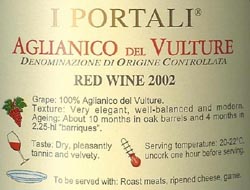
Budget-minded enthusiasts who turn to this wine from the southern Italian region of Aglianico del Vulture will be amply rewarded. The Aglianico grape that comprises 100% of the wine may be unknown in the US but has been in the region for 3500 years (and is very timely given the Athens Olympics since Aglianico means Hellenic, referring to the probable origins of the varietal). A dark reddish-purple in color, this full-bodied bodied wine has a silky smooth character that comes from the hand-harvesting and selection of the grapes as well as 14 months in oak. It is an excellent compliment to hard or aged cheese, such as pecorino, or grilled meats. Importer Gregory Smolik deserves recognition for providing such an informative back label–others should follow. Join the “vulture culture”!

Chateau Guiot, Costieres de Nimes, rosé, 2003. $9. Find this wine
The Costieres de Nimes region has produced many excellent values as readers of these pages know. Mas de Guiot had an excellent red in 2001. And — wow! — this rosé from the same producer (confusingly known as Chateau in this bottling) is excellent stuff. Not overly tart as are many rosés and a more reddish hue of pink, this wine is a full and rounded accompaniment to a wide variety of foods, especially when consumed al fresco. And it is not at all sweet. Robert Kacher, importer.

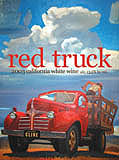
Red Truck, red table wine, California, 2002. $9.99. Find this wine Is this another gimmicky wine name (as with the many animal names on labels) that is worth a laugh but not a buy? In fact, Red Truck not only has potentially the most eye-catching label of the year but is worth taking for more than a metaphorical test-drive. And without a grape variety on the label, it is worth checking under the hood to find that this wine has a blend of Mourvedre and Syrah as well as some Merlot and Pinot Noir. Sourced from several vineyards in Contra Costa County owned by Cline Cellars, the producer, the wine in the glass has tons of red fruit aromas and flavors, a short-ish finish, but enough character to makes it a good accompaniment for the barbeque. With oil prices so high, reach for this red truck instead of the one in the garage.

Domaine D’Andezon, Cotes du Rhone, 2001, $9.49. Find this wine
Why is Syrah fast becoming the world’s most popular red grape? One sip of the wine will let you know. Unlike most Cotes du Rhones that blend Grenache and Syrah, this Domaine D’Andezon is pure Syrah, from about 50 year old vines, bottled unfiltered. In a blind tasting it could easily be mistaken for an Aussie Shiraz with its very lively nose of dark fruits including plums and
berries, but the good acidity indicates a cooler growing climate and gives it an excellent concentration. Very food friendly. Importer: Eric Solomon, European Cellars.

Gerard Bertrand, Les Cailloutis, AOC Corbières, 1999. $9. Find this wine
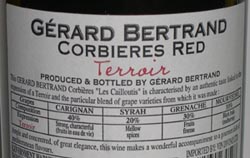
A red blend from the Corbieres appellation of Languedoc might look enticing but leave you wondering: just which grapes varietals are in the wine? Well, thanks to an informative back label, the consumer knows with precision what makes up this yummy wine from Gerard Bertrand (Carignan, 40%; Syrah, 20%; Grenache 30%; Mourvedre, 10%). With an inky-purple color and a solid mid-palate, this earthy wine with notes of dark berry is ready to drink now and goes great with a pizza. Importer: VinDivino.

Big Red
Chateau La Sentinelle, AOC Cotes de Castillon, 2000. $9.99 Find this wine
Bordeaux is often considered to be either the world’s premier address for quality wine or a place of uninspiring bulk wine. But there is a third, often neglected, category of producers in far-flung appellations who are making interesting wines at a fraction of the price of the top chateaux. Such is the case in the Cotes de Castillon, which lies beyond celebrated St. Emilion. This Chateaux La Sentinelle has an inky-purple color with the classic Bordeaux terroir on the nose of this mostly merlot blend. And at $10, this is a Bordeaux 2000 for everyday consumption!! Importer: Wine Vine.

Hedge fun

The automobile industry does it. The airline industry does it too. American wine importers need to use currency hedging to prevent price rises and protect their profits.

Porsche, the luxury auto maker, reported a rise in profits for the first-half of their fiscal year. While this alone raised eyebrows because of global economic sluggishness, the real surprise was that there was any profit at all for the German company since just about half of its sales came from the US market. After all, the dollar’s sharp decline against the euro should have eaten most of the profits. But it did not. Why?

Management predicted the dollar decline and bought a currency hedge through 2006-7. This hedge is not an ornament of the manicured lawn at the Stuttgart HQ, but rather a financial strategy that limits the risk of currency fluctuations. The hedging program saved the corporation’s profits—and protected the leather-loafered American consumer from having to pay higher prices for the product.

Hedging is common in industries with volatile markets. Continental Airlines’ recent profits were hurt because they did not hedge their fuel costs the way most airlines do. Starbucks hedges the risk of a coffee price rise. Some heating oil companies even offer consumers the right to lock in their winter fuel bill at summer prices.

Hedges, once the exclusive domain of investment bankers, have now gone mainstream. Hedging provides a firm the opportunity to manage risk, often at a reasonable price (and there are even some “zero cost” options). In the wine industry, if American importers anticipate a decline in the dollar, which would raise their costs of buying wine overseas, they can buy the foreign currency at today’s prices in what is called the spot market. But that would tie up a lot of capital to simply buy, say, one million euros today. A lower cost strategy is to buy cheap options on one million euros at today’s prices. This provides the importer insurance against a decline of the dollar. And a similar strategy can even be set up to protect against a rise in the dollar too.

Wine needs currency hedging more than other consumer products.
Car producers can hedge their currency risk by moving production into the consuming countries as BMW did by opening a plant in South Carolina. But wine producers cannot shift production. Wine from Burgundy cannot be produced in Bangalore. That makes wine extremely vulnerable to currency fluctuations.

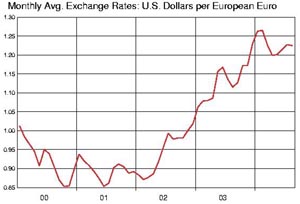
As the dollar has dropped sharply over the past two years, particularly against the euro and the Australian dollar (see chart below), the two main currencies of American wine imports, wine consumers have had to suffer a rise in wine prices on the retailers’ shelves.
Wine from Burgundy cannot be produced in Bangalore.

Futures for the wines of the Bordeaux 2003 vintage have more than doubled from the prior year for many of the top chateaus. Granted, the extreme heat of the growing season led to some rave reviews for the vintage. But even other, more humble wines from other region of the euro-zone that used to sell for under $10 now are pushing $13.

Passing the cost of currency fluctuations on to the consumer is but one strategy for an importer. One importer told me that his sales had doubled recently while his profits remained flat because he refused to raise prices to the consumer. Instead of simply buying the currency in the spot market, just think how much profit he could have made with a hedging program! He could even have lowered prices while his competitors raised them.

Wine consumers are already accustomed to producer greed driving up prices. The financial bumbling of importers should not further add to the tab. American wine importers would do well to seize this current pullback in the dollar to purchase some protection against another run on the dollar. (With large deficits in trade and the federal budget, it’s not too difficult to imagine the dollar losing ground again.) That way squeezing or squabbling with producers about price can be avoided and the price can remain stable to the consumer. Then the saved profits could help the importer’s bottom line—or even be passed on to the consumer in the form of lower prices!

FX rates at publication (8/24/04)
euro/dollar: 1.2099
US dollar/Australian dollar: 1.4156

image sources:
1) Porsche
2) www.n-tv.de/5204475.html
3) & 4) http://fx.sauder.ubc.ca/plot.html

Leap-frogging French Wines in America

French wines have dropped to third place in the American market. What can be done about it? Providing more information on the back label would be a good start.

As if it weren’t hard enough to remember the difference between a Pouilly-Fuissé and a Pouilly-Fumé, consider keeping the Cotes Duras apart from the Cotes de Jura.

Such are the pitfalls of the French appellation system for the American consumer. Appellation wines, also known as appellation d’origine controllée (AOC), account for half of the wines produced in France today, including almost all the top quality wines. Throw in the other categories that use geographical indications (e.g. vin de pays) and then consumers have to further distinguish the Cotes de Toul from the Cotes de Thau and the Cotes de Tarn.

The trouble with geographical indications is that once the hallowed grounds at the top of the hierarchy such as Margaux and Champagne are left behind, the course becomes much more difficult for the consumer to navigate, which often penalizes out-of-the way and good value producers. If you find the system confusing, you are in good company.

“There are so many appellations that I don’t even know them all,” said Michel Rolland at a recent panel at the Vinexpo 2004 trade show in Chicago. Indeed, if this “flying winemaker” who consults at wineries from Napa to Argentina finds the French system confusing, then how about the average American consumer?

Enter the kangaroo. Australian wines have leap-frogged France in the US market based on strong marketing, brands, and varietals such as Shiraz and Chardonnay on the label. Yellow Tail is a case in point. With an indigenous art depiction of a kangaroo on the label, flashy colors, and a price tag of around $5 a bottle, consumers have snapped up the stuff making it the most successful wine product launch in history. Four million cases can’t be wrong, eh?

But France is not going to have as consolidated a wine industry as Australia any time soon. In Bordeaux alone there are 12,000 producers and that number is down about 50% from a decade ago. Indeed, about one wine producer closes in Bordeaux every day. But that will still take a long time to reach the Australian levels and would require a major overhaul of agricultural policy.

So what about better label art or even names that are more memorable to English speakers? Robert Parker, the world’s foremost wine critic, ruled out witty names in his participation on the same panel at Vinexpo. “Gimmicky names aren’t the answer: ’Fat Bastard’ or the ’Pope’s Nose’ should be avoided,” he said.

What the French do need is more information on the label. Parker suggested that the American consumer, who buys most wine at supermarkets, needs at least the name of the grape varietal to accompany the place name of the appellation. However, such action contravenes the appellation rules. So put the varietal information on the importers label on the back, Parker suggested. (That might also help diminish the obligatory US government warning on the back too, he added.)aoc graph
Parker stated that the appellation rules are overly confining for French producers. But this stands in sharp contrast to the recent trend toward more appellations d’origine. Clearly the producers on the ground, who set the appellation rules anyway, see something positive in the system as the amount of acreage under appellation has increased almost four-fold over the past 30 years (see chart).

Given their popularity with producers, François Loos, French trade minister, told the press at the Vinexpo conference that France was committed to preserving geographical indications in ongoing trade talks. That being the case, doesn’t putting varietal names on the back label represent a middle ground?

Yes it does and more importers should take up this task. In fact, why not design a back label that is super informative with acidity and sugar levels, an indication of when to drink the wine at its peak, a tidbit about the winery, and what types of food pairing would be good? At least the consumer would then have too much information—that he or she knows how to understand and digest—rather than too little.

Wouldn’t the American consumer then have an easier time picking a wine off the shelf? Maybe that Pouilly-Fuissé would be appealing with its 100% Chardonnay aged for 3 months in French oak barrels, with medium acidity levels, low residual sugar and goes great with lobster. Or perhaps the Pouilly-Fumé is just right with 100% unoaked Sauvignon Blanc and crisp acidity levels that goes well with a salad on the deck? Providing more information would help make American consumers make more accurate choices. We might even learn more about the appellations themselves!

As Parker said, “I couldn’t imagine a day without French wine. I mean that quite literally.” Wouldn’t the French be happy if all Americans could say that?

***

UPDATE 7/22: through a stroke of luck, a prescient call, or eerie power that I exert over the French wine industry, grape varietals will soon be allowed on the FRONT labels! See story.

Value vino list number nine

Rosé
Chateau Mourgues de Gres, Les galets roses 2002, $9.99.
Rosés aren’t just for summer any more. But since summer weather is now upon us, we have all the more reason. Dry rosés are versatile food wines that have gotten a bad rap. Once dismissed as mere “summer wines” or tainted by the sweetness of such travesties as white Zinfandel, rosés are coming into their own. And there are few better bargains than this Morgues de Gres, which is excellent despite the region being submerged by floods at the time of the harvest. Les Galets rosés has a heft and complexity that makes it more like a red than most rosés (which come from red grape varietals). Great with an African spice rub or salade nicoise. US importer: Weygandt-Metzler.

Whites
Chateau Campuget, blanc, AOC Costieres de Nimes, 2002. $7.
Bargain hunters should run-not walk!-to find this wine. Given the difficult conditions of the 2002 vintage (flooding) this reliable, value producer stands out for a fine white blend of Roussane and Grenache blanc. More than simply a “summer wine” it has greater depth with notes of melon and minerality that make it a great match for seafood and salads. Robert Kacher, importer.

Huber, “Hugo” Gruner Veltiner, (Austria) 2003, $8.79.
While “extreme-value” in the US has brought wines at $2 a bottle, this $9 wine is about as extreme as the value will get from Austria. Although the mountainous vineyards are producing excellent whites, the prices are generally too high to make the Dr. Vino grade. It is hard to get fresher than the wine – or the winemaker, Markus Huber, who at a mere 23 years old (!!) has already won the acclaim of his peers with the Winemaker of the Year title in 2002! This is a bright, clean example of the local grape, Gruner Veltliner (aka “Gru V”). Though not as complex as more expensive Gruners, the minerality, acidity and faint spice make it a refreshing complement to dinner on the deck. Importer: Boutique Wine Collection.

Indaba, Sauvignon Blanc, 2003. $6.50
South African wines have come a long way in the past 10 years of democracy. One noticeable change has been the planting of more “international” grape varietals as opposed to the traditional ones (e.g. pinotage) that had predominated before the world market opened up for South African wines. Mzokhana Mveme, winemaker at Indaba, offers this fresh, crisp Sauvignon Blanc, perfect for sipping on the deck. Imported by Cape Classics. www.capeclassics.com

Montes, Sauvignon Blanc, reserve, 2004, Chile. $8
Fresher than a Beaujolais nouveau, this sauvignon blanc was just harvested at the end of the Chilean summer in March and is now on retailers’ shelves. Montes has a line of “reserve” wines that offer excellent value for around $10. Thanks to steel tank fermentation and aging, this pale yellow SB has crisp aromas of clean fruit and a smooth finish. Not likely to be long-lived, but perfect for drinking this summer-or during next summer down under. This SB is no BS.

Reds
REDS, 2001 Laurel Glen Vineyards, $9.
What better way to celebrate the Fourth of July than with a bottle of REDS? (The white and the blue are up to you.) This wine hails from Lodi, gold country in the days of the Gold Rush, and given that it is harder to find a good, domestic bottle under $10 now than it was to find gold back then, this is indeed a useful nugget. Made from a blend of Zinfandel, Petite Sirah, and Carignane, this concentrated wine comes from some vines that date from before 1900. The dark red colors of the wine in the glass come from the low yields of the old vines (only half as many cases were produced with this vintage-and, admirably, the price as not taken off) and the enticing flavors of red berry make it a great match for the best of the barbeque.

Patricia Green, Pinot Noir, Oregon 2002. $17
The 2002 vintage from Oregon has produced excellent-and excellent value-pinot noirs. Pinot noir has proven fickle and difficult to grow successfully outside of the cool climes of Burgundy, the region that made it famous. So it is small wonder that the prices of Pinots tend to be higher than other, more hearty, varietals. Oregon is a clear leader in American pinot noir production. Patricia Green produces a large line of fine pinots at reasonable price points, many from single vineyards or even single corners of vineyards known as “blocks.” But why have a single vineyard when you could have the whole state? This generic “Oregon” designation not only gives this these more limited production wines a run for their money, but costs a lot less of it too. Wonderful aromas of wild strawberry and hints of earthiness and tobacco yield to smooth and supple tannins with a long finish. Astute readers will note that this wine is in fact not under the usual $10 threshold, but it is such a good value, consider splurging on it as a “wine of the weekend.”

Ravenswood, Shiraz, Vintner’s Blend, southeastern Australia, 2002, $7.99.
The recent trend toward globalization is epitomized in a glass of this Ravenswood Shiraz. Ravenswood, based in Sonoma, was sold (for $148 million) in 2001 to Constellation Brands (formerly Canandaigua). Constellation subsequently bought BRL Hardy in Australia to become the world’s largest publicly traded wine producer. The Ravenswood winery that had a cult following thus became a mere brand in a large portfolio of wines. But Joel Patterson stayed on with Ravenswood and this Shiraz is a product of the new, global company. The “no wimpy wines” motto still applies to this big red from down under fruit. Hints of mint and eucalyptus in the sweet tannins make it have pleasant complexity, a perfect companion for grilled meats. I would take this wine with kangaroos on the label over another (ahem), more famous one.

Chateau Montroche, Costieres de Nimes, 2001. $7
Bobby Kacher should become the honorary president of the Costieres de Nimes appellation. The American importer has unearthed so many great bargains from the region that he definitely makes the Dr. Vino importer Hall of Fame at the very least. This Chateau Montroche is yet another excellent syrah-grenache. Although it is light in color, the flavors and aromas of dark fruit and tar are pleasantly potent. Rather than opening a Montrachet, this Montroche will sufficiently impress the neighbors on a weeknight.

Villa Maria, private bin, Hawke’s Bay, Cabernet/Merlot, 2002, $9.99
When you think of New Zealand wines, which grapes leap to mind? Certainly not cabernet and merlot. Nonetheless, Villa Maria blends the two popular red grapes into this wine, ruby red in color, rounded and smooth with notes of plum and spice and a pleasant finish. If you don’t finish the bottle in one sitting, just screw the screw cap back on. Vineyard Brands, US importer.

Value vino list number eight

White
Hugel et Fils, Gentil, Alsace, 2002. $9
Etienne Hugel is a confident and funny guy. His confidence in winemaking must come from being the 12th generation to own Hugel et fils. His humor? Well, maybe it comes from his confidence in his wines and wine making. Hugel says he is as proud of this Gentil, his largest production wine, as he is of his excellent limited production Jubilee Riesling ($45). More floral than your grandmother’s couch, this racy white is an unoaked blend of Gewurztraminer, Pinot Gris, Riesling, Muscat and Sylvaner—a veritable catalogue white varietals. Yellow/green in color, the wine has a perfumed sweetness that is not cloying and is great for quaffing on the deck or with seafood. Wildman, importer. www.hugel.com

Reds
Castano, Hecula, 2002, $9.99
This wine turns heads. Guaranteed to have even your biggest wine-geek friends thinking that it costs well over $10, this is a “Parker-style” hedonistic fruit bomb. The Castaño family now has an excellent line-up of big-style, budget reds from their out-of-the-way winery in Yecla. The 100% monastrell (aka mourvedre) wine, aged in American oak for 6 months, will impress even those whose palates have turned to leather. Back up your cart and buy this one with both hands. Importer, Eric Solomon.

Domaine de la Gasqui, vigne du loup, vdp Vaucluse, $9 (sale)
Life may not be a bowl of cherries, but this wine is a glass of red berries. With the gentle sweetness that is typical of Grenache, these 80 year old vines from the base of Mt. Ventoux have produced an approachable and medium-bodied wine, light in color. Although not officially organic according to the new USDA standards (no wine meets the USDA standards) the wine does meet the “agiculture biologique” standards of Ecocert. Jeffrey Davies, importer.

Domaine de la Petite Cassagne, AOC Costieres de Nimes, red. 1999. $4 (sale, $9.99 regular)
Dr Vino readers are already familiar with the wines of Grande Cassagne but this one from Petite Cassagne bears mentioning, particularly at the petite sale price. Wonderful textures of the Grenache, Syrah, and Carignan make this probably the best $4 wine I have ever tasted (I would even pay full price for it!) with notes of blackcurrant that contribute to its full flavor. Consider this the “4 buck Charles” as you buy it by the case. Robert Kacher, importer.

Chateau St. Germain, Coteaux du Languedoc, red, 2000. $6.60 (sale, $9.99 regular)
Think ink, as in inky purple. Purple label, purple cap and inky-purple wine, this vigorous Chateau St. Germain has gobs of purple fruits such as plum and blackberries. Although the wine has 15% alcohol a good balance makes it rounded and not heady. Languedoc has made a significant qualitative turn in the past decade and this Syrah-Grenache blend of hand harvested fruit, grown chemical-free, is a good representative. Jeffrey M. Davies, importer.

Baron Rothschild, Carmenere, Reserve, 2001. $9
Carmenere, the fraternal twin of Merlot, is in safe hands Chez Rothschild. Except that this is the Rothschild chateau away from the chateau at their property in Chile. With notes of blackcurrant, this lush black cherry colored wine has a smooth finish. Bold design on the label makes it a good wine to bring to a party since your selection will stand out. An easy food match, try it with smoked meats. Importer: Caravelle Wine Selections.

Moulin d’Eole, 2001, Costieres de Nimes. $9
The Costieres de Nimes region is cranking out lots of excellent value reds in a Rhone style. This excellent one, imported by Kysela, resembles a Cotes Rotie with delicate floral notes in the aroma followed by the usual notes of leather, dark berries, smoked meat, and that southern France flavor of garrigue. Best at room temperature, the soft tannins lead to a longish finish. Knock the socks off anyone you’re having over on a weeknight with this wine!

Encuentro, Ribera del Duero, 2000, $8
While good bargains are becoming increasingly hard to find in Spain’s Ribera del Duero region, Trader Joe’s grocery stores have tracked down a good value vino. Encuentro, or “meeting” in Spanish, is a good example of a Ribera, although a bit lighter and not as full bodied as other wines that are now above the $10 price point. One does wonder where this 100% Tempranillo crianza (12 months oak cask aging) has been since the 2000 vintage, but it still has smooth notes of plum and leather making it a good accompaniment to lamb or simply easy drinking at your favorite encounters. Plum Ridge imports for TJ’s.

Habitat, red blend, Napa Valley, 2002. $9.
A California red for under $10 that is worth drinking?! The only thing more amazing is that this yummy red is also made from organically grown grapes (although since no wine technically meets USDA organic standards, the producers opted for the more oblique “handcrafted” on the label). The blend of 50% pinot noir, 25% cab, 25% merlot actually works and comes off as a rounded red, with a welcoming aroma of dark fruits and a finish that leaves you saying “hey California, how about some more good under $10s!?!” Send back the screw-cap top and the winery will donate $1 to an ecological cause. You don’t need to save this one for Earth Day since it would be a good house wine for your domestic habitat.

Las Rocas de San Alejandro, old vine Grenache, 2002, $7.79
Las Rocas “may be the greatest wine value I have ever tasted” according to Robert Parker who bestowed 91 points on this Grenache from 75 year old vines in the remote Calatayud region. With many great wines under $10 available, Parker’s comments may seem hyperbolic, but the Las Rocas does have has certain stand-out characteristics. Most notable is an ability to evolve in the glass that is rare for wines of this price. When first opened, the wine is closed, without striking aromas or flavors. But left to open up for an hour, the wine’s aroma becomes more complex with a sweet black cherries and smoke and a long, pleasant finish. Decanting essential. Eric Solomon, importer.

Beyond the grade (but worth it):

Domaine Weinbach, Gewurztraminer, Cuvee Theo, 2002 ($20)
Belles Soeurs, pinot noir, Willamette Valley, 2001 ($40)
Elizabeth Spencer, Napa, Cabernet 2000 ($26)
Mas de la Barben, Coteaux de Languedoc, 1999 ($12)

Why national wine recommendations are stupid (but I still make them anyway)

With so many wines hard to find, why do it?

Bob in Minneapolis faithfully prints out the Dr. Vino lists of ten wines under $10 and brings them to his local store. With almost the regularity of the lists, I get an email from Bob to the effect of “why the heck can’t I find any of these?”

Many wine consumers have surely had a similar experience when reading a write-up of a great sounding wine in a wine newsletter or magazine only to call the local shop and find the wine is not available. More than many other pleasurable consumer products, it seems, wine can come with its own disappointments in simply tracking it down. It’s often a lot easier to find a limited edition book or the latest Louis Vuitton handbag than it is to find a wine.

This begs a couple of questions: Why is it so hard to find wine picks in the US? And why bother even making wine recommendations for a national audience?

Clearly supply and demand play a key role to explaining why it is hard to find some wines. A supermarket wine manager often faces a choice among 25,000 wines to stock. And for the more creative wine shop manager the choice is even greater with new producers emerging in exciting corners of the wine world every year. Thus tough competition for shelf space means that a manager may choose not to stock some lesser known or smaller production wines.

Further, many good wines have limited supply. Some of these are limited production from the boutique wineries of Napa. But some good, inexpensive wines are also limited, particularly ones imported from small producers overseas.

High demand also means that good wines, particularly good value wines, often fly off the shelves. Influential critics (the initials RP and WS leap to mind) are an important part of sorting through the rubble but these picks then create demand.

But beyond supply and demand, which affect wine consumers around the world, the American market has the idiosyncrasies of the states. The uneven repeal of Prohibition means that each state really acts like a sovereign state with rules on “importing” wine (even if that it is from remote locales such as California). Since this effectively divides the country into 50 markets, it is no surprise that the distributors (and thus consumers) in smaller states cannot get the attention of producers and importers, especially if the production is at all limited or in high demand.

So why make recommendations at all? There are a few good reasons.

Even if consumers can’t actually try a certain wine, it is at least reassuring that a great wine is being made-whether it is exquisite or simply an exquisite value. Reading a Parker review of Screaming Eagle (500 cases production and $250+ per bottle) is about as close to fun as most wine drinkers will get to this wine. Or reading a Dr. Vino review of the succulent Higueruela wine that sells for around $7 may frustrate bargain hounds like Bob who can’t find it. Knowing might be nice, but drinking is better.

In order to connect consumers with good wines, I provide information on the winery (if domestic) or the wine’s importer (if from overseas). Importers are a good proxy for quality since an importer’s taste permeates the entire portfolio of wines he or she has available. Further, if you like a wine review, then you can contact the importer and find out if it is available in your state or town—or pressure them to make it available if it is not.

For those consumers who live in limited wine markets, there may be the opportunity to ship or travel. Retailers often can ship wine to more states than producers based on the logic that it has cleared the distributor channel somewhere. And what trip to New York, Chicago, or Los Angeles is complete for the wine geek without a trip to a local wine shop? Although security measures post 9/11 restrict carry-on luggage on air travel, there’s always the trunk of the car…

Reviewing wines that sound attractive but are difficult to find also has the advantage of recognizing quality producers and importers. Starting demand at the bottom, repeated consumer inquiries at the local shop may lead to repeated calls to the distributor who then might gain access to certain wines.

In the end, the best wine picks may be local ones since if the critic actually bought them in the local market, then there’s a better chance that you can find them there too—as long as you can beat your neighbor to the store.

Value vino list number seven

Whites
Steele, Shooting Star, Washington State, Aligoté. 2001. $9.95
Jed Steele, the winemaker from Lake County California, has sourced this exciting white with fruit from Washington State. The obscure Aligoté rarely gets to be a headline act as it has traditionally played a supporting role to Chardonnay in Burgundy. But the future for Aligoté in the lead role will be more than a shooting star if winemakers continue to make it in this appealing style. This wine from a two-acre plot is aged in old oak barrels, making it rounded without being oaky, and is an excellent food wine (try it with grilled swordfish). Catch a bottle of Shooting Star, before it becomes a star! www.steelewines.com

Cuvées de Castilla, Cuvee R.S., DO Rueda, $6.
As the prices of Spanish wines go up, budget-oriented consumers may have to move down-the river in this case. Just down the Duero River from the excellent and increasingly high-rent growing area of Ribera del Duero, lies Rueda and the vineyards of this excellent value white. It’s not just the grape varietals that count here (since they are mostly the little known Verdejo and Viura) but the freshness in the glass that matters more. With floral notes in the aroma and firm citrus base on the palate, this wine is a hands-down winner on the deck in the summer (drink up, those of you in the southern hemisphere! The rest of us can drink it and be nostalgic for summer.). Try with seafood or as an aperitif with a sharp dry cheese such as manchego. Eric Solomon, importer.

Mas Carlot, Cuvee R (Riesling), 2002, $7.
If you think that a Riesling from the south of France is not strange enough, consider that this vintage of this exotic wine did not sacrifice quality despite massive flooding in the region just prior to harvest. The Cuvee R is an excellent white, strikingly golden in color and complements spicy food such as stir-fry very well. A refreshing crispness derives from the pleasant firmness of the acidity that also has a generous coating of lychees. Sadly, this vintage will be the last one for this unusual wine. According to Bobby Kacher, the wine’s American importer, the one-acre plot of old vines has been forcibly uprooted at the demands of the Alsace producers of Riesling, despite the many efforts of Mas Carlot (such as making it a humble table wine as opposed to AOC) to mollify them. So raise a glass of this final bargain vintage while it is still available. Robert Kacher, importer.

Reds

Capçanes, Mas Donis, “Barrica” 2001. $10.41
Where do value-oriented wine drinkers find their Priorat? In Montsant! As the price of wines from the small Priorat region of southern Catalonia has had a vertiginous recent rise, neighboring Montsant is picking up steam. Capcanes is an old cooperative of growers that has a portfolio of enticing value and high quality red wines. The Mas Donis Barrica 2001 is made from 60 year old vines (mostly Grenache and some Syrah), aged in American oak and bottled unfiltered. Not a fruit blunderbuss, the wine hits the mark with the precision of a sniper. Black cherry and tobacco make the wine compelling and long lasting and an excellent accompaniment to meals. Eric Solomon, importer.

Castell del Remei, Gotim Bru, 2001. $10.49
Castell del Remei is a house known for fine value vino. Investment from the Cusine family in wine making talent and the vineyard mean that variations among vintages will be slim. The Gotim Bru was formerly one of the most exciting wines under $10 but it has crept up in price and come down a smidge in terms of quality (although it is still worth seeking out). While the 99 and the 2000 vintages were legends in their own time, the 2001 shows signs of being mortal. The color remains ruby red and the aroma and tastes are slightly more berry and grapey than they were previously. Nonetheless, the tempranillo grape that serves as the base for this wine makes it a wine that is very food friendly. Eric Solomon, importer.

Cousino-Macul, Cabernet Sauvignon, 2002. $9
What do you do when a city grows up around your vineyard? This is a problem that confronted the Cousiño family at their 800-acre Macul vineyard (planted in 1856) as Santiago built up all around it. Feeling the pressures of urbanization, the family sold half the vineyard (still open for visits) and built a state of the art winery in Buin, 20 miles to the south-west in the Maipo Valley. This young wine, the first from the new winery, has notes of cherry and smoked meats and the tannins will make it a favorite of those who enjoy “big reds.” The Antiguas Reservas is more refined at a higher price point ($16). Imported by Billington Imports.

Domaine Santa Duc, les vieilles vignes, Cotes du Rhone, 2001 $9 (sale).
The current vintage of this wine remains just as compelling as the previous one making this a value vino name to set in stone. The humble CDR appellation belies the complexity and refinement of this lush, leathery and lingering wine from a leading producer of Chateauneuf. Moreover, even alongside the Rasteau 2001 ($16) from the same producer, this CDR was the winner. A robust red that is versatile with food pairings from ravioli to roast beef. Robert Kacher, importer.

Dominis M, red, vdp Catalan, 2002. $8.50
With a similar name as the famed Napa producer Dominus, but at a fraction of the price, this wine begs the question of what would you prefer, a case of easy-drinking table wine or one excellent bottle? If you opt for the lower bottle price of the former, then Dominis M is the way to go. Inky-purple in color with gobs of vibrant, dark fruit, the young wine is immediately accessible and drinkable. In fact, this vin de pays would make a great wine for a picnic especially in France, where it would probably cost about €4. Eric Solomon, importer.

Enate, Cabernet Sauvignon/Merlot, D.O. Somotano, 2001. $8.50
This ultramodern winery (founded 1991) makes wines from international varietals high in the foothills of the Pyrenees. Ever heard of a Spanish Gewurztraminer? They make one (and it is apparently good). From the off-the-beaten path (up and coming?) growing area Somotano in Huesca, this cabernet/merlot blend is an inky red in color with notes of blackcurrant and black cherry. Balanced and medium-bodied, the wine goes well with food, such as a risotto. And with a price tag of €7 in Spain, the wine is a shockingly good value in the US. Eric Solomon, importer. www.enate.es

Peace Family Vineyard, South Eastern Australia 2003. $6
Was 2003 a year for peace? If you’re the Australian wine maker Andrew Peace, every year is full of Peace but now is a good time to play on the name. Complete with artistic peace sign on the label, this value red has a blend of four red varietals (shiraz, cabernet, Grenache, and mataró in descending order) with plenty of initial cherry and dark fruits though not a long finish. Not a wine for cellaring, it is a bargain for grilled meats straight off the barbie. Nor is it a wine for impressing out-of-town guests-unless you are trying to make a point and the guest happens to be Donald Rumsfeld. TGIC, importer.

Beyond the grade (but worth it):
Morambro Creek, Padthaway, shiraz, 2002 ($20)
San Pedro de Yacochuya, 2001 ($45)


winepoliticsamz

Wine Maps


Monthly Archives

Categories


Blog posts via email

@drvino on Instagram

@drvino on Twitter


winesearcher

quotes

One of the “fresh voices taking wine journalism in new and important directions.” -World of Fine Wine

“His reporting over the past six months has had seismic consequences, which is a hell of an accomplishment for a blog.” -Forbes.com

"News of such activities, reported last month on a wine blog called Dr. Vino, have captivated wine enthusiasts and triggered a fierce online debate…" The Wall Street Journal

"...well-written, well-researched, calm and, dare we use the word, sober." -Dorothy Gaiter & John Brecher, WSJ

jbf07James Beard Foundation awards

Saveur, best drinks blog, finalist 2012.

Winner, Best Wine Blog

One of the "seven best wine blogs." Food & Wine,

One of the three best wine blogs, Fast Company

See more media...

ayow150buy

Wine books on Amazon: