Wine Blogging Wednesday 18: wine shops that feel the love

Ah, February with its abundant love cliches is soon approaching. But this year we food and wine bloggers will have nothing to do with pink champagne and heart-shaped tubs (at least that we’ll write about). Instead, the theme for Wine Blogging Wednesday #18 is:

wine shops that feel the love!

We all have to buy our wines somewhere and why settle for dreary supermarkets or liquor stores when there are so many great (new) wine shops around the world? The shop that you will write about doesn’t have to be big. Or fancy. But it does have to feel the love for the fruits of the vine with a knowledgeable and enthusiastic staff, a good selection, periodic free tastings (where legally available) and reasonable pricing. Custom shelf talkers (if any at all), original design, store layout, wine displays, or an informative newsletter are definite plusses.

And for those who absolutely MUST drink taste wine for WBW, consider it bonus points to write-up a value vino that a member of the shop’s staff recommended.

I’m looking forward to learning about fun new shops endorsed by fellow bloggers that I can check out on my future travels. Wednesday February 1, 2006 is the date for your posting on your blog. If you don’t have a blog, start one! (or I can post the comment of the blogless in my roundup) If you want to post photos to Flickr, tag them WBW and/or WBW18. Thanks to fearless WBW coordinator and founder Lenn–I’m pleased to be able to use the new logo! Cheers,

Tyler

tags: | | |

Geoffrey Roberts travel award

Are you a writer in food, wine or travel with a project that you would like to explore further? If the results of the project would provide intellectual nourishment for other food, wine or travel writers, then you are eligible to apply for the Geoffrey Roberts Award, an annual travel grant in the amount of £3,000 (almost $6,000).

Applications for this year are due March 31, 2006. For further details, including a list of previous winners, please see www.GeoffreyRobertsAward.com

tags: | |

Price, critics and quality

A few weeks ago an interesting experiment was undertaken at the Brussels food fair, a yearly affair where food lovers wander around among the many stalls stuffed with all imaginable delicacies. A stall was put up selling boxes of Belgian chocolates. The first day the price was set at Euros 9 for each box. Sales went well. The next day the price was raised to Euros 15 per box. Steeped in economic theory, you might think that demand now declined. Wrong. Demand doubled. On the third day the price was lowered to Euros 2 for each box. Demand for chocolates collapsed. What went wrong with the law of demand?

The explanation is given by psychologists. It is very difficult, if not impossible, for the consumer to find out the quality of chocolates by just looking at their appearance in the shop. When confronted with such uncertainty about the intrinsic value of things, consumers use simple rules of thumb that they understand. Psychologists call these “heuristics”. In this case, the price of the chocolates provides the rule of thumb.

Most consumers have some experience that allows them to associate high price with high quality. It is not always like that, but on average it probably is. Thus when looking at the Euros 15 box the consumers infer that the high price reflects high quality and they buy the chocolates. Consumers who see the boxes priced at Euros 2 infer that the quality of these chocolates is not to be trusted, and they do not buy them. The law of demand is turned upside down.

So writes Paul de Grauwe in today’s Financial Times. Though he was relating the Belgian chocolates example to the strength of the US dollar, it doesn’t take much for a wine enthusiast to relate the example to wine. Price is not a reliable indicator of quality in wine (as much as wineries would like it) as my value vino picks demonstrate.

When price fails, wine consumers often turn to critics for indicators on quality. This is something we will be discussing in my critics class, starting next month. Critical reviews too can be deceiving since palates vary and a simple numerical rating is so spare that it doesn’t convey food pairings or flavor profiles. The good thing about wine is that it’s not that hard to determine the quality yourself–just pull the cork!

tags: | |

Terrazas de los Andes, Malbec, 2004

Terrazas de los Andes, Malbec 2004. $9. Find this wine
Polyphenols, they’re all the rage. No, they’re not a chemical additive dumped into wines by industrial wine makers; instead they are chemical compounds, high in antioxidants, that may fight cancer. Since polyphenols occur naturally in red wines, enthusiasts and the producers of red wine have been quick to make tout the health benefits of red wine (yes, something we enjoy doing may actually be good for us). According to a 2001 study in the magazine Nature, the high elevation of the Argentine vineyards gives their reds more exposure to ultraviolet rays and raises the polyphenol level. So don’t reach for a bottle of POM pomegranate juice, reach for an Argentine Malbec. This Terrazas is a great place to start. After tasting through a half a dozen entry-level Malbecs, I found this 100% Malbec grown at 3,000 ft above sea-level to be the most attractive. Dark in color, with notes of blackberry, plum, cassis, and saddle leather, and the tannins in the finish were smooth. The obvious food pairing is a steak but would also be good with burgers. Importer: Schieffelin & Somerset NY.

tags: | |

Shrinking Cotes, expanding AVAs


How many Cotes are too many? Five it turns out.

While Prime Minister Dominique de Villepin and his Minister of Agriculture are thinking (after listening) how to resolve the crisis hitting French wine, some industry participants are moving on their own.

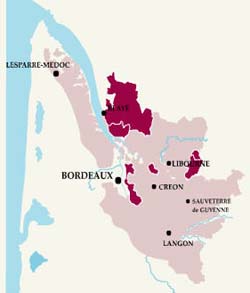
The producers who compose five Bordeaux appellations, or AOCs, with similar sounding names are hoping to merge, Decanter reports. Bordeaux has 57 appellations with only the top ones such as Margaux or Pomerol exacting a premium in the marketplace. A contraction is an excellent idea. The new proposed Côtes de Bordeaux region will merge potentially five non-contiguous AOCs including the Côtes de Bourg, Côtes de Blaye, Côtes de Castillon, Côtes de Franc and Premiere Côtes de Bordeaux.

“Our aim is to simplify things for the consumer. These regions have a lot in common – all are Right Bank, largely Merlot-based, and largely approachable, fruit-driven wines. With better consumer recognition, they have great potential on the export market,” Christophe Chateau, director of the Cinq Côtes Association told Decanter.

Does this represent the triumph of marketing over terroir, or growing area? No, since the predecessor AOC will still receive mention as in, “Castillon: Côtes de Bordeaux Controlée” (although it would be better to place the more specific designation after the new name instead of in front of it).

The process will not be swift, if indeed it happens at all, since it must be approved by the National Office of Appellations of Origin (INAO). Look for the new region to appear on labels in 2007.

* * * *

Meanwhile, the American federal authorities who regulate growing areas in the US have been on a recent binge approving or modifying four American Viticultural Areas on January 6. Quite different from the AOCs, these toothless AVAs do not control winemaking practices the way the AOCs do, but are merely growing areas for grapes. And most grapes at that. To state an AVA on the label, a wine must contain only 85% wine from grapes grown in the designated region, compared to 100% in the AOCs. And this leads us to the new…

Texoma!!! No, it is not a Broadway revival. Instead, this sprawling new AVA comprises four Texas counties and 3,650 sq. mi., or a whopping 2.34 million acres. That dwarfs last year’s approval of the Horse Heaven Hills in Washington State, which rolled in at 570,000 acares.

While the fine line that the AVAs tread between marketing and distinctive growing climates appears to have been blown away in the sand: this AVA has a bouquet of 100% marketing. Terroir anyone? Hmm, that must be French.

tags: | | | |

Bidding higher

The trend in wine auctions is up, way up. Last year, I speculated that the estimated $100 million of wine destroyed in a warehouse fire in Napa was about the size of one year in the wine auction market. That was so 2004 of me.

Last year wine auction houses saw $166 million of wine come under the hammer Decanter reports. That is an increase of 28% over the $129 million of wine sold at auction in 2004.

Howard Goldberg, the author of the story, produces annual sales figures for each auction house. He doesn’t cite his source for the data and only on one house does he mention that the sales include the house’s commissions, which can represent a premium of 15% to the buyer and seller.

Of note, Zachy’s of Scarsdale, NY, only its third year of auctions, further solidified its lead as North America’s largest auction house. Winebid.com, which holds its auctions online, finished with the third highest US gross.

Paddles ready! Here are the 2005 sales figures (number of auctions in parentheses):

Christie’s: (43) $42,158,972 worldwide. US: (10) $15,628,592
Zachy’s (10) $33,835,286
Sotheby’s, (16) $29,141,728 worldwide. US: (6) $18,597,374
Acker Merrall & Condit (22) $20,881,008
WineBid.com, (NA) $20 million
Hart Davis Hart (4) $9,503,414
Bonhams & Butterfields (6) $5,592,253
Morrell & Company’s (4) $3,902,990
Edward Roberts International (5) $1,563,322

Technorati tags: |

Wine quiz winners

Scott in Park City, Utah come on down! Scott was randomly selected from those with a 100% score on the year end wine quiz and he has won a case of wine. Given the fact that I was paying for the prize out of my measly ad revenues as a thank you to all readers of the site, the fact that Scott lives in Utah was just a minor inconvenience. Because it is impossible to ship wine to Utah, I dealt with the charmingly named wine shop, State Department of Alcoholic Beverage Control Store #34 to help arrange the case for Scott. As bleak as this windowless warehouse may seem, they actually have wines from several good importers and producers.

Nathan in Portland, OR won the NYC Michelin Guide (which I switched for him to Emperor of Wine since he is about as far as possible from NYC in the continental US), Rebecca in Chicago won the Accidental Connoisseur, and Patricia in Evanston, IL won the aroma wheel. Congratulations to all!

The quiz generated over 500 responses with 19% getting all 12 questions correct (see the answers). Many participants came from Chicago and Dayton OH but there were many places beyond including Abu Dhabi (!), the UK, Norway, Finland, Ireland, Canada, Argentina and many more. All those with 100% correct scores were put into a folder and random.org generated the numbers of the winners.

Thank you for your participation and hopefully you found it as interesting in taking it as I did in compiling the material. If you want to be notified of the next quiz, go to the main site and sign up for the email list. Thanks to all bloggers and web sites who linked to the quiz–a list follows below.

Cheers.

Chicagoist.com
Accidental Hedonist
Lenndevours
Uncorked
Slash Food
Oenonline.com
Zen Foodism
Mango & Ginger

Technorati tags:

Mapping New York City wine shops


Are you ever in a new neighborhood in the city, looking for a bottle? Or wondering exactly where is that wine shop you keep reading about? Then this map of NYC wine stores should come in handy. My tech department in Bangalore has been slaving over this so, as they say in the finest casual dining locations, “enjoy!”

See the map of New York wine shops

PS- I WISH there were a tech department in Bangalore!!

Technorati tags: | | | |


winepoliticsamz

Wine Maps


Monthly Archives

Categories


Blog posts via email

@drvino on Instagram

@drvino on Twitter


winesearcher

quotes

One of the “fresh voices taking wine journalism in new and important directions.” -World of Fine Wine

“His reporting over the past six months has had seismic consequences, which is a hell of an accomplishment for a blog.” -Forbes.com

"News of such activities, reported last month on a wine blog called Dr. Vino, have captivated wine enthusiasts and triggered a fierce online debate…" The Wall Street Journal

"...well-written, well-researched, calm and, dare we use the word, sober." -Dorothy Gaiter & John Brecher, WSJ

jbf07James Beard Foundation awards

Saveur, best drinks blog, finalist 2012.

Winner, Best Wine Blog

One of the "seven best wine blogs." Food & Wine,

One of the three best wine blogs, Fast Company

See more media...

ayow150buy

Wine books on Amazon: