Taste the terroir of the Marlboro Man

Regional American wines are increasingly popular, with winery tasting rooms buzzing in New York, Ohio, Virginia, North Carolina, and… Utah!?

Yes, Utah. After all, there are wineries in fifty states. Even in that most Mormon of states, where beer is weaker than elsewhere in the country and wine is exclusively sold from state-run shops.

Wine production isn’t exactly a major industry in the state, but it is a small touristy bonus for visitors to the southeast portion of the state looking for a short diversion from the routine of hiking, rafting, mountain biking, and generally being extreme.

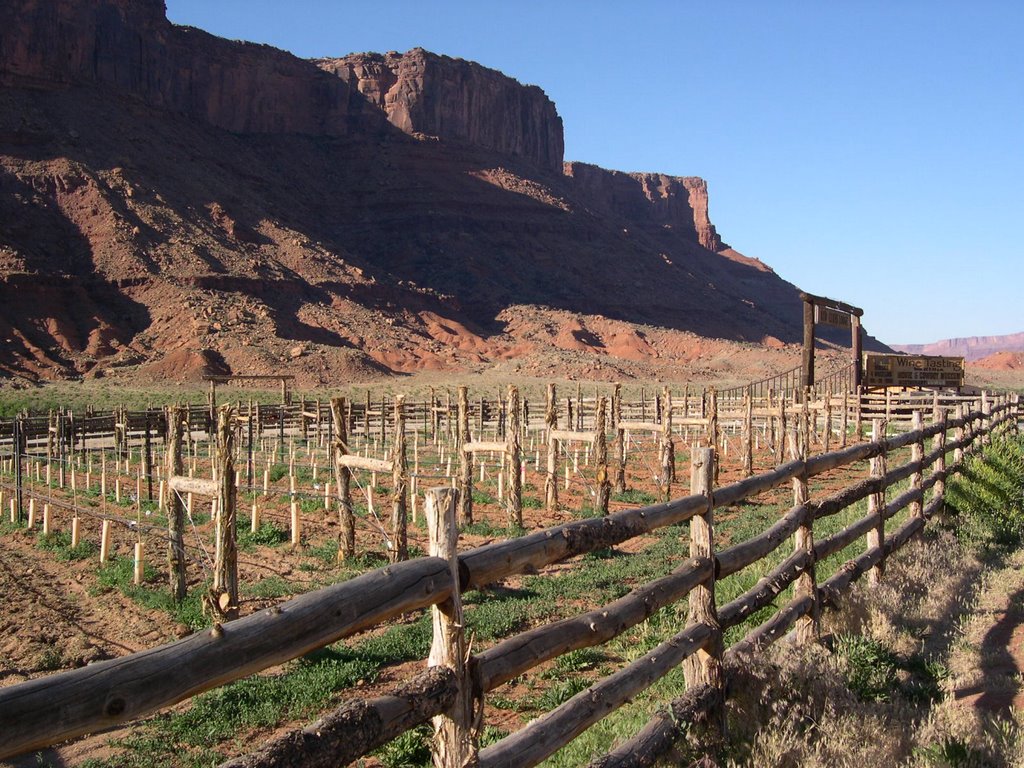
I visited two of Utah’s four “real” wineries (sorry, fruit wines don’t count) on a trip to Moab in May. The larger of the two, Castle Creek winery, was also the first commercial winery in the state. It’s in a lovely setting, along the Colorado River, northwest of Moab proper. The grounds include a lodge and a film museum, tracing the area’s history as a backdrop in Westerns. (The Marlboro Man ads were shot here.)

Production is small: Castle Creek only produces a total of 2000 cases of wine a year, produced from grapes grown in the Moab area. Some vineyards exist on the property (pictured above), but most fruit comes to the winery from local growers, some of whom grow grapes in their backyards or along fencelines. These are small, small suppliers. If you look for vast vineyards, you won’t find them. The white wines were superior to the reds — the “Lily Rose White” blend was full of fruit (like all wines here, actually) and easy to glug.
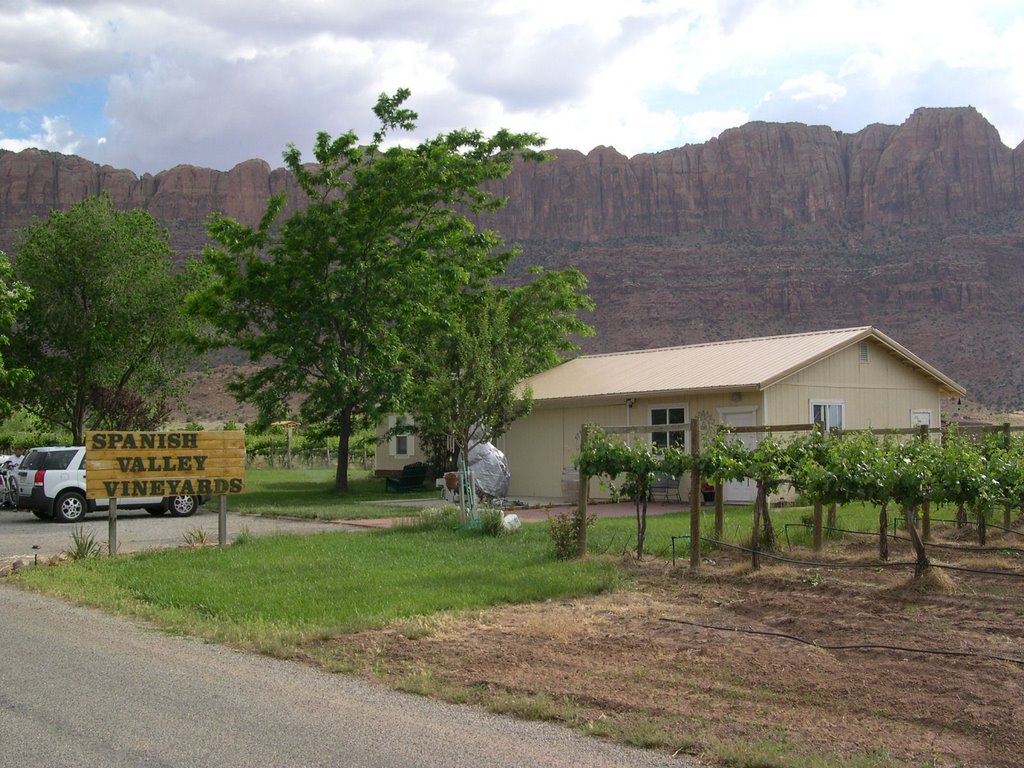
South of town, smaller Spanish Valley Vineyards only produces 700 cases. The co-owner, self-taught winemaker Cory Dezelsky, used to send his fruit across the state line to Colorado wineries in the Grand Junction area, but figured he could do as well or better making and selling his own wine.

The winery is tiny. Really, really tiny. The entire process, from crushing to fermentation to bottling, takes places within the confines of the small yellow house (pictured). Interestingly, Spanish Valley doesn’t age their wines in oak barrels, or even steel. They use plastic. (Fermentation en plastique!) The process works reasonably well for Dezelsky, especially for the dessert wines. Other wines are generally competent, though I would avoid the zinfandel at all costs.

Utah wines won’t be a sommelier’s pick at Per Se or Trotter’s anytime soon, but the wineries are run by motivated wine lovers who want to showcase their skills and local character. You won’t find a 98-point wine that you’ll want to cellar for years to come at either of these wineries, but no matter where you are, it’s nice to step out of the sun and into the tasting room.

–Mark Ashley

Dr. Vino 7/21 update: Congratulations, guest author Mark! This post was just named one of the “top five blog posts of the week” by Food & Wine magazine’s website!

tags: | |

The price is right, part deux

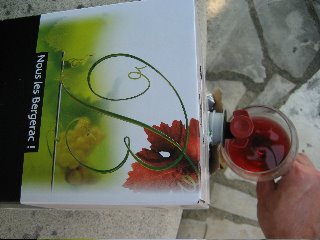
Congratulations to Jack of Fork & Bottle who correctly guessed the price I paid for the 5L box of rosé! Five liters, 12 euros, now that’s a price per ounce that I can drink to! At about $15 a box, that works out to the equivalent of about $2.25 a regular bottle.

The dry rosé was an appellation Bergerac wine from Chateau Tiregand ( find this wine). They actually sell a similar rosé in a bottle for 4.50 euros but why pay that when you can have a bag-in-a-box for your summer time refreshment? Kept on the fridge shelf, the rosé flows fresh for several weeks. Whenever a friend or neighbor drops by–bang!–a cool glass can great them upon arrival. I wish more restaurants would offer wine-by-the-glass from a bag-in-the-box–providing that it is worthwhile wine to start–since it solves the freshness problem that plagues many restaurants.

The rose is very dark in color in part since it is from malbec and cabernet franc grapes. If rosé is a wine that straddles red and white, this one leans much more toward red. It’s got heft–maybe even a little more than needed in the middle of summer (I was caught adding an ice cube to mine for chilling and diluting purposes–but hey at least it was an Evian ice cube!).

tags: | |

Dr. Vino for minister of information

In France, wine is a better way to riches than the internet. According to latest Challenges magazine, which ranks the 500 richest people in France, the first telecom fortune appears 15th on the list but the first purely internet fortune doesn’t appear until 233rd place. Thirty-one of the fortunes, by contrast, came from wine including nine of the top 100.

Couple underperformance in this powerful medium with a potential restructuring of the wine industry that could result in large job losses and there may be a winning idea: a blog in every pot.

There’s no excuse for the lamentable state of internet access today in (particularly rural) France. One good thing about the internet is that it empowers people in rural areas. Whether you’re buying an airplane ticket or selling hand-made ceramics, it doesn’t matter if you’re in Boston or Bergerac are as long as you’re online. Since part of the reason that the EU has subsidized low-end winegrowers is to prevent rural depopulation, introducing a national plan for broadband access would mean that, through some retraining, people–particularly young people–could stick around in the countryside. Skip manufacturing, which sucks people to factories and cities, and jump right to information technology. Graft a vitis vinifera onto American rootstock, as it were.

So here’s my proposal: take a fraction of the budget for rural development and run broadband wires into the countryside. In fact, don’t even run wires and just go straight for wi-fi. Have it free or low cost for people in their homes. It will be liberating to think about being online all the time for a fixed price instead of being charged by the minute as with phone service.

Need help or training local people? How about an internet training facility next to every tourist office with free access for locals and everybody else pays 3 euros an hour. Any country with 75 million tourists a year should have internet cafes at every turn.

Granted, visiting a room full of active eBay PowerSellers hunched over computers has no value for tourists–even if it were in Provence. But the project is more about getting at bounty of France on line, be it artisanal goods or even information (doing research on France can often dissolve into a dizzying spiral of frustrated google searches, followed by phone calls, and ultimately visits during the appropriate hours). In wine, since many appellation rules prevent the listing of grape varieties on the label, the web is a likely place to turn for such information–and it is the very rare AOC that has a comprehensive web site. Further, a small vigneron could take orders through a web site and relieve the burden on supply staff who are limited to 35 hour work weeks.

But my plan assumes too much of an “old-school” perspective in thinking of redirecting government funds. Really I should be more entrepreneurial. Maybe this idea would catapult me into the top 500 richest people of France? Excuse me while I go talk to venture capitalists…

tags: | |

The price is right

Tis the season–for dry rosé. And I’m doing my best to drain the wine lake while in France. Combine these two things and that means a whole lot of rosé.

I bought a 5 liter bag-in-a-box rosé from a winery last week just outside Bergerac. How much did a pay for it? Whoever is closest without going over (true Bob Barker style) gets a link back to their site–or your name in lights. I paid euros but will have my currency calculator handy to field dollar-based guesses.

tags: |

France 500 fortunes, wine version

Is wine a path to riches in France? The two-sided market that is French wine today, which sees some wines pre-release at $750 a bottle while other winemakers go out of business, has in fact made some of the richest people in France.

Fully 31 of the 500 richest people in France have a hand in the wine (or spirits) biz according to according to Challenges magazine dated July 13. Bernard Arnault, CEO of LVMH is the richest man in France according to the annual survey, with his 48% stake in the luxury goods company valued at over 17 billion euros.

Some other people on the list own chateaus, such as Serge Dassault and Francois Pinault, but I didn’t include them here since they made their fortune in other industries (aviation and retailing, in those two examples). Also, two barrel makers are on the list (Jean Francois and Henri de Pracomtal) but I didn’t include them either.

Sometimes the magazine includes “and family” but for the sake of brevity, I just include the individual.

Individual or family (500 rank), brands/company: net worth (millions of euros)

Bernard Arnault (1), LVMH–Moet Hennessey: 17,205
Patrick Ricard (26), Pernod-Ricard: 1,278
Pierre Castel (28), Castel Freres: 1,200
Chandon-Moet and Hennessy families (45), LVMH: 905
Dominique Herlard-Dubreuil (53) Remy Cointreau: 726
Jean-Claude Rouzaud (88) Louis Roederer champagne: 375
Bernard Magrez (96) Pape-Clement: 335
Eric de Rothschild (100) Lafite Rothschild: 311
Corinne Montzelopoulos (116), Chateau Margaux: 260
Nonancourt family (146), Laurent Perrier champagne: 202
Paul-Francois Vranken (191), Vranken champagne: 154
Albert and Robert Cohen-Skalli (194), Les Vins Skalli: 150
Philippine de Rothschild (194), Baron Phillippe de Rothschild: 150
Pierre Cointreau (233), Remy Cointreau: 127
Michel Reybier (242), Domaines Reybier: 120
Lurton family (276), Andre Lurton Vignobles: 100
Bollinger family (310), Bollinger champagne: 90
Jacques Marnier-Lapostolle (324), Grand Marnier: 85
Antoinette Coury (329), Grand Marnier: 83
Carol Duval-Leroy (336), Duval-Leroy champagne: 80
J. Helfrish and G. Bimmerle (336), Grands Chais de France: 80
Bruno Paillard (355), Boizel Chanoine champagne: 78
Christian Moueix (374), Antoine Moueix et fils: 72
Gerard Perse (376), Chateau Pavie: 70
J-H Delon and G. d’Alton (402), Ch Leoville Las Cases: 65
Jean-Michel Cazes (426), Ch Lynch Bage: 60
Jean Pol-Roger and C. de Billy (426), Pol-Roger: 60
Didier Cuvelier (457), Leoville-Poyferre: 55
Leroy and Villaine families (477), Romanee-Conti: 54

tags: | |

Malbec match-up

How do winemaking and terroir affect malbec? We put this to the test recently with a leading wine from Argentina’s Mendoza region and the Cahors in France where the grape is also known as cot.

On my trip to Mendoza earlier this year, one of the most exciting wineries I visited was the Clos de los Siete project. Seven French investors, including many wine making families such as Rothschild (Lafite) and Cuvelier (Poyferré) joined forces under the teutalage of Michel Rolland, the “flying winemaker” par excellence who is also a stakeholder. They bought a vast plot of 850 heactares (over 2000 acres) in the Val de Uco at the base of the Andes and planted a small sea of vines, mostly malbec.

Each of the families either makes or will make their own wine but collectively they pool some grapes to make the Clos de los Siete wine, available for about $15 (Find this wine). This 2003 is mostly malbec but also includes some cabernet sauvignon, cabernet franc, and some syrah (!).

Against this wine, I poured blind the 2002 Clos la Coutale, which I bought in NYC for about $12 (Find this wine). From Cahors, the Clos La Coutale, a blend of mostly malbec with a little merlot and cab franc, is imported to the US by Kermit Lynch.

One wine exploded with rich aromas and flavors of violets, blackberries and tobacco from the glass. It had a round, soft complex mouthfeel and a good finish. The second wine was inky dark in color, and had a much more truncated flavor range with a certain tartness on the finish.

After the unveiling, wine #1 was the Clos de los Siete and wine #2 was the Cahors.

Although the malbec from Mendoza showed better that evening, a note of caution is necessary because of the 15 percent alcohol stated on the label. It’s big. The complexity would probably make a great BBQ wine for those tired of zinfandel.

This wine reminded me of a Cadillac Escalade: it’s fun to take it for a spin once, but who wants to own it and pay the gas bill? Drink too much of this one and you may be paying for it the next day.

* * * * *

Now in France, I found a bottle of the Clos la Coutale 2003 and tried it. The bottle showed much better–more full-bodied, more round, more complex, and even “bigger.” Pity I couldn’t taste this much better vintage against the Clos de los Siete. Especially since I got it for 7 euros ($8.90). Ah well, I’ll throw it in a future malbec match-up with some more wines from the two regions.

tags: | |

Explore Perigord

The Perigord–aka the Dordogne–specializes in three declining agricultural products: wine, tobacco, and foie gras. Although wine consumption is rising in the US, it is headed the other way in France. Grape vines used to be more abundant up the Dordogne River in centuries gone by but now it is pretty much limited to the thirteen appellations around Bergerac. Bordeaux lies downriver what is today a couple of hours drive. Cahors and its vineyards lies to the south on the River Lot but several wines are available in the Dordogne. I’m tasting through many of these wines and some of my notes and picks will follow.

Originally imported from America, the producers in the region used to make dark tobacco that was a specialty of French cigarettes (think Gauloises). But dwindling demand for that has led growers to transition to lighter varieties for the international market–or stop production altogether.

The Perigord has typically been a center for foie gras production. This, the object of American bans and boycotts, is produced and consumed throughout the region. More on this fascinating subject too in future postings.

The region is also known for other gastronomic delights including its walnuts, truffles and strawberries. We bought some strawberries in town over the weekend and finished the whole box before we got back to the kitchen. They are like candy. It’s great to have real strawberry flavors. Too often at home strawberries look pumped up and are strangely white inside and relatively flavorless.

I have managed to find a way on to the internet so I can resume a more normal schedule of posting . Although we’ll see just how normal–excuse me while I go get the rose…

tags: |

Dr. Vino, unplugged

I am currently in foie gras country in the south of France. I understood that there was going to be limited internet access but instead there is NONE! Yes, several years ago we logged on to the Net from a shack on the beach in Thailand, but alas, internet access and even cafes (of the internet variety) are hard to come by here…

I’ll save my tales and post when I can.

Cheers,

Dr. Vino

tags:


winepoliticsamz

Wine Maps


Monthly Archives

Categories


Blog posts via email

@drvino on Instagram

@drvino on Twitter


winesearcher

quotes

One of the “fresh voices taking wine journalism in new and important directions.” -World of Fine Wine

“His reporting over the past six months has had seismic consequences, which is a hell of an accomplishment for a blog.” -Forbes.com

"News of such activities, reported last month on a wine blog called Dr. Vino, have captivated wine enthusiasts and triggered a fierce online debate…" The Wall Street Journal

"...well-written, well-researched, calm and, dare we use the word, sober." -Dorothy Gaiter & John Brecher, WSJ

jbf07James Beard Foundation awards

Saveur, best drinks blog, finalist 2012.

Winner, Best Wine Blog

One of the "seven best wine blogs." Food & Wine,

One of the three best wine blogs, Fast Company

See more media...

ayow150buy

Wine books on Amazon: