French microbrews

What do you do when it is 97 degrees outside and there’s no AC? And combine that with stumbling on a new shop specializing in microbrews? There’s only one answer: comparative beer tasting!

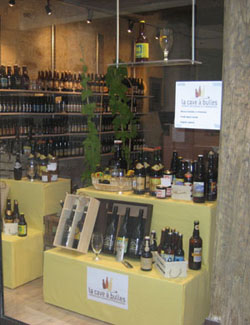
Walking along a narrow street not far from the Pompidou Center (Beaubourg) I found La Cave a Bulles, which had a strategic location right across from the Belgian cultural institute. The gregarious and knowledgeable Simon Thillou opened the store on July 18th and he has hundreds of “artisanal” beers in stock, mostly from France but some from Belgium too. Simon said that 20 years ago there were only 20 beer producers in France but that today there are over 200. Sure, it’s not much compared to the number of microbreweries in the US, but it is still good growth.

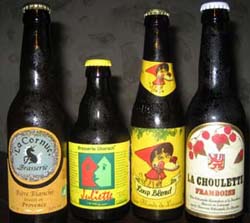
So I put him to the test: give me four summer beers, two lagers, one white beer, and a fruit beer. This may seem kinda like trying to find the best burrito in France, but hey, the circumstances presented themselves.

Sadly, the results were not good. La Cornue from Provence, the biere blanche was not a blanche as some others I’ve had (e.g. Hoegaarden) and had some aromas that were distinctly unusual, if not off. Juliette, the first lager tasted artificial, like the fake scents of a cleaning solution (pine). Loup blond, which has a great label, was sort of cidery and the least offensive of the tasting. Hardly high praise. Finally, the framboise again tasted artificial, and didn’t cohere, like a mediocre lager with a shot of raspberry.

Perrier anyone? Despite these results, I would definitely go back and visit Simon again and try some more. After all, there are still 196 bottles of beer on his wall.

La cave a bulles
, 45 rue Quincampoix, 75004 Paris tel: 01 40 29 03 69

tags: | |

Reader mailbag: traveling to Spain


tlc in Minneapolis writes:

For spring break I will probably go to Spain since one of my friends will be there next year on a Fulbright. Some mutual friends who like wine are seriously considering doing the trip with me. So let me ask you for recs on Spanish wine regions that would be nice to visit in March! My colleague will be based in Madrid but I’d have about 7-10 days so could get out and about a bit.

Shazza in London writes:

Any tips for travel in Rioja? I’ll be there in October.

* * * *

If I were vactioning in Spain, based in Madrid and interested in seeing Spanish wineries, I might be tempted to go to Ribera del Duero since it is a little closer and a very exciting region. In fact, the whole Duero/Duoro region is fascinating, but I’ll post more on that in October.

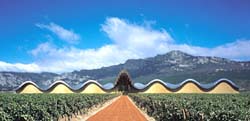
Visitng the grande dame La Rioja could also be good. At least one thing makes traveling there exciting now: a new museum/winery extravaganza designed by Frank Gehry. I saw a model of it at the MOMA exhibit earlier this year about New Spanish Architecture. But as of September 17 it will be open to visitors. I doubt it will do for tourism in La Rioja what Gehry’s Guggenheim did in Bilbao (the world has had a whole lot a Gehry since then) but it will certainly motivate some people to check out this wine region.

Decanter magazine recently described Gehry’s having “designed the roof of wave-shaped titanium sheets in homage to the flowing skirts of Flamenco dancers.” Um, I sincerely hope that is not the case since flamenco is from Andalucia, all the way on the other side of Spain. Maybe Gehry had already had a little too much tempranillo.

So where to visit? (town name in parentheses)

Marques de Riscal (Elciego): Leading producer in the modern style and with the Gehry museum/hotel/spa, why not schedule a tour and a vinotherapy treatment.

Muga (Haro): the classic “old school” producer was brought, the story goes, a bottle of Napa cab by its importer and told to replicate it. Hence Torre Muga, their high-end wine. Otherwise a traditional producer. Try the Prado Enea as well as one of the whites.

Lopez de Heredia (Haro): Founded in 1887, they still use traditional methods. Very cool. Definitely try a white.

Marques de Murrieta (Logrono): Old oak barrels and stainless steel can be seen here in this atmospheric castle; try the Castillo de Ygay, red and white.

CVNE (Haro): Old company that got a new winery in 1989 with gravity moving the wine from one stage to the next.

Granja de Nuestra Señora de Remelluri (Labastida): A newer producer that is a Parker fave; very pretty location.


Ysios (Laguardia): If you haven’t had your fill of wineries designed by world-class architects, then check out this futuristic wave-like winery, designed by Santiago Calatrava. Now part of Pernod-Ricard.

With all of these wineries, it’s best to plan ahead and reserve for a tour if necessary. And surf on over to Catavino and drop Ryan a line and see what he has to say.

What are some of your favorite spots in La Rioja?

Send in your questions.

tags: | | |

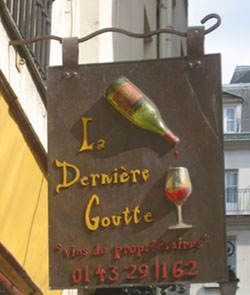
La Derniere Goutte, Paris


American wine geeks will feel at home at La Derniere Goutte. And it’s not because the name—the last drop—evokes an American ad campaign of a bygone era. It’s thanks to the fact that the owner speaks perfect English, since he is an American.

Juan Sanchez started his first wine shop in Paris 13 years ago in the charming streets of the Latin Quarter. After three years at one location he moved around the corner and started La Derniere Goutte. He has been sourcing wines from boutique producers ever since.

The small, climate controlled shop has a great selection of wines from independent growers particularly from the Languedoc and the Rhone. Many of the growers practice wine making that uses little intervention in the vineyard and in the winery.

And many of the producers aren’t imported to the US so you can keep WAY ahead of the Jonses. Have you ever wanted to try a champagne from Anselme Selosse for example? Juan has several as well as other champagnes made by the growers themselves (not the norm in Champagne where the big houses prevail). It’s a good thing he offers a tax refund of 13 percent for purchases over 120 euros.

Beyond simply having great wines, Juan and his staff make it easy for you to actually buy them on a tight travel schedule since they’re one of the few Paris (wine) shops open on Sundays. And oh yeah, if you’re local, they deliver too. How about that for convenience!

6, rue de Bourbon le Chateau, 75006 Paris
tel : 01 43 29 11 62

* * *

Juan is also a partner in the restaurant Fish, just around the corner on rue de Seine. Located in an old fishmonger’s store with ornate tile work on the façade, the food and service on the inside are just as refreshing as the air conditioning. We enjoyed the Domaine Roquefort rose from Provence (find this wine), which is available by the glass, carafe, or bottle. The friendly staff pour natural wines from the list and would no doubt welcome naturalistas seeking glass when the restaurant is not in full swing. You may even see Juan there after the shop closes.

A bit of trivia: directly across the street from Fish is a sandwich shop called Cosi. They bake their own flatbreads in the oven and offer a menu of light fare. Sound like the publicly traded American company by the same name is following Starbucks and making inroads into France? Actually it is the other way around in this case. This location spurred American investors to buy the rights and turn it into a hugely successful business in the states.

Fish, La Boissonnerie, 69, rue de Seine 75006 Paris. Tel : 01 43 54 34 69

tags: wine | wine shops | natural wines | Paris

Reader mailbag: biggest wine store in the world

Icosta from San Pedro de Atacama, Chile writes:

Which is the biggest wine store in the world?
Thank you very much!!!!

Wow! Great question!

Of course Costco and Sam’s Club (Wal-Mart) are the largest retailers of wine in the US but their stores could hardly be considered wine stores even though they have some wine in them.

The biggest store that is devoted mostly to wine sales that I have been in has to be Sam’s Wine and Spirits in Chicago (privately owned by the Rosen family, not part of Wal-Mart despite the similarity in names). It’s like an airplane hangar filled with wine and spirits and beer. It’s got 9,500 wine SKUs in 25,000 sq ft and has to be one of the largest in the world if not the biggest. It grossed $60 million in 2004 and the Rosens opened a new location in 2005 and 2006, also in the big box format.

One of the NYC area stores may be as big in revenues but none competes in terms of square footage. Perhaps one in LA? Or a BevMo? Bottle Barn?

Perhaps there are bigger ones outside the US? What do you think? I’m sure whichever wine store it is would love to have bragging rights.

Send in your questions.

tags: |

Tasting sized pours

Think pink: The NYT discusses trendy rosé and the $30 Domaines Ott. Lettie Teague is quoted saying, “‘An expensive rosé is oxymoronic,’ she said. ‘Domaines Ott is good but not so significantly better than wines that are $10 cheaper or half the price.’ She suggested that Domaines Ott is ‘a good wine for those psychologically unprepared to drink rosé, because it’s so beautifully packaged and expensive.'” [NYT] I agree. Sorry, “D.O.” my picks can save you over $20 a bottle. All together now: do not overpay for a dry rosé!

Randall Grahm cashes out: Big House Red and Cardinal Zin are jettisoned from the Bonny Doon portfolio and sold to The Wine Group. Perhaps Grahm can now focus more on his biodynamic vineyards? [WBM]

Bordeaux adds a vin de pays category called vin de pays de l’Atlantique. More varietal labeling to come. [Vitisphere]

Beer regains the lead: a Gallup poll this year showed beer to be the drink of choice by 41-33-23 breakdown over beer-wine-spirits. Last year wine edged out beer for the first time. [WBM]

Illinois beer distributors, who are against shipments directly from wineries to consumers, have made record contributions to state legislators. [StL Today]

Illinois also approved a “doggie bag” bill so that diners can take an unfinished bottle home with them–just don’t forget to put it in the trunk! [Sun-Times]

Evan Rail chugs 70 cent beers on a quest for the best brew in the Czech Republic. Is this a new wave in going to the winery brewery? [NYT]

Jeffrey Stambor, winemaker at Beaulieu Vineyard in Napa, tells the NYT about his favorite travel companion: wine, particularly the rare and valuable. [NYT]

Blogging is economically rational!
The Economist says so! [Economist]

UPDATE: A comment from Pat expressed the opinion that because the fasionistas at the New York Times (hear my Stephen Colbert impression) liked Domaine Ott rosé, that means it’s out. A good point. Fashionistas may know their Dolce from their Gabbana but as we saw earlier this year, they also fell for the “Eccotini” brought to them by Gallo.

tags: | |

Keeping up

On Friday I sent out the latest installment of my vinogram, the free monthly email that clutters up your inbox and keeps you apprised of Dr. Vino doings. If you want to subject yourself to this, then surf on over to www.DrVino.com and enter your email address in the top right. If I were more technologically savvy, then I would give you the chance to do that on this page. Your email address is safe: I promise to never to sell nor exchange, lend nor lease, truck nor barter the email list. There are other ways to keep up with the site:

Dine-in: bookmark this page and check back often!

Delivery: sign up to read the “feed” from the site as it rolls out. Bloglines is the most popular feed reader for subscribers, but Netvibes, My Yahoo!, and Firefox live bookmarks are also well used. Mmm…Feed…Delivery…

Mail: If you are mysteriously hooked to this web site, you can have every posting automatically sent on your Outlook or crackberry via Squeet, a service that sends site feed via email.

Any which way, thanks for your support and comments!

tags: |

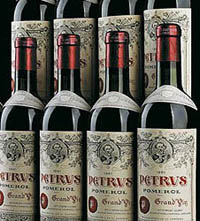
Wine or a new car?


One case (12 bottles) of Chateau Petrus 2005 futures (wine arrives in 2008): $24,000 at Morrell’s Wine in NYC (currently sold out)

2006 VW Jetta: $23,790 sticker price (available now, any color).

See some of my other posts on the insanity and the misery of Bordeaux 2005

tags: |

Goose gitmo

[Caution: potentially disturbing photos follow the text]

Foie gras has emerged as a searing flashpoint in America where the Chicago city council has banned it and the California legislature has told the two resident producers to leave the state. Their logic is one of animal rights: cruelty to geese and ducks through force feeding that enlarges their livers to ten times the normal size.

I had abundant opportunity to sample foie gras while I was in the Dordogne region of France last month. But beyond simply eating it, I could see how it is made since it is one of the main agricultural products of the region. The characteristic low-slung, windowless barns that are the sites of the force feeding punctuate the rural landscape.

An American might suspect the barns to be underground bunkers or out of view as a refuge against rampaging hordes of activists from the animal rights group PETA. In fact, many producers hang signs to encourage visits, motivated in part by the high profit margin of selling directly to the consumer. I stopped by one producer who had a small sign in the window to his sales room: gavage 11:00 AM and 6:00PM.

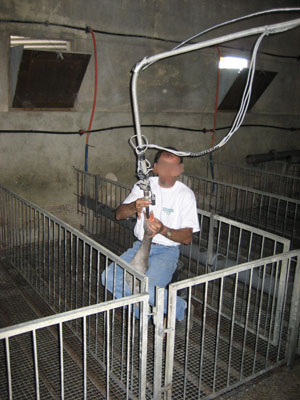
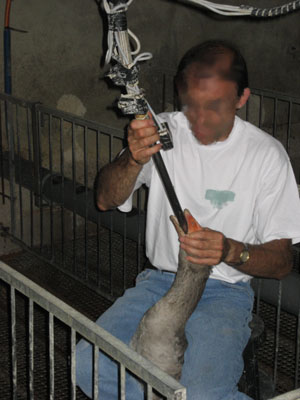
Gavage is the process of force feeding the geese during the last month of their lives. I was intrigued that the producer would invite us into this goose gitmo. Did I have the stomach to see such a controversial practice in action? The rest of my family opted for a swim. I returned to the farm at 6 PM.

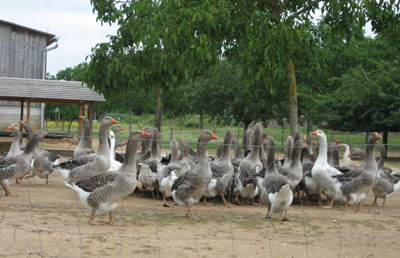
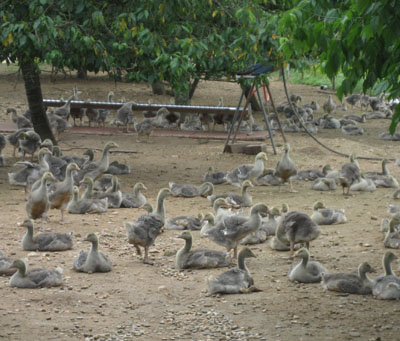
The geese were distributed in two large, open fields. The fluffy young ones were on one side. At about eight weeks old, they are moved to the other field for the final month before heading to the gavage barn. These were Toulouse geese, gray in color with darker plumage in the wings, a white undercarriage, and an orange bill and orange feet. The older ones already had a formidable waddle in the low-hanging bellies that almost touched the ground.

The several hundred geese in both areas had abundant food and water and could eat at will. They were outside and could roam freely. Their heads were bobbing up and down out of the water trough on the hot day. And they were loud. I hadn’t heard this much honking since I left Manhattan.

Two French couples (and a pet dog) had turned up as well and at about 6:20 the farmer arrived to lead us around. He was very open in describing the process and answering questions. One of the others in the group asked about American protests and the farmer said that he didn’t really care since none of his sales went to America. All of his sales were direct from of his shop adjacent to the large goose pastures.

Further, he said that French media coverage of American boycotts and bans devastating the industry was overblown since only four percent of French foie gras was exported to the US. Unlike cognac, which the French make for the rest of the world with 95 percent of production exported, the French tend to make foie gras for themselves, making 70 percent of the world’s production and eating 85 percent of it (Hungary helps fill the gap). According to a well-written story by Mike Steinberger in the Financial Times, the French National Assembly declared foie gras “a cultural and gastronomic patrimony protected in France” last October.

The farmer then picked a goose by the wings and we then moved into the gavage barn, which was mercifully empty and surprisingly dark. Although there were still geese on the farm, the farmer didn’t do gavage during July and August to take a vacation for himself and the staff.

After three months in the open, the geese are escorted to the gavage barn and put twelve per pen. He explained that they are gregarious and that’s why they are kept together. They are then force-fed four times a day with a machine operated by a person in the pen with the geese. The food is corn, starchy, empty calories good for fattening he said. This stands in contrast to the balanced diet that the geese received while they were outside.

The farmer said that the geese do not have the ability to swallow, which explains why their heads bobbed at the water trough outside: they filled their mouth and gravity took the water down. Nor do they have a gag reflex, which is apparently linked of the ability to swallow. No peristalsis, no reverse peristalsis. He said that conditions were worse for ducks (whose livers are also valued and he does not have) since they are smaller and have less of a group mentality they are force fed mechanically and kept in smaller pens with more per shed.

Whether or not having a feed tube shoved down the throat causes pain to the birds, the fact that they are kept in the dark for this last month of their lives, fed four times a day and rapidly put on weight cannot be pleasant. In the end they are slaughtered and a new group is brought in.

What’s interesting from a socio-economic point of view is that the nature of the French farm is changing. The farmer told us that a generation or two ago, a farmer would have a limited number of diverse livestock and would force-feed a goose in time for Christmas. But now there is increased specialization among farmers. He started only a decade ago. His neighbors around him grow only corn.

Back in America, what’s motivating the foie gras protesters and the legislators? Is foie gras production really any different than the inhumane conditions that exist for veal? Or other livestock from poultry to hogs to cattle? (As vividly shown in Michael Pollan’s The Omnivore’s Dilemma or Eric Schlosser’s Fast Food Nation among other places) Will osso buco be coming into the sights of legislators?

Probably not. The trouble with arguments that suggest foie gras is the thin edge of the wedge is that it is just so thin–the amount of foie gras consumed in America is miniscule. And that’s a part of what appeals to activists and legislators alike: it’s easier to take on the three American producers of foie gras than it is the National Cattlemen’s Beef Association.

But it is instructive—nay, essential—to know where food comes from. That’s why I signed up for the gavage tour. Meat, while it’s alive is a lot different from meat in a confit jar or under plastic wrap in the supermarket. If everyone were more aware, more people might choose to be vegetarians. Or not. After all, Michael Pollan still eats meat and Eric Schlosser still eats hamburgers. But it would be an informed choice.
tags: | | |


winepoliticsamz

Wine Maps


Monthly Archives

Categories


Blog posts via email

@drvino on Instagram

@drvino on Twitter


winesearcher

quotes

One of the “fresh voices taking wine journalism in new and important directions.” -World of Fine Wine

“His reporting over the past six months has had seismic consequences, which is a hell of an accomplishment for a blog.” -Forbes.com

"News of such activities, reported last month on a wine blog called Dr. Vino, have captivated wine enthusiasts and triggered a fierce online debate…" The Wall Street Journal

"...well-written, well-researched, calm and, dare we use the word, sober." -Dorothy Gaiter & John Brecher, WSJ

jbf07James Beard Foundation awards

Saveur, best drinks blog, finalist 2012.

Winner, Best Wine Blog

One of the "seven best wine blogs." Food & Wine,

One of the three best wine blogs, Fast Company

See more media...

ayow150buy

Wine books on Amazon: