[Caution: potentially disturbing photos follow the text]
Foie gras has emerged as a searing flashpoint in America where the Chicago city council has banned it and the California legislature has told the two resident producers to leave the state. Their logic is one of animal rights: cruelty to geese and ducks through force feeding that enlarges their livers to ten times the normal size.
I had abundant opportunity to sample foie gras while I was in the Dordogne region of France last month. But beyond simply eating it, I could see how it is made since it is one of the main agricultural products of the region. The characteristic low-slung, windowless barns that are the sites of the force feeding punctuate the rural landscape.
An American might suspect the barns to be underground bunkers or out of view as a refuge against rampaging hordes of activists from the animal rights group PETA. In fact, many producers hang signs to encourage visits, motivated in part by the high profit margin of selling directly to the consumer. I stopped by one producer who had a small sign in the window to his sales room: gavage 11:00 AM and 6:00PM.
Gavage is the process of force feeding the geese during the last month of their lives. I was intrigued that the producer would invite us into this goose gitmo. Did I have the stomach to see such a controversial practice in action? The rest of my family opted for a swim. I returned to the farm at 6 PM.
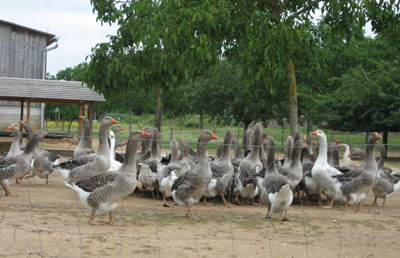
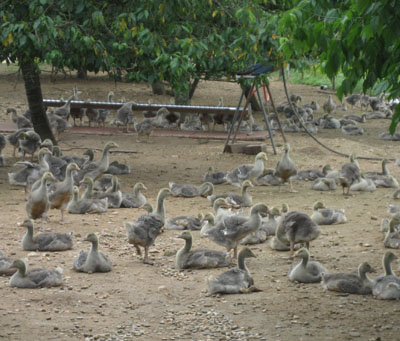
The geese were distributed in two large, open fields. The fluffy young ones were on one side. At about eight weeks old, they are moved to the other field for the final month before heading to the gavage barn. These were Toulouse geese, gray in color with darker plumage in the wings, a white undercarriage, and an orange bill and orange feet. The older ones already had a formidable waddle in the low-hanging bellies that almost touched the ground.
The several hundred geese in both areas had abundant food and water and could eat at will. They were outside and could roam freely. Their heads were bobbing up and down out of the water trough on the hot day. And they were loud. I hadn’t heard this much honking since I left Manhattan.
Two French couples (and a pet dog) had turned up as well and at about 6:20 the farmer arrived to lead us around. He was very open in describing the process and answering questions. One of the others in the group asked about American protests and the farmer said that he didn’t really care since none of his sales went to America. All of his sales were direct from of his shop adjacent to the large goose pastures.
Further, he said that French media coverage of American boycotts and bans devastating the industry was overblown since only four percent of French foie gras was exported to the US. Unlike cognac, which the French make for the rest of the world with 95 percent of production exported, the French tend to make foie gras for themselves, making 70 percent of the world’s production and eating 85 percent of it (Hungary helps fill the gap). According to a well-written story by Mike Steinberger in the Financial Times, the French National Assembly declared foie gras “a cultural and gastronomic patrimony protected in France” last October.
The farmer then picked a goose by the wings and we then moved into the gavage barn, which was mercifully empty and surprisingly dark. Although there were still geese on the farm, the farmer didn’t do gavage during July and August to take a vacation for himself and the staff.
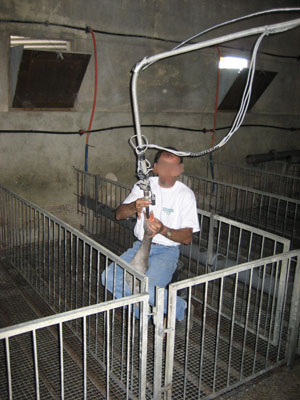
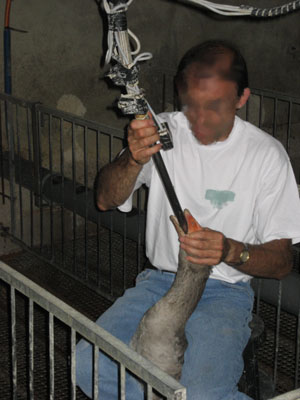
After three months in the open, the geese are escorted to the gavage barn and put twelve per pen. He explained that they are gregarious and that’s why they are kept together. They are then force-fed four times a day with a machine operated by a person in the pen with the geese. The food is corn, starchy, empty calories good for fattening he said. This stands in contrast to the balanced diet that the geese received while they were outside.
The farmer said that the geese do not have the ability to swallow, which explains why their heads bobbed at the water trough outside: they filled their mouth and gravity took the water down. Nor do they have a gag reflex, which is apparently linked of the ability to swallow. No peristalsis, no reverse peristalsis. He said that conditions were worse for ducks (whose livers are also valued and he does not have) since they are smaller and have less of a group mentality they are force fed mechanically and kept in smaller pens with more per shed.
Whether or not having a feed tube shoved down the throat causes pain to the birds, the fact that they are kept in the dark for this last month of their lives, fed four times a day and rapidly put on weight cannot be pleasant. In the end they are slaughtered and a new group is brought in.
What’s interesting from a socio-economic point of view is that the nature of the French farm is changing. The farmer told us that a generation or two ago, a farmer would have a limited number of diverse livestock and would force-feed a goose in time for Christmas. But now there is increased specialization among farmers. He started only a decade ago. His neighbors around him grow only corn.
Back in America, what’s motivating the foie gras protesters and the legislators? Is foie gras production really any different than the inhumane conditions that exist for veal? Or other livestock from poultry to hogs to cattle? (As vividly shown in Michael Pollan’s The Omnivore’s Dilemma or Eric Schlosser’s Fast Food Nation among other places) Will osso buco be coming into the sights of legislators?
Probably not. The trouble with arguments that suggest foie gras is the thin edge of the wedge is that it is just so thin–the amount of foie gras consumed in America is miniscule. And that’s a part of what appeals to activists and legislators alike: it’s easier to take on the three American producers of foie gras than it is the National Cattlemen’s Beef Association.
But it is instructive—nay, essential—to know where food comes from. That’s why I signed up for the gavage tour. Meat, while it’s alive is a lot different from meat in a confit jar or under plastic wrap in the supermarket. If everyone were more aware, more people might choose to be vegetarians. Or not. After all, Michael Pollan still eats meat and Eric Schlosser still eats hamburgers. But it would be an informed choice.
 tags: food | foie gras | France | activism
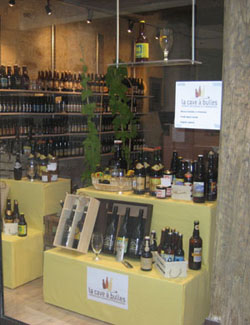 What do you do when it is 97 degrees outside and there’s no AC? And combine that with stumbling on a new shop specializing in microbrews? There’s only one answer: comparative beer tasting!