Wine quiz winners

The quiz is over! Long live the quiz!

Mark in Chapel Hill, North Carolina was selected at random as the winner of the Oxford Companion to Wine! All hail Mark’s wine geekdom! Chris Craig! from the UK won the second book prize. We are still working out whether elves can bring books to England.

Thanks for all of your participation in the quiz this time around. Clearly it was too easy for all you sharp wine enthusiasts this time since it had the highest success ratio by far of any quiz to date (see the answers here or head to the wine quiz archive if you are still jonseing). But still your chances of winning either prize were much better than the lottery.

Sign up for the free monthly email list to keep posted on future quizzes. Happy reading Mark and Chris! We look forward to your tasting notes book reports.

tags: |

Holy Cheval Blanc, Batman!


You may have been disappointed that I only mentioned the 50 case lot of 1982 Mouton that sold for $1.05 million after it happened.

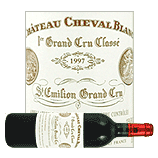
Here’s some new extravagance for you — one lot of 11 vintages of Cheval Blanc vertical from 1995-2005 (hey, wait, are those futures for the 04 and the 05? Make that 9 bottles and two bottles yet to arrive.) And, oh yeah, these are all enooooormous 18 liter bottles. The estimate is $750,000 – $875,000. There have been no bids thus far. Everybody must be waiting to snipe it. Twenty percent of the proceeds benefit a charity.

The craziest thing about this auction is that it’s through the online auctioneer, winecommune.com! See the lot listing. If they sell this lot, the internet wine auction may have come of age! If not, it will be back to the regular sized bottles for them…

What are you waiting for? It’s 1 day, 12 hours, 57 minutes, 9 seconds until bidding is over! And no buyer’s premium! (The seller’s premium in this case is six percent or less.)

Fwiw, Steve at Vinfolio reckons that the most this lot is worth for the wine itself is $226,380. Ha, much more reasonable!

tags: |

Squeezing the small suds


This is not a beer blog. But we can commiserate with our hops and barley brethren and sist’ren on occasion. (I even posted about French microbrews this summer.) Looking at a recent story about beer is especially important since it sheds light the political construction of alcohol markets in the US.

The Chicago Reader has a cover story about how the owner of Bell’s, a popular beer from Michigan, has withdrawn from the large Chicago market because of distributors. Roll the tape:

Until October Bell’s was distributed in Chicago by Union, which is owned by National Wine and Spirits. (NWS is currently enmeshed in court proceedings; NWS vice president Greg Molloch says a gag order prevents him from commenting for this article.) Bell was happy at NWS. But according to state law, NWS was entitled to sell Bell’s distribution rights to another wholesaler without his approval, and a few months ago it decided to do just that, in a deal with Chicago Beverage Systems— the Miller distributor in Chicago. CBS is part of Reyes Holdings, the biggest beer distributor in America and, according to Crain’s Chicago Business, the biggest privately held company in town.

…People in the industry are skeptical about whether CBS can properly distribute these smaller brands. “What they do, before they started dabbling [in regional beers], they did very well,” says Laura Blasingame at the Map Room. She buys Heineken and Amstel from CBS. “Those brands are hard to mess up. CBS takes care of beers that don’t need as much love. I understand why Larry Bell would be nervous. I don’t know if they really know how to handle craft beer.” CBS officials didn’t answer questions on its approach to distributing craft beer.

State law says that a distributor can drop (or better yet, sell the rights to) a brewery at any time. But outside of identifying “just cause” like gross professional misconduct— such as selling beer past its sell-by date—there’s no easy way for a brewery to dump its distributor.

Check out the whole story. It has sad parallels to the wine biz…

Thanks, Mark!

tags: | |

Say g’day, bonjour, or hola to “American” wine

Trivia: When is an American wine not an American wine?

Answer: When it is from overseas!

According to federal regulations on labeling, for a wine to be labeled as generic “American wine” only 75 percent must come from the good old US of A. According to the TTB, they don’t have a rule on where the other 25 percent comes from. Hmm, truthiness…

This is now being exploited by California producers according to a story on Decanter.com. In the story, an unnamed source cites The Wine Group’s Franzia brand as exploiting the regulatory gap. The California Association of Winegrape Growers is lobbying against it. Bulk wine imports are up 229 percent in the past year according to the story. Meanwhile California had a bountiful harvest last year.

It’s hard to get fired up over jug wine. But American jug wine needs to be all American, dammit! Call your member of Congress and tell him or her to put this issue ahead of a flag burning amendment.

Or just tell the wine regulatory authority, the TTB, that you are for truth in labeling.

phone: (202) 927-8210
Fax: (202) 927-8525
ttbquestions@ttb.treas.gov

tags: |

Tasting sized pours — tasting edition

Until my post in the next couple of days about gift wines, here are a couple wine pick articles that should tide you over:

* NPR: Holiday wine. Bryan Miller offers some solid, general suggestions. No audio. But you can listen here to the hilarious Amy Sedaris taking a literary drinking quiz! No wait, take my pop-culture wine quiz!

* WSJ: The inveterate John & Dottie present a case for under $150–now that’s my kind of thinking! (See my case of fall wine picks or last year’s wintry case) Unfortunately their picks are not available online, only in the dead-tree edition or behind a pay barrier, but I do recommend the general idea of giving a well-chosen mixed case as a way to give a gift that makes an impact–and not just on the carpet where it lands.

Also, taste some wines free of charge tonight at Astor Wine & Spirit: “small grower champagnes,” their “French favorites,” and some of that throat-warming fire water, cognac, including some XO Tesseron from the 20s, 50s, 70s, and 90s! All free, the first two with discounts for wine purchased. 6-8 PM today. I’m just sorry I can’t make it. Map it.

tags: | |

Terry Theise and his merry band of small growers


LVMH, the global luxury goods company, has a 60 percent market share of champagne sales in the US according to the IMPACT databank 2005. Their brands include such names as Veuve Clicquot, Dom Perignon, and Moet. They’re big.

Moet, like the other grandes marques, has been fabulously successful thanks to mostly buying other people’s grapes and then blending wine. In fact, the brand management has been so successful that the big champagne houses are among the most successful brands in the wine business: wide name recognition, relatively high volume, and selling at a high price point. They’ve hit the economic sweet spot. Moet sold 600,000 cases in 2005 in the US and the average retail price of each bottle was $43.50 according to Impact.

On the other end of the champagne continuum is a merry band of small growers. No, they’re not an elf-like 3’9″–they just don’t make a lot of bubbly. But that’s also a point of difference. Like a traditional “chateau,” they grow their own grapes and make their own wine.

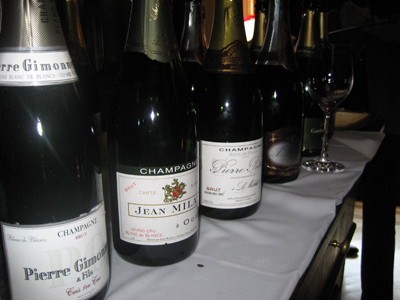
Terry Theise, known for importing fine wines from Germany, Austria, and more recently, Champagne, spoke to a lunch of the Wine Media Guild last week about his “grower champagnes.” His spiel for grower champagne rests on three elements: value, ethics, and taste.

He argues that without the ad budgets to place products in James Bond movies, grower champagnes offer more attractive values. (But what about the economies of scale that the grandes marques employ?) And buying “farmer fizz” means supporting small family businesses. And they taste better he says.

While I was ready to be wowed, I thought that his range of champagnes was competently done but I couldn’t help but being a little disappointed. After all, I was starting to dig his logic. (My tasting notes to follow.) I should add that Theise is not the only importer of boutique, grower champagnes.

Apparently the economic sweet spot is not the only thing that is sweet about the big houses (Theise doesn’t like many of the grandes marques but he holds a lot of ire for one unnamed house in particular.) He reported to the Guild that he had done some market research and bought a bottle of the same label at shops in Paris, London and New York. All were freshly received in the shops. He sent them to the lab for chemical analysis. These were his findings, in his words:

They were different in acidity, they were different in sweetness, they were different in pH. They were not the same wine. It is an open secret in Champagne: the British get the oldest tasting stuff–not necessarily the oldest stuff. It’s because they usually put a little Spanish brandy in the dosage liqueur to give it that patina of antiquity…The French get the youngest stuff. The Americans get the sweetest stuff…We get the sweetest stuff over here that is pretty well known. Most of the big commercial brands have their dosage up tickling the legal limit.

“So what?” someone asked. The different bottlings for different markets is not inappropriate, Theise relented. “What’s inappropriate is to lie about it.”

For his merry band of growers, the trend is toward dry bringing down the sweetness, sometimes even bottling without dosage. (See my backgrounder on sweetness in champagne.) Theise and his growers occasionally argue about how dry to go. Apparently they are wanting to take the sugar levels down every year, while he tries to get them fractionally more. He said adding sugar in champagne, like salt in cooking, should not be perceptible itself but when it is present in enough quantity it makes the other aromas more pleasing or “awaken,” in his phraseology. “The issue is balance,” he said.

If you want more fighting words from Terry Theise, surf on over and read his provocative catalogue (pdf). And if you enjoy his wines, you are advised to buy them this month. Starting in January, Theise said, he’s raising his prices because his costs are going up thanks to the declining dollar.

tags: | |

Reader mail: Champagne, how sweet it is

Champagne’s sweetness makes me sick. Should I look for “extra dry” on the label to find one that’s not sweet?
-Jennifer via hotmail

Actually, no. “Extra dry” is not all that dry when it comes to champagne. Brut is the magic word. But even “brut” can go as high as 15 grams per liter of residual sugar. With 5 grams about the threshold for human perception, some brut champagnes may still taste sweet.

You might even want extra brut or a champagne with no dosage, the little shot of wine and sugar that gets added right before bottling.

Amazingly, the sweet “demi-sec” category is starting to make a comeback. Get this one for your sweet tooth, not necessarily your sweetheart.

Residual sugar, grams per liter
< 3g: brut nature < 6g: extra brut < 15g: brut 12-20g: extra dry 17-30g: sec/dry 33-50g: demi-sec/medium dry > 50g: doux/sweet

Source: Oxford Companion to Wine

tags: |

David Sinclair bites the grape that feeds him


“I don’t care about red wine,” Dr. David Sinclair told the Boston Globe in a story that ran on Monday. Why should we care that he doesn’t care?

Sinclair, associate professor in Harvard Medical School’s Department of Pathology, is the lead researcher in the much-reported study about resveratrol and aging. He and his research team found that resveratrol extended life in yeast cells first, then tried it on mice. The mice not only lived longer but had lower incidence of diabetes.

Resveratrol is a naturally occurring component in red wine among other things. Lab mice were given the equivalent amount of resveratrol as a human would find in 300 glasses of wine.

So what’s up with the ‘tude, dude? Why denigrate red wine in it’s entirety? Where’s the respect for the French Paradox? Or intellectual curiosity? Or gastronomic adventure? He’s from Australia, after all. He may win a medal one day for his research on aging, but I doubt anyone is going to send him a case of shiraz with an attitude like that toward the fruits of the vine.

The 37 year old researcher is obsessed with mortality (if he wants to postpone death, what does he do with his equally inevitable tax payments?). “Aging is the worst thing that has ever been put upon humanity,” he told the Globe. Well, I guess he’ll be popping pills–not corks–til he’s old and crinkly. But he might just want to chill out from time to time, live that long life a bit, and have a glass of old vine grenache.

Related
“His research targets the aging process”, Boston Globe
Sinclair Lab, with pics of him and his research team
Resveratrol now promises cardiovascular sloth” [Dr. V]
BREAKING: resveratrol extends life and promises free gluttony” [Dr. V]


winepoliticsamz

Wine Maps


Monthly Archives

Categories


Blog posts via email

@drvino on Instagram

@drvino on Twitter


winesearcher

quotes

One of the “fresh voices taking wine journalism in new and important directions.” -World of Fine Wine

“His reporting over the past six months has had seismic consequences, which is a hell of an accomplishment for a blog.” -Forbes.com

"News of such activities, reported last month on a wine blog called Dr. Vino, have captivated wine enthusiasts and triggered a fierce online debate…" The Wall Street Journal

"...well-written, well-researched, calm and, dare we use the word, sober." -Dorothy Gaiter & John Brecher, WSJ

jbf07James Beard Foundation awards

Saveur, best drinks blog, finalist 2012.

Winner, Best Wine Blog

One of the "seven best wine blogs." Food & Wine,

One of the three best wine blogs, Fast Company

See more media...

ayow150buy

Wine books on Amazon: