Marcel Ducasse bids adieu to Lagrange
I walked to my place. There were 14 glasses of red wine in front of me. But not just any red wine–Chateau Lagrange. I knew this was going to be good.
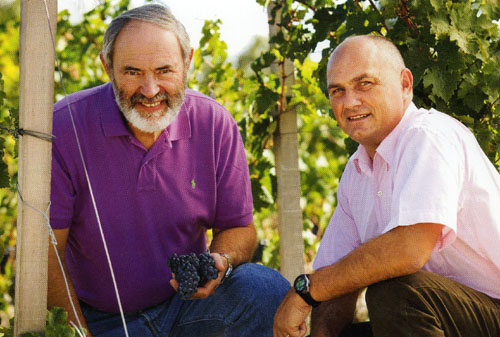 Many of New York’s A-list wine writers (somehow I was invited) turned up for lunch today at Union Square Cafe to celebrate–and taste through–the career of Marcel Ducasse. For 23 years, Ducasse has been the winemaker at Chateau Lagrange in St. Julien. He will soon be able to literally hang out his “gone fishing” sign since he will be spending time on his boat and with his family in Arcachon. Although he is a sage voice in the industry, he let the wines do most of the talking today.
In late 1983, Suntory Ltd of Japan purchased the chateau for 54 million French francs (at the then-exchange rate of 8.38 francs to the dollar, that’s $6.4 million). Interestingly, one company official there today told me that they encountered some local patriotism that resented a “crown jewel” being purchased by foreigners. Although a classified growth in the 1855 classification, this “jewel” was in need of a lot of TLC. Ducasse, who was then brought on board, told us that the company has proceeded to pour ten times the original purchase price into the property. They needed 13 years stanch the losses and become cash-flow positive.
If there was one theme that Ducasse touched on today it was that the vintages are getting warmer. “When I started in the wine business, it was a miracle–a dream!–when the cabernet reached a level corresponding to 12% alcohol,” he told the gathered crowd of scribes. Now, 13% is the norm. Since 1995 the vintages have been decent, good or very good–but none has been disastrous. The summers are now warmer, drier and sunnier.
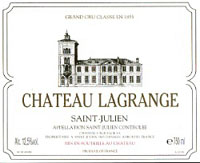 We tasted the components of the 2005 vintage–only cabernet sauvignon, merlot and petit verdot are planted on the chateau’s 115 hectares. Each good in their own right, the cabernet offered aromas of dark fruits, violets and firm tannins while the merlot–though no wimp–was softer with earthy notes and truffle aromas. The petit verdot was a tannin bolt. The blend transcended these component parts and showed a beautiful complexity at this early stage. In the excellent yet overpriced 2005 vintage, this is a tremendous value at under $50 a bottle (find this wine).
Then we moved back in time. We had a glass of each of the vintages from 1995-2004 served blind. The 2002 stood out to me as excellent and again it is reasonably priced at $50–though I found one vendor selling it for $37. At that price, this is a wine to buy by the case–get the duct tape out and seal it up for another 10 years. How do I know?
Because next we tasted the 1989 and 1990. Although these wines were from a different climatological era, they were fully resolved, delicately balanced, and hugely appealing right now. If anything, I gave the 1990 the edge but they are rewarding. And the best news of all? These lovely mature Bordeaux can be had a fraction of today’s prices since each is under $100 a bottle (find the 1990; find the 1989). If you want to taste a real claret, try is 1988. It is a trip back in time in more ways than one.
Continuity will likely be the key at Chateau Lagrange. Suntory remains the owner. And Bruno Eynard, who assumes the winemaking duties, has already been the numéro deux there for 17 years. Having raised the bar, the team aims to keep it there.