There’s an adage in the restaurant business that the reputation is made in the kitchen but the profits are made at the bar. Perhaps that should be refined to “wine cellar” instead of merely “bar” for the world’s top restaurants. The highest profits seem to come from selling wine, not mere booze.
In a fascinating and lengthy profile of Chef Gordon Ramsay in the New Yorker, Bill Buford let this nugget drop about the operations at Gordon Ramsay at the London:
“The [food] prices—the best value in New York—had been deliberately set low, Ramsay told me, to encourage people to spend more on wine, an upmarket restaurant’s greatest potential profit (no overhead, no spoiled ingredients).”
So is wine the REAL profit center at restaurants? One time Mrs. Vino and I were dining at Charlie Trotter’s in Chicago with another couple, one of whom ordered a gin and tonic. The waiter frostily told her that the restaurant serves no cocktails. Apparently it’s in the name of gastronomy since alcohol can deaden the palate. Chef Thomas Keller does not serve cocktails at the French Laundry in Napa either, although it has something to do with allegedly not being able to get the proper license.
Are gourmet restaurants pushing diners toward wine? In the New Yorker story, Buford reports on a group of hedge fund managers at the exclusive “chef’s table” who ordered $10,000 worth of food and wine. Another group from Goldman Sachs was set to take the table the following night: “budget not important,†was the word in the house. And at Petrus, a Ramsay restaurant in London, investment bankers famously ran up a $63,000 wine tab a few years ago (they later had to resign over it). That’s a heck of a lot of gin and tonics even at $20 a pop, the price at Per Se.
So is wine the real profit center at high-end restaurants? If this secret gets out, maybe mid-tier restaurants will start upgrading their wine programs. A wine geek can but hope.
* * *
On a related note, Gregory Condes, who oversaw the acquisition of $750,000 worth of wine for Gordon Ramsay at the London, has been fired according to the Sunday Mail after a wild night. It could be an April Fool’s spoof, but it seems too harsh.
The eyes of the wine world turn to Bordeaux this week as hundreds of critics and buyers descend on the region for “en primeur” week. The dark, inky, fiercely tannic wines of the 2006 vintage are rolled out to the thronging crowds, who get to smile at each other with purple teeth. Then they decide how much they like the current wines, for delivery in 2009. Opinions will roll out from critics and some of the prices at the top chateaux will not be set until as late as June.
Since I won’t be there this week, I dug through my notebook for a producer profile from my stop in St. Emilion in January.
I dropped by Chateau Corbin and met with Anabelle Cruse-Bardinet. The Grand Cru Classe property had been run by three generations of women in her family. But in 1999, Anabelle, now 39, and her husband Sebastien decided to purchase the property from her grandmother.
The big, stone chateau was in need of some TLC. They added a new roof and rehabbed two barrel rooms, one with an office overlooking the wines quietly aging. Now they live there full-time with their three kids under ten. It is a vital chateau, unlike many of the properties in the Medoc, the left bank, which are more museum-like.
However run down the main house was, the vineyard was in much better shape. She brought in Michel Rolland from neighboring Pomerol to have a look at the vineyard planted to merlot and cabernet franc and advise on grape maturity. But she makes the wine. Trained in enology at the University of Bordeaux, she makes the wine though and wants the wine to “reflect the vineyard first and the human hand second.”
She sells the wine at what she calls an “ultra-realistic” price in the system known as the place de Bordeaux. She sells it to about 30 brokers in Bordeaux who then sell it domestically and to importers from places like the US. In the past couple of years, she is selling all of her wine faster–it took one day a few years ago but the 2005 was sold out in one hour. The wines eventually make their way to the US market at the reasonable price of $25 -30 retail (find these wines).
These merlot-based wines are ones that would make Miles eat his words. Of the wines that I tasted at the chateau, the 2003 is an excellent price to quality ratio (find this wine). The dark purple wine has great St. Emilion character, with good balance between dark fruits, faint oak spice, and acidity from this vineyard that shows well in hot vintages. Not too extracted, not too high in perceptible alcohol, the wine has great character. The 2005 is even better, more concentrated and still wrapped in tannins at this stage and will require some bottle aging (find this wine). The 2002 is wonderfully drinkable–paired with grilled meats it would be a great match (find this wine). The 04 is very solid and I saw it for a reasonable $20 online, which makes it serious wine for a very reasonable price (find this wine).
We’ll check back with Anabelle soon to see how things went for her showing her 2006 wine at en primeur.
A new wine bar, 90pluspoints, opens in New York City’s East Village neighborhood next Tuesday. The focus of the bar is, as the name implies, serving wines that have been rated 90 points and more by the influential wine review, Robert Parker’s The Wine Advocate.
“Anything under 90 points is crap,” owner Joseph Coonawara told me last week. “The point score is all that matters. Grape variety, region, and especially vintage, even food pairings–the rest of it’s all noise.”
Known as “Run Rig” to his friends after the Torbreck wine awarded 99 points by Robert Parker, the Australian Coonawara has built a solid resume for launching his own wine bar. He rose in the ranks at New Jersey wine shop Wine Library and later became head of internet sales at Zachy’s. But he left because “they weren’t points oriented enough for me. There’s a great opportunity here to bring the pleasure of points to an on-premises establishment.”
Coonawara will have several flights of wine by the glass available. Most notably, there will be the five two-ounce shot glasses of Parker favorites from Spain and Australia that roll in at more than 16 percent alcohol.
“You don’t need to swirl and sniff, just toss it back,” Coonawara said. We’ll see if New Yorkers have a taste for it starting next week.
90pluspoints
131 e. 4th st
212-555-9463
click here for directions and other background information
Meet the newest wine blogger! Her name is Mariann and she hails from Denmark! When she’s not blogging she is known as Mariann Fischer Boel, the Commissioner of Agriculture of the European Union. Check out her blog.
She’s just getting into blogging so she’s just learning the ropes. For example, she hasn’t learned yet that she doesn’t have to put her photo in EVERY posting. And she doesn’t have a blogroll and couldn’t hyperlink her way out of a conference room. But at least she has comments! And she blogs in the blogging lingua franca–English!
This woman, who carries the big stick of wine policy reform, has the cojones to go to regions that could be affected by her radical initiative to uproot vineyards, reduce subsidies and upgrade quality. She went to Sicily to pat on the back and taketh away (see the Bloomberg story on her trip). And she lived to blog the tale. Roll the tape from her blog:
We visited vineyards in the hills around Etna whose high quality red wines matured in oak barrels are finding ready markets all across Europe and further afield.
As we work towards major reforms in both fruit and vegetables and wine, I was really inspired by what I saw. European farmers really can do well if we give them the correct conditions to allow their entrepreneurial talents to flourish.
Of course, it would be wrong of me to pretend that everyone was happy. I had the impression that my speech in general went down well. But I did notice some mumbling in the audience when I moved to the subject of wine reform – and more specifically the proposals for grubbing-up and ending distillation.
I know this seems harsh, but we cannot continue spending half a billion euros disposing of unwanted wine. We need to spend the money on improving the quality and marketing the results. The winemakers I saw in Sicily showed what is achievable if you have an open mind and a good business sense.
MFB is pro-barrique! And also a little unsure of who she’s blogging for. Clearly it’s not her constituency–European farmers–since they get hit with the third person pronoun. Maybe European taxpayers? Maybe Brussels bureaucrats? But, hey, even if it amounts to little more than a pamphlet, at least she takes comments!
The gleaming 72,000 square foot Whole Foods Bowery, opening today, has a “fromagerie” complete with an aging room. Cheeses come from Neal’s Yard in London, French affineur Hervé Mons, and some American classics such as Jasper Hill. The cheese manager was formerly at Artisanal Premium Cheese. There is a French fry station, a culinary center for classes and events, and two dining areas including conveyor-belt sushi. They can sell beer, local micro-brews and national macro-brews.
But there will be no wine.
Yes, it’s time for another edition of “New York’s crazy wine retailing laws!”
Law #1: Thou shalt not have more than one wine retail license in the state of New York. This is the fourth Whole Foods in Manhattan and the seventh in New York State. None of the NY stores sells wine (you never know what might happen if you could buy Sancerre the same time you buy Camembert), unlike Whole Foods stores in renegade states California, Illinois and Texas–where, I hasten to point out, levels of social unrest are no higher than in New York as a result of selling wine.
Whole Foods did have a wine retail license at their Columbus Circle location when it opened. They pulled the pulled the plug on that location voluntarily if somewhat mysteriously–there was something about it not being a street-level entrance, another instance of NY wine retail craziness. Apparently, WF still has the right to transfer the license to another location. Which brings us to…
Law #2: Thou shalt get down on bended knee and ask locals for the privilege of selling them wine. As Eater.com has been chronicling in their excellent series on the “drying of NYC,” this law affects bars and restaurants a lot more. Think about it: bar opens in your neighborhood, spills loud people into streets while you are trying to sleep. Fair enough, that could be worth getting riled up about.
But a shop? People go in, buy wine, take it home to drink it. It’s closed by 9 PM. I fail to see how that can cause angst in the neighborhood. Unless of course you are a competing wine retailer and you are attempting naked economic protectionism.
And apparently that’s what’s really happening. According to the NY Sun, Frank Geresi who owns local wine shop Elizabeth & Vine fears Whole Foods as a wine shop. He said “If I were a small hardware store and you were Home Depot, who would come to me to get a hammer once you moved in?” Nice try, Mr. Geresi: hammers are commodities and Whole Foods isn’t a discounter.
I don’t doubt that if Whole Foods got permission from the Community Board for the at-grade store-next-door-to-the-store that they would do a good job filling it with tons of interesting, biodynamic, organic or otherwise natural or even local wines. Look at all the TLC they’re putting into the “fromagerie” after all. And it would be convenient. But anybody who’s been to a WF in another state that does sell wine knows that you pay for that convenience: shopping around other wine stores will cut probably 15% off your wine bill.
So to New York officials: down with state laws limiting licenses! And to the Elizabeth & Vine: drop the resistance and let WF in! Just step up your game. Get great wines. Offer great prices and service. Heck, offer shipping to increase your reach. Who knows, WF selling wine in the neighborhood might just make more people in the neighborhood want wine. And to Community Board 3: do your bit and help make wine more accessible in America. Grant them the license!
(image)
The screwcap posting from a couple of days ago generated an interesting discussion on The Consumerist about the pros and cons of closures. Check it out.
One thing that came up is that the World Wildlife Fund has proclaimed that using cork–actually tree bark harvested every nine years–is better for the environment. They claim it makes those forests more economically viable, which then reduces the possibility they will be sold for other development (no word on why making it a national forest would not achieve the same goal). And they even invoke the Iberian lynx habitat!
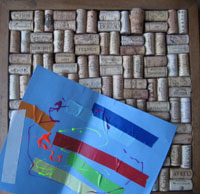
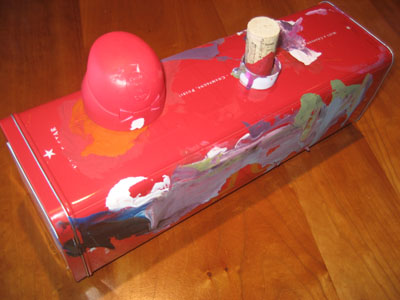
Whether or not using corks is better or worse for the environment, we all no doubt have a cache of corks. I, for one, rarely throw them away (except for those rubber bullet synthetic corks). I even made a cork board out of them once thanks to a frame as a birthday present. What do you do with your corks?
One company in Missouri that specializes in green building materials is encouraging consumers to send in their corks so that they can reuse them. They need 1,200 pounds and appear close to attaining their goal! If only they had recruited this guy earlier on…
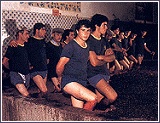
You know that caricature of someone in a vat, crushing grapes by foot to start the fermentation process? You know, the image long-ago phased out in practice for wine? Well, it turns out that nothing beats the foot in Portugal for making port.
Only two percent of all port is still foot-crushed and it is mostly the best ports available, vintage ports. Despite some negative associations, feet are especially good at crushing the skin without crushing the seed–filled with bitter tannins–as well.
Electricity came late to the upper Douro Valley. When it did, in the 1980s, labor prices were high so producers rushed to adopt automated crushing and stainless steel closed-top fermenters. Quality fell. There was just something about those feet. Or oxygen.
The traditional lagares are made of granite and are wide, open-top vats or troughs. Somehow the exposure to oxygen provided a slight degree of oxidation that was more appealing in port, a fortified wine. David Fonseca Guimaraens told me today that his company, the Fladgate Partnership, was among the first in the region to develop mechanized foot-like pistons in open-top stainless steel vats. I didn’t ask if the pistons had toes. But Guimaraens did say that the added labor of foot crushing made it twice as expensive as mechanization.
I tasted a sample of each of the three methods, foot-trodden from a stone lagar, piston-trodden in a stainless steel tank, and closed top.
The last one was quite hollow in the middle with elevated, aggressive tannins. The piston-pressed one was much more complete, with a beginning a middle and an end with good freshness. But it was the lagar sample that had the most layers of complexity. Then there was a blind sample just to see if I was paying attention. Fortunately I got it right (the odds were good though).
In the ongoing discussion about wine and technology, it’s a cute story of the advantages of simplicity. But technology is on the march. Guimaraens says in five years, the pistons could catch the feet. They’d better keep running.