36 hours in…New York City for wine lovers!

With 44 million tourists expected in the Big Apple this year, not everybody can fit into the Met or go up the Empire State Building. Some might just want to do some wine tourism. So here is a suggested itinerary for 36 hours in…New York City for wine lovers!
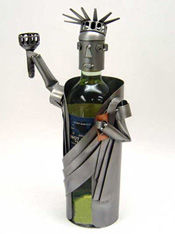
You arrive from the airport late Friday afternoon. Because few hotels offer us wine lovers anything distinctive, you can roll the dice with Priceline. In this scenario, our home for two nights will be…The Pod on E. 51st Street. Remodeled recently, it now targets the “stylish and spendthrifty traveler” so sounds good. And thanks to Priceline, you scored it for under $200–more to deploy on the wine budget!

Drop off your bags and head up or down. The rooftop area has a bar; on the ground floor is Le Bateau Ivre, a good little bistro/bar to get your evening started on a wine note.
Then head down to 20th street to dinner at a vaunted wine destination, Veritas. If you want to keep the vino flowing before getting there, drop by Moore Brothers wine shop on the same side of the street. With the store constantly cooled to 60-some degrees, and bottles always open for free sampling in the rear of the store.

Then it’s off to dinner at Veritas. Ask one of the sommeliers to help you navigate the wine list and choose from one of the 100,000 bottle inventory. Prix-fixe menu of New American cuisine is $76–how much you spend on wine is up to you.

If you aren’t too weary from your encounter with the TSA on this travel day, an optional stop afterward is Flute champagne bar across the street.

Saturday morning: no rest for the winey! It’s up bright and early to pick up your paddle and start bidding at auction! Acker, Merrall regularly holds auctions on Saturday mornings at the venerable wine restaurant Cru (190 page wine list). You can browse the catalogue and bid or just soak up the 70-lot-an-hour pace and enjoy the yummy (free) coffee.
Next up, lunch at Fatty Crab in the West Village. Try some of the excellent noodles, crispy pork, skate panggang skate with the well-crafted, concise wine list.

Then it’s down to pick up some wines for dinner in Tribeca. Chambers Street Wines is a great neighborhood wine shop that specializes in the Loire, Champagne and other wines from boutique producers. The staff will help walk you through some great options for your dinner.
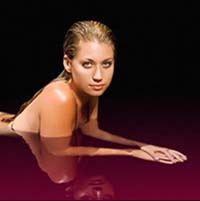
All right, you said you want some rest? Well stroll over to Delluva day spa and soak up the wine with their “vinotherapy.” If there’s one thing us wine lovers like besides drinking wine, it’s bathing in it–right?!? Well, maybe not. But you probably need to put your feet up so why not let someone rub grape waste into you while your doing it.

Then it’s back uptown to Read more…

Seeing green and being green

Eric Asimov fires off a “green wine” column for his first post-Earth Day (NYT).

One thing that struck me from the column–and that I have often encountered among many “green” producers–is their reluctance to put their method front-and-center, hoping to let the wines be appreciated on their own merits first, then as “green” wines second.

That happened last night in my NYU class when I poured the Porter Creek, Fiona’s Vineyard, 2004, a certified organic, transitioning-to-biodynamic pinot noir from Sonoma’s Russian River Valley. The wine was almost unanimously loved (find this wine). After I said that it was made organically and almost biodynamically, one participant said “why don’t they put that on the label?”

It seems there are two poles of along an axis of motivations for making green wine. On the one extreme, some producers are doing it because it’s makes good wine (and is good for the Earth). On the other, some may be doing it doing it because the sales and marketing department told them to. Or there might be a bit of both for all involved. It seems Porter Creek is on the good wine/Earth side since they don’t advertise it on their labels.

How about Fetzer with their huge Bonterra brand? I was intrigued to note on Monday here that they will be spending $1 million on marketing their wine, which states “made with organically grown grapes” on the label. Hmm, seems to have a whiff of marketing, not the terroir.

(Incidentally, “made with organically grown grapes” need only have a minimum of 70 percent organic grapes. Truthiness?)

Related: “Red, White and Green: can you taste the difference?” [University of Chicago, May 12]

Landmarc Time Warner Center – wine for the washed masses

lndmrctwc.jpg
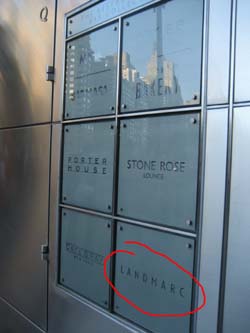
Landmarc at the Time Warner Center is Marc Murphy’s brand new bistro, an extension of his location in TriBeCa. The math is different: he’s shooting for a high volume model to pay the hefty rent. By what I saw there yesterday, that shouldn’t be a problem.

Home to many top restaurants, the Time Warner Center is a highly polished locale (btw, I saw Time Warner CEO and vineyard owner Richard Parsons ambling toward the Mandarin Oriental as I got off the escalator, so there really is Time Warner there somewhere lest anyone think it was simply naming rights). It needs Landmarc TWC since the Bouchon Bakery has all the atmosphere of airport dining and Whole Foods is a grocery store, albeit a nice one.

Landmarc’s 300-seat environment is spacious and stylish. There’s a big, curved bar in the center, a private dining room on one side, a waiting area with low, wood-block stool thingies at a long table, and some cool, semi-circular nooks for semi-private dining.

The menu (available here) is similar to the TriBeCa location with salads, daily special pastas, and steak in a variety of cuts.

But the wine is why I went. The word on the street is that it is priced “near retail.” Not always true. While it is affordable and interesting, it’s not always near retail. For example, I bought the Vavasour Sauvignon Blanc from New Zealand last week at a store for $18; at Landmarc, it’s $29, or 50 percent higher. The D’Arenberg Footbolt 2004, a $13 retail wine, is available for $28. The Dr. Loosen “L” 2006, an $8 wine a store, is available for $26.

But what all those wines have in common is being reasonably priced. Wine under $30? Many. Wine under $50? Practically the whole list. Though there is a 1995 Pétrus for $1500 for those who mistakenly wander over from Per Se. And the Ridge vertical of Monte Bello (1990, 1991, 1992) sounds interesting, even for $675.

Along with affordability, the list scores big points in my book for diversity. Pinot noir from Tasmania. Arneis from Giacosa in Piedmont. Clos Sacrés from Nicolas Joly in the Savennières. Garretson syrah, “The Caric.” Fun stuff.

And the half-bottles are a fantastic idea. They say the list changes frequently, but here are a few of my suggestions from the half bottles that I saw yesterday:

Pieropan, Soave Classico, $14 Soave doesn’t have a great reputation as a whole, but this could change your mind. A great aperitif wine. (find this wine at retail)

Domaine Sorin, Provence rosé, $14. This is a wonderful dry rosé from a biodynamic (organic plus) producer. Great acidity makes it very food friendly–try with the calamari fritti. (find this wine at retail)

Nicolas Potel, red Burgundy, 2005, $16. A fantastic vintage, a top producer, this is a no-brainer for entry-level Burgundy character. (find this wine at retail)

Terrabianca, Croce, 2003, $26. Hugely tannic, fun wine to try with a cheese course. (find this wine at retail)

A final note: if you end up ordering more wine than you can finish, thanks to New York State’s doggy bag law, you can ask them to recork it, bag it, and take it home (providing that you ordered a meal).

Related: Landmarc, web site, Time Warner Center, 10 Columbus Circle, 3rd Floor. 212-823-6123
Battle for the bottle at Time Warner Center” [Dr. V]
Eater Inside: Landmarc TWC” with photo [Eater]

Couples that drink wine together…cooperate?

other5.jpg

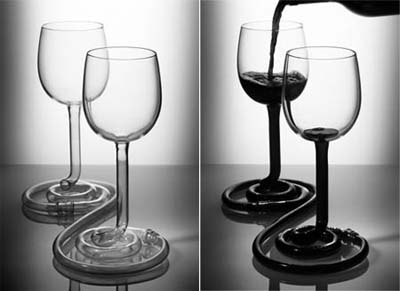
As if wine weren’t fun enough to drink with another person, a new set of glasses “forces” cooperation among couples. Hmm, I guess cooperation is another word for backwash?

The developer of the glasses, called “my other half,” describes them as two glasses as attached by a tube. If someone tries to drink alone then all the wine flows into the other person’s glass, hence “cooperation”–or frustration!–or the need to find someone taller than you are.

Photos of the glasses in action after the jump. Read more…

Airport wine, Churchill Downs, green marketing, wine diet – tasting sized pours

Downing at Churchill Downs
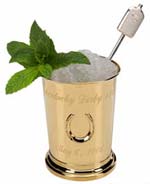
What are the odds? Good-bye mint julep, hello chardonnay? [BusinessWeek]

Vino Volare
Vino Volo, the wine bar behind security at Dulles airport (IAD), is now opening an outpost at Baltimore/Washington International Thurgood Marshall Airport (BWI). Southwest passengers can rejoice! Vino Volo also operates at Sacramento and Seattle airports. Next up: JFK. [via Upgrade: Travel Better]

Seeing green
Fetzer announces a $1 million marketing campaign trumpeting their high-volume organic wines. But are they doing it to be green or make green? Or both? [Courier-Journal]

Wine diet
Want to bulk up? Forget Weight Gainer 2000. Try wine. Such is the logic of a new diet for the size zero Victoria Beckham, fka Posh Spice. Wine “gives her the munchies.” According to Closer magazine, “It’s the reason she has a drink. If she has a wine or two then she’ll have an appetite like everyone gets when they’re on a night out and drinking.” Um, OK. Maybe her diminutive size has to do with the fact that she only eats one meal a day? [via NZ Herald]

Gold medal
Congratulations to Jonathan Gold, restaurant critic of LA Weekly, for winning the Pulitizer Prize for criticism!

Bordeaux 2006: Comment dit-on “big problems” en francais?

tr1age.jpg

After slamming the 2006 vintage last week saying it was “a great vintage for mushrooms and truffles, but less great for wine,” Jancis Robinson is back this week to sort through the rubble.

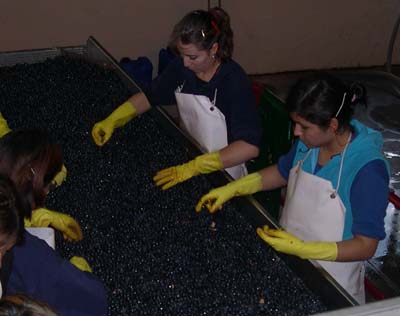
At the best properties there had been crucial work at the sorting tables, throwing away any split and rotten grapes as well as those which were most obviously underripe.

Wow. Triage tables. Sorting the wounded. Here were the survivors, per Jancis (full story):

Whites: Climens, Haut-Brion Blanc, Laville Haut-Brion, Pavillon Blanc de Château Margaux, Yquem

Left bank reds: Cos d’Estournel, Grand Puy Lacoste, Haut-Brion, Lafite, Latour, Léoville Barton, Léoville Las Cases, Margaux, Palmer

Right bank reds: Angélus, Arrosée, Conseillante, Evangile, Le Pin, Tertre Roteboeuf, Vieux Château Certan, Eglise Clinet, Lafleur, La Fleur Pétrus, Providence

POSSIBLE GOOD BUYS:

Bernardotte, Bahans Haut-Brion, Clos du Clocher, Grand Puy Lacoste, Haut Bages Libéral, Phélan Segur, La Tour Carnet

Back in London, the wine retailer Berry Bros & Rudd threatens to take a pass on large chunks of the 2006 vintage. “Having tasted the vintage I am convinced that 06 is not as good as 05 or possibly even 04,” Simon Staples told the Telegraph. “We will have no qualms about walking away from even the most illustrious châteaux if they do not offer good value.”

Related: “St. Emilion Grand Cru Classe, suspended!” [Dr. V]
Bordeaux 2002: undervalued” [Dr. V]

Green wine: the zen forest of Matassa, Roussillon

matassa.jpg

Perched in the hills and nestled in the forest not far from the sea lie the vineyards of Matassa. But the vigneron farming the land in Rousillon, on the French side of the Pyrenees, is distinctive for two reasons. First, he’s young. And, second, he’s from South Africa.

Tom Lubbe lives near the vineyards with his family. He developed Matassa with Nathalie Gauby and Sam Harrop, MW, who used to be the head buyer for Marks & Spencer. At a recent tasting where I tried their wines, Tom told me that the Rousillon is one of the few places in France where a young person can afford to start out since real estate in many other wine growing areas is horrendously expensive.

Tom has several vineyard parcels and he farms them all biodynamically, a sort of organic plus method. He aims to make the wines as naturally as possible and even do a preliminary foot crush and use only indigenous yeasts. The prized vineyard, in Tom’s eyes, is one of 112 year old carignan at 1,800 feet above sea level. It’s surrounded by a forest so Tom doesn’t have to worry about pesticides from a neighbor blowing into his vineyard.

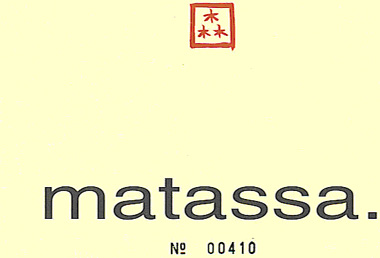
The labels have two surprising things on them. First, simplicity. Many French labels are cluttered with confusing terms such as superieur when the wine is not actually all that superior. These labels have zen-like minimalism and in fact include a kanji character on them (the one for forest). Second, Harrop and Lubbe are some of the rare quality wine producers who have thumbed their nose at the appellation system and make only vin de pays wines, specifically vin de pays Cotes des Catalanes. There are no grape varieties on the labels, however, since vdp regs state that a wine has have a 100 percent truth claim to state the variety on the label.

The Cuvee Marguerite is a blend of viognier and petit grain muscat aged in old Burgundy barrels. It has huge araomatic intensity and an intriguing minerality underneath. (find this wine)

The Matassa blanc is a white of rare intensity from the region. Surprisingly pleasant acidity, the wine has a wonderful well-balanced and waxy texture with great minerality and hint of Key lime and a drop of honey. (find this wine)

Moving to the reds, the “Cuvee Romanissa” 2004 is a surprisingly light and lively blend of mostly grenache with a dollop of carignan, mourvedre, and cabernet sauvignon (find this wine). Dark fruits and an alluring savory character make this a great food wine, calling out for grilled meats. The piece de resistance is the Matassa rouge, made from all 112 year old carignan (find this wine). Surprisingly light in color in the glass, the wine has a sort of rusticity on the nose that compliments dark fruit notes. On the palate the wine has a light weight yet great intensity and balance between fruit, acid, minerality and lightly peppery tannins. Really an extremely attractive red wine. And to think it is from the humble carignan…

Environmentally friendly. Good packaging. Great product. Other French producers should take note and follow the lead of Matassa (it’s just a pity about the price, but hey, you can’t have it all).

Total production: 20,000 bottles. Importer: Eric Solomon.

Poll: should the US drinking age be lowered?

John McCardell is not exactly the face you would expect to be making an issue of lowering the drinking age in the US. But he is becoming the issue’s poster child.

McCardell, the president emeritus of Middlebury College, is described as having “gray hair, gray suit, soft voice” in an provocative piece on the subject by George Will in the WaPo. Quote:

McCardell thinks that, on campuses, a drinking age of 21 infantilizes students, encouraging immature behavior with alcohol and disrespect for law generally. Furthermore, an “enforcement only” policy makes school administrations adversaries of students and interferes with their attempts to acquaint students with pertinent information, such as the neurological effects of alcohol on young brains. He notes that 18-year-olds have a right to marry, adopt children, serve as legal guardians for minors and purchase firearms from authorized dealers, and are trusted with the vote and military responsibilities. So, he says, it is not unreasonable to think that they can, with proper preparation, be trusted to drink.

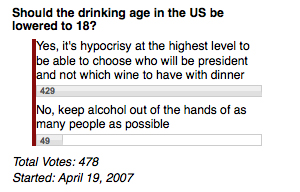
So what do you think? Have your say with the new polling software!

democracy17
poll now closed


winepoliticsamz

Wine Maps


Monthly Archives

Categories


Blog posts via email

@drvino on Instagram

@drvino on Twitter


winesearcher

quotes

One of the “fresh voices taking wine journalism in new and important directions.” -World of Fine Wine

“His reporting over the past six months has had seismic consequences, which is a hell of an accomplishment for a blog.” -Forbes.com

"News of such activities, reported last month on a wine blog called Dr. Vino, have captivated wine enthusiasts and triggered a fierce online debate…" The Wall Street Journal

"...well-written, well-researched, calm and, dare we use the word, sober." -Dorothy Gaiter & John Brecher, WSJ

jbf07James Beard Foundation awards

Saveur, best drinks blog, finalist 2012.

Winner, Best Wine Blog

One of the "seven best wine blogs." Food & Wine,

One of the three best wine blogs, Fast Company

See more media...

ayow150buy

Wine books on Amazon: