Dr Vino's wine blog
wine talk that goes down easy
Value vino list number seven
Whites
Steele, Shooting Star, Washington State, Aligoté. 2001. $9.95
Jed Steele, the winemaker from Lake County California, has sourced this exciting white with fruit from Washington State. The obscure Aligoté rarely gets to be a headline act as it has traditionally played a supporting role to Chardonnay in Burgundy. But the future for Aligoté in the lead role will be more than a shooting star if winemakers continue to make it in this appealing style. This wine from a two-acre plot is aged in old oak barrels, making it rounded without being oaky, and is an excellent food wine (try it with grilled swordfish). Catch a bottle of Shooting Star, before it becomes a star! www.steelewines.com
Cuvées de Castilla, Cuvee R.S., DO Rueda, $6.
As the prices of Spanish wines go up, budget-oriented consumers may have to move down-the river in this case. Just down the Duero River from the excellent and increasingly high-rent growing area of Ribera del Duero, lies Rueda and the vineyards of this excellent value white. It’s not just the grape varietals that count here (since they are mostly the little known Verdejo and Viura) but the freshness in the glass that matters more. With floral notes in the aroma and firm citrus base on the palate, this wine is a hands-down winner on the deck in the summer (drink up, those of you in the southern hemisphere! The rest of us can drink it and be nostalgic for summer.). Try with seafood or as an aperitif with a sharp dry cheese such as manchego. Eric Solomon, importer.
Mas Carlot, Cuvee R (Riesling), 2002, $7.
If you think that a Riesling from the south of France is not strange enough, consider that this vintage of this exotic wine did not sacrifice quality despite massive flooding in the region just prior to harvest. The Cuvee R is an excellent white, strikingly golden in color and complements spicy food such as stir-fry very well. A refreshing crispness derives from the pleasant firmness of the acidity that also has a generous coating of lychees. Sadly, this vintage will be the last one for this unusual wine. According to Bobby Kacher, the wine’s American importer, the one-acre plot of old vines has been forcibly uprooted at the demands of the Alsace producers of Riesling, despite the many efforts of Mas Carlot (such as making it a humble table wine as opposed to AOC) to mollify them. So raise a glass of this final bargain vintage while it is still available. Robert Kacher, importer.
Reds
Capçanes, Mas Donis, “Barrica” 2001. $10.41
Where do value-oriented wine drinkers find their Priorat? In Montsant! As the price of wines from the small Priorat region of southern Catalonia has had a vertiginous recent rise, neighboring Montsant is picking up steam. Capcanes is an old cooperative of growers that has a portfolio of enticing value and high quality red wines. The Mas Donis Barrica 2001 is made from 60 year old vines (mostly Grenache and some Syrah), aged in American oak and bottled unfiltered. Not a fruit blunderbuss, the wine hits the mark with the precision of a sniper. Black cherry and tobacco make the wine compelling and long lasting and an excellent accompaniment to meals. Eric Solomon, importer.
Castell del Remei, Gotim Bru, 2001. $10.49
Castell del Remei is a house known for fine value vino. Investment from the Cusine family in wine making talent and the vineyard mean that variations among vintages will be slim. The Gotim Bru was formerly one of the most exciting wines under $10 but it has crept up in price and come down a smidge in terms of quality (although it is still worth seeking out). While the 99 and the 2000 vintages were legends in their own time, the 2001 shows signs of being mortal. The color remains ruby red and the aroma and tastes are slightly more berry and grapey than they were previously. Nonetheless, the tempranillo grape that serves as the base for this wine makes it a wine that is very food friendly. Eric Solomon, importer.
Cousino-Macul, Cabernet Sauvignon, 2002. $9
What do you do when a city grows up around your vineyard? This is a problem that confronted the Cousiño family at their 800-acre Macul vineyard (planted in 1856) as Santiago built up all around it. Feeling the pressures of urbanization, the family sold half the vineyard (still open for visits) and built a state of the art winery in Buin, 20 miles to the south-west in the Maipo Valley. This young wine, the first from the new winery, has notes of cherry and smoked meats and the tannins will make it a favorite of those who enjoy “big reds.” The Antiguas Reservas is more refined at a higher price point ($16). Imported by Billington Imports.
Domaine Santa Duc, les vieilles vignes, Cotes du Rhone, 2001 $9 (sale).
The current vintage of this wine remains just as compelling as the previous one making this a value vino name to set in stone. The humble CDR appellation belies the complexity and refinement of this lush, leathery and lingering wine from a leading producer of Chateauneuf. Moreover, even alongside the Rasteau 2001 ($16) from the same producer, this CDR was the winner. A robust red that is versatile with food pairings from ravioli to roast beef. Robert Kacher, importer.
Dominis M, red, vdp Catalan, 2002. $8.50
With a similar name as the famed Napa producer Dominus, but at a fraction of the price, this wine begs the question of what would you prefer, a case of easy-drinking table wine or one excellent bottle? If you opt for the lower bottle price of the former, then Dominis M is the way to go. Inky-purple in color with gobs of vibrant, dark fruit, the young wine is immediately accessible and drinkable. In fact, this vin de pays would make a great wine for a picnic especially in France, where it would probably cost about €4. Eric Solomon, importer.
Enate, Cabernet Sauvignon/Merlot, D.O. Somotano, 2001. $8.50
This ultramodern winery (founded 1991) makes wines from international varietals high in the foothills of the Pyrenees. Ever heard of a Spanish Gewurztraminer? They make one (and it is apparently good). From the off-the-beaten path (up and coming?) growing area Somotano in Huesca, this cabernet/merlot blend is an inky red in color with notes of blackcurrant and black cherry. Balanced and medium-bodied, the wine goes well with food, such as a risotto. And with a price tag of €7 in Spain, the wine is a shockingly good value in the US. Eric Solomon, importer. www.enate.es
Peace Family Vineyard, South Eastern Australia 2003. $6
Was 2003 a year for peace? If you’re the Australian wine maker Andrew Peace, every year is full of Peace but now is a good time to play on the name. Complete with artistic peace sign on the label, this value red has a blend of four red varietals (shiraz, cabernet, Grenache, and mataró in descending order) with plenty of initial cherry and dark fruits though not a long finish. Not a wine for cellaring, it is a bargain for grilled meats straight off the barbie. Nor is it a wine for impressing out-of-town guests-unless you are trying to make a point and the guest happens to be Donald Rumsfeld. TGIC, importer.
Beyond the grade (but worth it):
Morambro Creek, Padthaway, shiraz, 2002 ($20)
San Pedro de Yacochuya, 2001 ($45)
Feb
7
2004
Comments Off on Value vino list number seven
Value vino list number six
Sparklers
Marquis de Perlade, Crémant d’Alsace, NV. $7
“In victory you deserve champagne, in defeat you need it,” said Napoleon. With such a view of sparkling wines for every occasion, perhaps Napoleon meant the more affordable crémant? With it difficult to find champagne under $25, crémant—or a sparkling wine from France ex Champagne—is an affordable alternative. This bubbly is a blanc de blancs, or from exclusively white grapes, which here are Pinot Blanc, Chardonnay, and Chenin Blanc (no Riesling!). Crisp and refreshing, it is an excellent aperitif for a big party. And hey, if you don’t like it, it makes a great base for mimosas! W.J. Deutsch & Son, importer.
Bernard-Massard, Luxembourg sparkling rosé, $10.50
While there are so many well-priced sparkling wines from Spain and France (crémants) the Bernard-Massard is probably my only chance to ever review a wine from Luxembourg. The Grand Duchy, known more for its banking than its wine-making has produced a crackling, dry rosé that sparkles. The firm acidity makes it a great complement to food, particularly seafood, and it would also make a great aperitif on the deck in the summer. With a price of €7, which converts poorly to over $10 in the US, there’s no need to save this one for New Year’s Eve (or, being a rosé, the heart-shaped tub).
White
Weingut F.K. Schmitt 2001 Niersteiner Kranzberg Riesling Kabinett $7.99
Rieslings aren’t just for grandmothers any more. Asian foods have become very popular here in the US and in a combination that must surprise the older producers along the Rhine, Riesling is a great complement to many Asian foods. This wine from the excellent 2001 vintage is no exception. From Nierstein, the wine has a straw color, floral aromas, and on the palate it has a nice balance of sweet with an acid base of tart fruits. Good on its own, this wine is greatly enhanced by your favorite stir-fry. Imported by Winesellers, Ltd.
Reds
Santa Duc Selections, les vieilles vignes, Cotes du Rhone, 2000. $9 (sale)
When you order a glass of red wine at a Parisian bistro, it will most likely be a fairly ho-hum Cotes du Rhone. This wine, also labeled as a CDR, puts the others to shame with its fat, lush, leathery complexity, soft tannins and long finish. From the excellent Rhone producer Domaine Santa Duc, this mostly grenache blend is actually a Chateauneuf in disguise since that is where the vineyard lies. Bottling under their lesser label makes it easy on the palate and on the wallet, especially during the October sales! Look for similar overstocks and reductions now at your local retailer. Robert Kacher, importer.
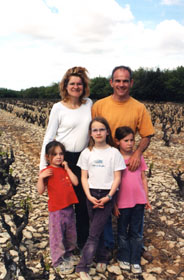 Domaine les Grands Bois, Cuvée les Trois Soeurs, Cotes du Rhone, 2001. $8
Marc Besnardeau was a sommelier in Paris when he met Mireille Farjon, whose family had a winery in the Rhone. A decade ago they married, moved to the Rhone, and Marc became the winemaker. Having honed his palate, Marc knew what to make from his old-vines and the result is a range of wines that should be on every bargain hunter’s wine list. This particular cuvee, called the three sisters after their girls (photo right), is a medium-bodied and fruit-forward blend of mostly grenache and syrah that may not be age-worthy but certainly will impress your friends—and daughters over 21?—now. Weygandt-Metzer, importer.
Chateau Mourgues du Gres, Les Galets Rouges, AOC Costieres de Nimes, 2001. $9
Denim, the original product “de Nimes,” helps to remember this up-and-coming growing area. With such a high percentage of excellent small growers, this pebbly growing area just south of chateauneuf deserves close attention, particularly from us bargain hounds. And the 2001 vintage has grown in importance since in 2002 the region was flooded shortly prior to the harvest. Anne and François Collard (who also make an excellent rosé) have crafted this gem called galets rouges, or “red roof tiles,” from a mostly syrah blend to resemble a classy Cote Rotie. The supple tannins and dark fruits make it a real winner. Get it while you can!
Apollonio, Terragnolo, Primitivo, 2000. $9.99
This luscious wine is not your typical Italian red. Grown well outside of the main wine areas, this wine comes from Puglia in the “heel” of Italian boot. And it’s not a sangiovese as are so many Italian reds, this one is made with the primitive grape, a distant relative of zinfandel. Not peppery as are many American zins, dark cherry and truffles are instead the main notes on the palate, and it is velvety and smooth with a pleasant finish. Try to pair this one with a risotto. Salute! Imported by Vin Divino.
Tres Picos, Garnacha, D.O. Campo de Borja, Spain, 2002, $8.
Tres Picos is back! This cooperative from the remote Campo de Borja region of Spain returns with another excellent vintage of old-vine Grenache. The varietal, common in the Rhone, often assumes a supporting role to syrah but is excellent as a lead performer as well. Slightly sweeter than syrah, this medium-bodied red has gobs of dark fruits including black cherry, a dash of white pepper, and a long finish. The excellent packaging of the sturdy bottle and sleek label makes it a gift whose recipient will assume it is at least double the price. Enjoy with foods ranging from pork to paella.
Excelsior, Cabernet Sauvignon, 2002. $8
When South Africa burst on to the international wine scene with democratization in the mid-1990s, many of the acres under vine produced the local pinotage grape. But now more vineyard owners are planting international varietals and this is a great value example. A deep, rich red in color, aromas of blackcurrant leap from the glass and the full-bodied texture of the wine will make it a favorite for those who like big reds. And with an October sale price of $5.21, how can you go wrong?
Thorn-Clarke, Shiraz, Barossa, 2002. $9.49
If you have heard the word “jammy” used to describe a wine and have not understood it, you need look no further. The wine practically coats the side of the glass as if it were spread on there with a knife. Fans of big, muscular reds may find this as good as it gets under $10. The earthy notes and dark fruits of this vintage make for a pleasant complexity (although those able to get the Shotfire Shiraz 2002 $16 will find it similarly big but more refined). The winery is family-owned, which is not actually rare in Oz, but hard to find in the US among all the imports from the enormous Oz producers. Imported by Kysela Pere et Fils. www.thornclarkewines.com
Beyond the $10 grade (but worth it):
Maison Rijckaert, Macon Villages white 2001 $14
Artadi Vinas de Gain, Rioja, 2001, $16
Thorn-Clarke, Shotfire Shiraz, 2002, $16
Torbreck, Woodcutter’s Red, 2002, $15 Read more…
Dec
19
2003
Comments Off on Value vino list number six
Value vino list number five
Spain
Artazuri, Navarre, 2000. $8.
I recently bought a $25 certificate on EBay to a local wine shop for about $8. If you can’t find the same deal near you, this wine gives you basically the same discount! Just beyond the Rioja from a vineyard in Navarre, Juan-Carlos Lopez de la Calle (the wine maker of the revered Atardi wines) has made what is one of the year’s best wines under $10. The alluring aromas of this old-vine Grenache draw you in like a siren and the notes of cherry and plum on the palate and light tannins make you never want to leave. The bottle disappeared so quickly I thought it had a hole in it! Imported by Eric Solomon.
Higueruela, D. O. Almansa, 2001. $9
Lost in La Mancha? It’s understandable with a wine like this. The arid plains of La Mancha have become a dynamic wine growing region and Higueruela is a vivid example. Rich and dark red in color, the wine (from 70 year old Grenache vines at Bodega Tintoralba) is smooth as velvet on the palate with light tannins, making it very accessible. Even if the name is unpronounceable to English speakers, it stands out for windmills on the label—although these are the sleek, 21st century variety instead of the 16th that Don Quixote encountered. Imported by Grapes from Spain, Inc.
France
Domaine de la Janasse, Vin de Pays de la Principauté d’Orange 2000 $8
Get your Rhones while they are hot! The 2000 vintage was great (unlike the 2002, which saw massive flooding at harvest time). Fans of “big reds†should run (don’t walk!) to find this wine value. A blend of merlot, syrah and Grenache has dark cherry on the nose and full mouthfeel with a good finish. This wine definitely punches above its weight. Eric Solomon imports.
Domaine de Fondrèche, rosé, Cotes du Ventoux 2002. $9.99
“Quantity was sacrificed in this vintage but quality was not,” says importer Robert Kacher. Inundated in 2002, production was more than cut in half to 500 cases but fortunately—miraculously?—the quality did not fall. A blend of roughly equal portions of Grenache, Syrah, and Cinsault, this excellent dry rosé has pleasant fruit on the nose complements good acidity. This is a perfect wine to accompany meals on the deck during your August vacation whether in Provence or not.
Grande Cassagne, GS, le Triage, AOC Costieres de Nimes. $8
Last year, Great Stuff! This year greater stuff! This vintage has been cranked up with some of the winery’s better grapes (Grenache and Syrah) and the results are an under $10 gem! Ruby is the gem of choice as it is the color of the wine. With complex aromas of dark fruits, the smooth sensation on the palate and excellent finish make this a leading contender for wine of the year in this price category. If you are looking to create a stir, try inserting this wine into a lineup of $30+ Rhônes and see if any one can tell the difference.
Mas Carlot, “R” vdt, 2001. $8.
I can’t believe it’s not Chardonnay! The crisp, clean and sweet nose seems to be a Riesling, but the buttery mouthfeel, golden color and excellent body are more akin to Chardonnay. As if making old vine Riesling from the south of France weren’t odd enough, this wine from a vineyard near Nimes is not an appellation wine but is instead a lowly vin de table category. Alas, importer Robert Kacher says that the 2002 (supposedly better than this 2001) is the last vintage. Winegrowers in Alsace, the French home of Riesling, have forced the uprooting of this one-acre plot with low yields on 40 year old vines simply because it is not from Alsace. What a pity. All the more reason to seek out this wine.
Chateau de Mattes-Sabran, Dionysos, AOC Corbières, 2001. $8.
Move over Bacchus, here comes Dionysus! This family-owned winery clearly has great ambitions to name their wine after the Greek god of wine. Perhaps it’s not nectar, but it sure would go nicely with ambrosia! The Corbières appellation is emerging as a leader in the dynamic Languedoc area and this wine is a prime example from the under $10 category. This tight blend of Mourvèdre, Grenache and Syrah has an appealing ruby red that gives way to excellent earthy scents and black cherries. You don’t have to wait for your next Bacchanalian feast to try this one-the barbeque will be fine! Imported by Wine Vine.
Austalia
Paringa, Shiraz, 2002. $9
Lush and velvety—what else would you expect from the land of Oz? David Hickinbotham, part of a home building family from southern Australia, bought a 900-acre property in 1996 essentially to meet demand from Southcorp. US importer Dan Phillips of The Grateful Palate sought to make a wine from their fruit and radically dropped yields by 90% from Southcorp’s levels. This resulting wine has garnered wide acclaim (including the cover of Wine Spectator) and is a global better value. This 2002 Shiraz has a dark red color with notes of clove and dark berries on the palate with a smooth finish. Served slightly chilled it accompanies cheeses very well.
Germany
Fitz-Ritter, 2001 Dürkheimer Hochbenn Riesling Kabinett. $9.
The good news about the German Riesling 2001 vintage is that there are plenty of good wines. The bad news is that since Germany is a high-cost producer, most are well above the $10 threshold. But this one qualifies on both counts. The Fitz family adheres to strict production criteria that yield a wine that is sweet but not cloying. Served chilled, it has a very good combination of brisk acid structure with notes of honey and peach. Try this one with seafood or live dangerously and try it with your favorite Thai food. For the sociologists out there, it will be easy to remember this good wine since it is from the town of Bad Dürkheim.
New Zealand
Babich, Sauvignon Blanc, Marlborough, 2002. $9.99
Sauvignon Blanc is extremely expressive. From the Bordeaux, Napa or New Zealand, the effect of territory is quite clear. This SB from the family-owned and operated winery diverges from the typical from NZ style, which often has strong notes of citrus. Floral notes in the aroma make it similar to a wine from Baden, but the steel-tank fermentation leads to crisp and refreshing wine with hints of mineral and peach. This is a perfect summer wine for drinks on the deck. Imported by Select Brokers.
Sep
27
2003
Comments Off on Value vino list number five
Value vino list number four
Spain
Castaño, Solanera, Monastrell, 2001. $10.46
From the obscure Spanish region of Yecla comes this superlative red wine. One of only four producers in the D.O., Castaño has hit their stride working with importer Eric Solomon (They would be S.O.L. without SOLOMON). This Solanera from old-vine monastrell (aka mourvèdre) has impressive nose, which decanting for one hour made even more intense with dark fruits and black cherry. The penetrating and all-encompassing mouthfeel yields to a smooth and long finish. Wow! This is surely the leading candidate for best wine of the year for under $10. Oops. The price increased from $9 last year. Pity we have to pay up, but if you are going to breach the $10 limit, make this the one!
Louis de Vernier, Blanc de blancs, Cava, NV. $9
Cava? Not well-known in the US, Spanish sparkling wine has grown to account for half of the sparkling wine market in the UK. This cava is a sparkling example of what has made it such a good export product. Dry and refreshing with vigorous bubbles, this wine is good year-round, from summer parties to New Year’s Eve. Even though it sells for about $4 in Barcelona, the low price tag here means that we can be more Spanish and not just save this for special occasions.
Castell del Remei, Gotim Bru, 2000, Costers del Segre. $10.41
This wine delights the palate while going easy on the wallet. Sadly, however, the price rose over 15% from last year’s vintage putting it above $10, thus leaving me with the dilemma of whether to review it at all. But it is still a terrific wine value, one that is too good to pass up. From Catalonia in northeastern Spain, this super smooth, complex blend (cabernet sauvignon, merlot and tempranillo) hits is mark like an arrow rather than a “hedonistic fruit bomb.” An excellent nose, with black currants and supple tannins on the palate, all give way to a lasting finish. Try it with a range of foods, from pork to paella. www.castelldelremei.com
Chile
Haras, Cabernet Sauvignon, 2000 Maipo Valley. $9
This winery epitomizes current trends in Chilean winemaking: young, export-oriented, well-capitalized, and a tasty wine. With their first vintage only a decade ago, the winery blends the two passions of Chilean businessman Eduardo Matte, horses and wine, into this horseshoe-shaped winery (a horse sketch also adorns the label of this wine). This 100% Cabernet cuvée for the US market is a dead ringer for a young, peripheral Bordeaux, where it would have cost double. Purple-red in color, with dark fruits on the nice nose, this wine has seen some oak for smoothing out. Fans of “big reds” will enjoy this wine but its supple and medium bodied mouthfeel do not make it overwhelming. Imported by Fine Vines, LLC. www.harasdepirque.com
Terra Rosa, Cabernet Sauvignon, Chile, 2000. $9.99
Patrick Campbell, the Sonoma winemaker, headed south, not just for the winter, but also for this wine. Campbell has an excellent focus not only on quality (with his Laurel Glen wines sell for $50) but also on value. The two Terra Rosa wines come from vineyards on both sides of the Andes. This one from Chile has a base of Cabernet Sauvignon (85%) but it is the added Carmenère (similar to a Merlot) that give this wine a voluptuous lushness that I have not encountered in other Cabs from Chile. Dark fruits with light notes of spice make this well-structured red a real crowd pleaser. www.laurelglen.com
Italy
Falesco, Vitiano, 2001, Umbria IGT $8
Viti-ano. When thinking Italian wine, why not think in Italian? Viti, a Latin root for grape; ano is similar to the word anno for year. Grape of the year? Well, a wine of the week at the very least. The alluring deep purple color draws the drinker in through the eyes while the intense aromas of black cherry and plums draw the drinker in through the nose. This medium bodied red has added complexity to sangiovese with good proportions of cabernet sauvignon and merlot. This one is a winner in the Italian wine under $10 category.
South Africa
Goats do Roam, Red, 2002, Western Cape, South Africa. $7.
Great skepticism accompanied the tasting of this wine. Was the witty name that plays on the Côtes du Rhône region of France covering up poor wine quality? (Goats do, in fact, roam on the property as Charles Back, the winemaker, is also a leading regional producer of goat cheese.) Was the pinotage, a leading red wine grape from the South Africa, going to be a disappointment as it had in the past? The wine itself dispelled the skepticism. A blend of several grape varietals including pinotage and the Rhône staples of grenache and syrah, this medium-bodied wine has a surprisingly concentrated nose with spice and dark fruits on the palate. From one of South Africa’s largest exporters, this wine is also easy to find.
France
Commanderie de Bargemone, rosé, AOC Coteaux d’Aix en Provence, 2001, $8.
When the thermometer rises and the humidity jumps, who wants a massive Cab? For those hot summer days, try a dry rosé. This quaffable choice, derived from Grenache, Cinsault, and Syrah, has just enough substance to be interesting, no sweetness to be cloying, and served chilled it is very refreshing. Pair it with some grilled white fish and you are on your way to an excellent summer barbeque.
Mas de la Bergerie, VdP Coteaux de Bessilles, 2001. $8
Folies Bergères? No, this vin rouge is not Moulin Rouge. This turbo-charged red from the Languedoc clocks in at 13.5% alcohol but doesn’t feel heady. One of the wines from the ever-growing Domaines Paul Mas, this vin de pays is a blend of syrah, merlot, old-vine carignan, and cabernet sauvignon. Ruby in color, the wine has a concentrated nose of dark fruits and strawberry jam and holds together well on the palate. Try it with thyme-infused meat dishes.
Chateau Pesquié, Les Terrasses, AOC Côtes de Ventoux, 2001. $9.99
The slopes of the Mont Ventoux, which have been such a showcase for the skills of Lance Armstrong in the Tour de France, also show the quality of this region’s winemaking. A blend of Grenache and Syrah, this ruby red wine is light in color and in tannins. Hints of earthiness and cloves are present in the excellent nose. On the palate, the wine has a bracing acidity and the wine evolves in the glass even though it is a young wine. Just as Lance makes going up the Mont Ventoux look easy, Chateau Pesquie makes their wines go down easy.
Jul
11
2003
Comments Off on Value vino list number four
Value vino list number three
Chile and Argentina are similar insofar as they are both Spanish-speaking, largely Catholic countries in the Southern Cone of Latin America that have experienced dictatorship and democracy over the past few decades. Despite these similarities, the two local rivals have contrasting winemaking styles and histories. Chile, with a smaller domestic economy, has been quite outward-looking to find markets for its wine. Argentina, by contrast, is one of the world’s largest producers but a relatively weak exporter. Climatologically, Chile is influenced by the prevailing Pacific weather patterns while Argentina has high deserts on the other side of the Andes.
Both countries are becoming very international in their winemaking as many companies from France, Spain, the USA, have come to make wines or to consult in winemaking. While the $10-and-up categories from both countries are mostly strong, the wines under $10 remain patchy. Two recent tastings defied expectations: the Argentine Malbecs were overly smoky and the Chilean Sauvignons Blancs tasted too much like what the French call pipi du chat; I liked several of the whites from Argentina and some reds from Chile. While the exciting winemaking in the region makes it very much worth watching, here are a few recommendations for now…
Chile
Casa Silva, Carmenère, Classic, 2000 (Chile) $8.
Carmenère has recently resolved a case of mistaken identity. In Chile, it was previously thought to be Merlot. However, DNA testing (no, this is not just reserved for paternity lawsuits) revealed about a decade ago that the carmenère is, in fact, distinct from its fraternal twin, merlot. The long-standing confusion between the two grapes means that it is quite similar to Merlot in taste and appearance. This wine is easy on the wallet and on the palate. It is purple red in color, with a nose of dark fruits and a good finish. It certainly stacked up well against two other watery carmenères. And it would probably be even better with food (pork chops?).
Concha y Toro, Casillero del Diablo, Cabernet Sauvignon, Maipo Valley, 2001. $8
The Devil is in the details. Legend (read: marketing department) has it that old man Don Melchor used to keep the staff out of his best wine cellar by telling them that the Devil lived there. Although this wine is good, it may have come from the wrong cellar since it is not the best wine this winery produces. But it is good value for money. The nose is closed at first but opens up into a ripe cherry and herbal aroma with similar notes on the palate. Slightly tannic and aged in some oak, this South American red will please red lovers who are accustomed with the North American style. From one of the biggest firms exporting wine to the US, it’s also easy find.
Argentina
Alamos, Chardonnay, Mendoza 2001 $9.99.
Nicolas Catena is probably Argentina’s leading producer. He makes a wine that sells for $90 a bottle so he is definitely a locomotive pulling Argentina behind him. His neo-Mayan winery at the base of the Andes produces several lines of wines and the Alamos label is the most affordable. Sleek styling on the label and heavy bottles make the wine noticeable from the get-go. On the inside, this Chardonnay is pale yellow in color and hints of butterscotch on the nose. It doesn’t have that creamy buttery taste of many Chardonnays and there is a hint of citrus, but it is agreeable, easy drinking and has a pleasant finish. This solid effort makes it easy to remember Ãlamos.
Navarro Correas, Cabernet Sauvignon, Colección privada, Mendoza. 2000. $10
This winery has seen the benefit of foreign investment. Diageo (former owner of Burger King), the international drinks conglomerate that also owns Guinness beer as well as many other wineries and spirits brands, has lent the winery their winemaker from Beaulieu Vineyards in Napa. The results are good with this fruit-forward Cabernet made in an international style. The nose is excellent with complexity and dark fruits although not all the complexity transfers to the palate. This smooth medium-bodied wine is at its most expressive with food, from pasta to grilled meats.
Santa Julia, Torrontés, Mendoza, 2002. $7.
Move over chardonnay, here comes Torrontés? Well, maybe not anytime soon. This varietal is widely planted in Argentina (in fact, they claim it to be of domestic origin) and almost unknown elsewhere. It should be better known though. Pale in color with a floral nose, the taste is clean and crisp. This refreshing wine is definitely good to keep on ice for sunny days on the deck. Torrontés can be easily overwhelmed by food though. But hey, maybe that’s OK sometimes—the wine doesn’t always have to be trying to shout down the food.
Spain
Abadia Retuerta, Rivola, 2001. ($9.99 with discount)
This extremely well capitalized winery produces a line of excellent red wines from the Sardon de Duero region of Spain. Located just outside the Ribera del Duero, the wines are not D.O. wines and are instead classified as table wines from the Castilla and Leon region. That does not harm the wine in the bottle as mulberries, cherries and hints of vanilla and good mouthfeel make this Rivola very alluring. The distinct downside to the fact that word is getting out about this serious winery is that their prices are creeping up with every vintage. Although it may be hard to pronounce (think 12th century abbey Retuerta), it is worth remembering.
Italy
Di Majo, Norante Sangiovese (IGT Molise) 2001. $7.
From the hills of Molise on the Adriatic comes this excellent Italian (organic) red. Although the producers follow local traditions, they classify the wine “IGT” or the Italian analogue to “vin de pays” (not appellation). Sangiovese, the predominant grape of Tuscany, is generally considered a “food wine” that doesn’t often stand out on its own. This one is good with food or without. It has a ruby color with hints of black currants on the nose, black cherry on the palate, and a pleasant finish. Since I have sadly harbored skepticism about Italian red wines under $10, it is nice to be proven so wrong.
USA
Laurel Glen Vineyards, Reds, 2000. $8
The California wine industry is fortunate to have Patrick Campbell—and so are we. Not only is he an industry leader in terms of organization but he also is an excellent winemaker with a full range of wines, including this yummy wine under $10 (a rarity in California these days). Reds is a blend of 5 red grape varietals that come from growing areas throughout the state. Sound like a hodge-podge? Perhaps in someone else’s hands. Medium-bodied with spice on the nose, Reds also has hints of blackberry and blackcurrant on the palate. If this wine were the official selection of the Communist Party of the Soviet Union, the party might have fared better!
France
Chateau Marjosse, red, AOC Bordeaux, 2000 $8
The 2000 vintage from Bordeaux has been widely touted in the press. From Pierre Lurton, also the winemaker of the esteemed Chateau Cheval Blanc, comes this very good wine from the under 10 group. A “generic” AOC Bordeaux, the wine has dark fruits on the nose, a nice weight-but not overweight-at mid-palate with hints of mineral, and a smooth finish. This selection is ready to drink now and also provides an affordable option from Bordeaux-an increasingly difficult proposition
Portugal
Costas de Santar, Dão, 2000. $8.
The Dão of Pooh? No, this Dão is from the center of Portugal. A blend of three local varietals makes this light-bodied and approachable red perfect for people who don’t like big reds with heavy tannins. Light in coloring, the nose has a mixture of raspberry and lollipop that follows through on the palate. A pleasant wine, if a little fleeting.
Beyond the grade (but worth it):
Bodegas Weinert, Cabernet Sauvignon, 2000 $11
Escudo Rojo, 2000 $12
Crios de Susana Balbo, Torrontés, 2002 $13 (white)
Catena, Chardonnay, 2000, $16
Apr
11
2003
Comments Off on Value vino list number three
Leaders, wine and war: a taste test
Heads of state, heads of governments, leaders of the sovereign—whether they sit atop dictatorships, democracies, or feudal orders—often have a passion for the fruits of the vine. Louis XIV kept the aristocrats well lubricated at Versailles. Thomas Jefferson tried (unsuccessfully) to plant vines at his property in Virginia following a stint as Ambassador to France. Winston Churchill celebrated the end of WWII (and everything else) with some Pol Roger Champagne.
Today’s leaders have brought us to the brink of war. Can their wine preferences help us predict the outcome? I have sorted through my clip file and have this quiz to offer. Connect the leaders involved in the current realpolitik with their preferred drink.
Mix ‘n match—who likes what?
| Leader list | Wine preference choices |
| 1. Jacques Chirac | a. “Lots of French wine, in big glasses” |
| 2. Tony Blair | b. Teetotaler |
| 3. Vladimir Putin | c. “Sickly sweet Portuguese rosé” |
| 4. George Bush | d. French wine and lots of it |
| 5. Saddam Hussein | e. Anything goes |
| 6. Gerhard Schroeder | f. Teetotaler |
| 7. Kim Jong-Il | g. Doesn’t linger over a bottle the way he used to |
Before revealing the answers to the quiz, the general theme here of wine in international relations does provide the opportunity to mention a couple other instances of wine as a political symbol.
Pity the French who are the major victims of this being the world's largest wine exporter. Indeed, when trade disputes break out among advanced industrial societies, symbolic products such as wine or cheeses are often the targets of stiff tariffs (or even those nasty non-tariff barriers). Beyond trade, the ruffling of diplomatic feathers provokes a similar response. When the French announced nuclear tests in the south, what did the Australians do? Why boycotted French wine, of course. Whenever the Americans do something controversial, flags are burned, McDonald's windows broken, Coke is boycotted. Wine hasn't made it to a national symbol yet for the US.
So, getting back to our leaders, who are the teetotalers among them? Surely they must include the only Islamic leader in the bunch. In fact, no. The two teetotalers are George Bush, who now has sworn off the stuff, and Vladimir Putin.
Several contenders are out there for the French wine title. Surely one must be Jacques Chirac? Indeed it is. He likes lots of French wine having been embroiled in a scandal while mayor of Paris for having improperly spent 2.2 million euros (about $2.3 million) on food and wine from 1987-1995 (The Independent, October 30, 2002).
Who else? Kim Jong-Il, it turns out, likes "lots of French wine, in big glasses" according to a source in the Financial Times (October 19, 2002). Maybe Chirac has more diplomatic leverage here than previously thought?
Anything goes? Well, that, of course, is Tony Blair. At the Anglo-French meeting at Le Touquet on February 4, the wines included Saint Aubin premier cru 1997 and Taittinger Champagne (FT 2/5/03). But he has also been photographed returning from the bar with a couple of pints. (Prince Charles, for what its worth, who was in France recently promoting and eating British beef, declared "nothing enhances the flavor of beef like a glass of good French red wine." Unfortunately there was none on hand and the staff had to scramble to find some. Daily Telegraph, 2/7/03)
So who doesn't have the time to enjoy wine the way he used to? Must be Saddam, bracing himself. In fact, no it is Gerhard Schroeder, the German Chancellor. Winning re-election in September has given Schroeder new issues to brood over. The Times of London claimed that "instead of lingering over a bottle of wine as he [Schroeder] would four years ago, he rushed back to his papers" after a non-political meeting (12/16/02). "He is like a dog that cannot settle" the columnist quoted a Schroeder "courtier" as saying.
Lastly, that leaves the brutal dictator Saddam Hussein with "sickly sweet Portuguese rosé" (NYT, 12/15/02). Indeed, in his recent book on the Iraqi leader, "King of Terror," Con Coughlin chronicles Saddam's rise to power in the 1970s and how he developed a taste for the sweet Mateus rosé (along with American-style ribs, fancy suits, and racetrack gambling). Wow. Rosé. Hopefully this information will make it to the Security Council.
The answers
| Leader list | Wine preferences |
| 1. Jacques Chirac | d. French wine and lots of it |
| 2. Tony Blair | e. Anything goes |
| 3. Vladimir Putin | b. Teetotaler |
| 4. George Bush | f. Teetotaler |
| 5. Saddam Hussein | c. "Sickly sweet Portuguese rosé" |
| 6. Gerhard Schroeder | g. Doesn't linger over a bottle the way he used to |
| 7. Kim Jong-Il | a. "Lots of French wine, in big glasses" |
Feb
14
2003
Value vino list number two
Spain
Spain once harbored the ambitions to become “the world’s wine cellar†in the late 19th century but the phylloxera aphid laid waste to those hopes as it had to the French vineyards slightly earlier. While never really emerging from the long French shadow, Spain does have the most acres under vine of any country and is the world’s third largest wine producer. A transition to quality has been underway over the past two decades and several dynamic new growing areas and winemakers have been emerging. Finding great price-to-quality wines from Spain is easy: here are but a few suggestions.
Castaño, Solanera, Monastrell, 2000, $9.
An old joke compares politics to sausage: you just want to enjoy the end result, not what went into it. This wine comes from Murcia, a region better known for its sausage than for its wine. But one thing you will want to know about this wine is what went into it (politics included!). Located just west of Alicante in the small and unknown growing area of Yecla (which only has four producers), Bodegas Castaño is making some top-flight wines. This one is smooth as silk from beginning to end. Imported by Eric Solomon, who has a large portfolio of excellent French and Spanish wines, the Solanera is a blend of old-vine monastrell grapes, more commonly known as mourvèdre in the Rhône, and cabernet sauvignon. Wonderful scents, beautiful complexity and an excellent finish will make people fortunate enough to find this wine savor each and every glass.
Dehesa Gago, g, 2001. $9.
Gago does it again! Telmo Rodriguez, the prolific and diverse winemaker from Spain, has produced another great vintage of this well-packaged wine. (Has it really been that long since the first 10 for 10 list?) The elegant black label with a prominent white g adorns this bottle. But it’s not just the container that’s important here since the local grapes (100% Tinta de Toro, the local name for the red-wine grape Tempranillo) are made in a jammy, New World style. With only limited imports to the US, it is best to buy this wine with both hands.
Osborne, Solaz, 2000, $5.50.
This is another easy-to-find, easy-to-drink wine from Spain. Viva España! A blend of 80% Cabernet Sauvignon/20% Tempranillo is from the sherry makers, Osborne (not the Osbournes of MTV fame!). Although the label states that the house was founded in 1772, that date refers to Osborne, not the new winery into which the company has recently poured $47 million. Thus far the capital that has rained over the arid Castilian plain near Toledo has produced a wine that may lack complexity but is very drinkable and an excellent value.
France
France produces many of the world’s top wines so the challenge in French wines is to find a good price to quality ratio. I find the far-flung growing regions of Bordeaux to be quite alive with innovation and great winemaking, yet quite well priced.
Château Cheval-Blanc Signé, white, AOC Bordeaux, 2000. $5.
Members of the ABC (anything but Chardonnay) club will enjoy this crisp, dry white from the outer reaches of Bordeaux. While made of mostly Sauvignon Blanc, it lacks the cloying sweetness and citrus of many other Sauvignon Blancs. Fans of granny smith apples will love this wine since green apples predominate. Riesling is often suggested as a good wine for spicy Asian foods but this one also fits the bill without the sweetness that many people dislike in Rieslings. This wine is a win-win to bring to a party: not only do you impress your host with a Bordeaux and enjoy it if it is opened, but if it is not opened the low price makes it easy enough to replace and have another at home.
SCV Castelmaure, Col des Vents, AOC Corbières, 2001. $6.50
Mrs. Vino and I sought out this winery during our April 2002 trip to Languedoc. The sommelier at a nearby restaurant recommended another of their wines, the excellent La Pompadour 1999 (not available in the US), and that made us take the winding road up to this winery. Located in a high valley in the Corbières growing area of Fitou, just a stone’s throw from the Mediterranean coast, this winery is a cooperative, which means that some 70 local growers collectively own the winemaking facility. The totally unpretentious facility cranks out wine that is much more complex than other wines from the area. A nice purple color gives way to an appealing nose followed by a palate of black currant and other dark fruits. When we were there, a Danish customer was filling his car with cases of their wines. Since Americans can’t drive there and load up, Kysela Père et Fils imports it. This American bottling has a handsome label and an even more attractive price to quality ratio.
Grange de Rouquette, Marsanne Viognier, 2001. $9.
This vin de pays d’oc blends two local white wine varietals that aren’t very well-known in the US, the Marsanne and the Viognier. Viognier is unforgettable from the Rhône’s Condrieu area and starting to catch on in California where it is generally north of $30 a bottle. Hence this Viognier is a steal. This pleasant, unoaked wine was a great complement to some Italian sheep cheese (pecorino) covered in fig spread on a water cracker. Another great import from Robert Kacher.
Château Paul Mas, Vinus, 1999, $8.
Unlike Château de la Négly, which started at the top, Domaine Paul Mas has traditionally been a table wine producer who is now reaching for quality. The 1999 Vinus, a grenache-syrah blend aged in oak barrels, is an appellation wine from the Côteaux de Languedoc. My brothers came over for lunch one day and we cooked a meal and ate on the deck with a bottle of Vinus served slightly chilled and in short, Italian-style glasses. Most enjoyable.
Grande Cassagne, Costières de Nîmes, 2001. “GS” La Civette. $7.
Think blue jeans. As in denim, or “de Nîmes” as the material was originally known in French. This wine, also “de Nîmes,” is supple and smooth as a pair of old jeans. Since appellation wines are not allowed to display the grape varietals on the label, this producer coyly calls it “GS,” which could stand for “Great Stuff,” but instead Grenache-Syrah, the blend’s two grape varietals. This wine has a good red color, a complex nose, and surprising sophistication and complexity. The finish is slightly abrupt although not unpleasant. But hey, it’s only $7 and for that, it’s a steal.
Domaine de Pouy, vin de pays Gascogne, 2001, $5.
Tired of Chardonnay? Try this unctuous white from Gascony in southwest France. Unbelievable value, the crisp flavors of peaches and apricots, devoid of citrus, butter or oak, make this a perfect wine to keep close to the deck (great with insalata caprese). Don’t buy more than you intend to drink for the next few months since it is best while young and fresh.
Austria
Austrian winemakers have had to overcome a lot of adversity. Not only are they high-cost producers in a global marketplace but difficult and unfamiliar names can be off-putting. Further, the winemakers hurt themselves through scandal. In 1985, sales of Austrian wines fell off a cliff when several producers were caught adding diethylene glycol to their wines to add sweetness. This led to a worldwide recall of almost all Austrian wines and tainted the local industry’s reputation. Real wine journalists now say that Austrian producers have thoroughly escaped this shadow and now are producing some strong wines, thanks to a new quality policy. Jancis Robinson recently reported that Austrian white wines decisively beat white Burgundies in a blind tasting. I was eager to find out for myself.
Loimer, Grüner Veltliner, Langenlois, 2000. $9.99.
“Gru-V,” baby. No this is not the wine commentary of Austin Powers. In fact, this is how sommeliers in fine restaurants are pitching this Austrian white wine varietal. The grüner veltliner is a crisp, dry alternative to the well-known Teutonic white wine, Riesling. Using no oak, this medium-bodied wine is very approachable with notes of citrus and a slight effervescence. As with many Gru Vees, this wine is fast friends with vegetables and shellfish. Loimer also makes a very good Spiegel wine that is more complex with a longer finish for $18. Surprise your friends by showing them this good wine from Austria.
Jan
13
2003
Double trouble for California wine
Fred Franzia, the bulk wine producer from California known for wine-in-a-box among other travesties, has been a busy pumping out the wine recently. His Bronco Wine Co. produces wine under the Charles Shaw label, which now sells for $1.99 at Trader Joe’s grocery stores (although it sells for $2.99 outside of California thanks to the mandatory distributor intervention).
The wine has been flying off the shelves as some shoppers are buying 10 cases at a time according to an article on sacbee.com. One Trader Joe’s store manager in Sacramento said that the store sells 300-500 cases of Charles Shaw a day. The wine producer has reportedly entered into this exclusive arrangement with the grocery store chain to the tune of one million cases. That’s a lot of wine for one label.
This aggressive marketing strategy underscores one half of the current crisis for California wines: a grape glut. Acreage under vine has been on a steady increase over the past decade. As a result, the harvest (amount of grapes crushed) has grown by over 40%. For several years as supply was increasing, prices were also increasing, the best of both worlds. This year, in contrast, the overproduction has caused prices at the low end to decline in a commodity-like fashion as final demand has slackened. (click here for the crush data)
That means bankruptcies in the industry. In the first major boom and bust in this country’s wine industry during the 1870s, many farmers were forced to sell below their costs, which drove them out of business. In this current cycle, growers have already declared some of the first bankruptcies and it remains to be seen whether some wineries will also be forced to close as well. The invisible hand of the market is delivering the bulk wine producers and growers a powerful slap.
Customarily the wine market does not operate as one monolithic market, but instead as two distinct markets split between quality and quantity. A crisis on the low end in which prices decline can occur without affecting the high end. Regions, varietals, brands and vintages all serve to insulate the high end from the brutal price competition of the low end. The price of apples need not affect the price of oranges: a Cabernet Sauvignon from Napa Valley would not really be affected by a glut of Merlot in the non-descript central valley of California.
Or at least that is how it works most of the time. While the current crisis of overproduction in the US market has forced prices down for low end wines, the slowing economy has put pressure on the high end. As a result of these two troubles, many producers are bringing prices down. That should be joy for the rest of us.
However, economics alone does not drive wine prices for the American consumer. The key aspect of the US wine market is that even if producers lower prices, prices to the consumer may not necessarily decline given the various, entrenched layers between the producer and the consumer. This time consumers may just be in luck. Hopefully some distributors will be compelled to also clear their inventories and lower prices accordingly (although the Charles Shaw example does not provide much hope). High-end restaurants are even lowering prices as Amanda Hesser reported in the 12/25/02 New York Times. Retailers are also likely to run lots of sales and discounts over the next few weeks and months, typically some of the slowest of the year.
All is not lost for the US wine industry during this time. The industry has taken significant strides toward putting better wines in the bottle over the recent past. The downturn in prices combined with good quality could turn Americans—with some of the lowest per capita consumption rates in the world—into more regular consumers. That, indeed, would be the silver lining for the industry. But producers would be well advised to heed recent consumption trends that indicate consumers drinking “less but better” wine and not skimp on quality. In the meantime, consumers can get some welcome relief from snap up some domestic bargains from California.
Jan
10
2003
Comments Off on Double trouble for California wine

Wine Maps
Monthly Archives
Blogroll
Categories
- American wine
- announcements
- Argentine wine
- auctions
- Australian wine
- Beer
- best wines
- Bling
- books
- Bordeaux
- bottled water
- Box wine
- Burgundy
- business of wine
- Celebrity wine
- Champagne
- Chicago
- China
- cocktails
- cognac
- corks
- corkscrews
- dining
- eco wine
- events
- foie gras
- food and wine
- French wine
- German wine
- giveaway
- grapes
- green wine
- guest post
- highlights
- how to
- Italian wine
- leaders and liters
- Mature wine
- meetups
- New York City
- On notice!
- photo captions
- podcasts
- Polls
- Port
- Portuguese wine
- power list
- reader mail
- rose
- sake
- Sommeliers
- South Africa
- Spanish wine
- spirits
- tasting sized pours
- The real wine world
- TV and movies
- Uncategorized
- videos
- vinexpo
- Weather
- wine and health
- wine and sports
- wine and tech
- Wine Blogging Wednesday
- wine blogs
- wine classes
- wine collecting
- wine gifts
- wine in india
- wine labels
- wine picks
- wine politics
- wine quizzes
- wine random
- wine science
- wine scores
- wine shops
- wine technology
- wine travel
- Wine under $10
- wine writing
- winemaking
- winespeak
 Blog posts via email
@drvino on Instagram
@drvino on Twitter
Advertise

quotes
One of the “fresh voices taking wine journalism in new and important directions.” -World of Fine Wine
“His reporting over the past six months has had seismic consequences, which is a hell of an accomplishment for a blog.” -Forbes.com
"News of such activities, reported last month on a wine blog called Dr. Vino, have captivated wine enthusiasts and triggered a fierce online debate…" The Wall Street Journal
"...well-written, well-researched, calm and, dare we use the word, sober." -Dorothy Gaiter & John Brecher, WSJ

Saveur, best drinks blog, finalist 2012.
One of the "seven best wine blogs." Food & Wine,
One of the three best wine blogs, Fast Company
Books for wine geeks

Wine books on Amazon: