Dr Vino's wine blog
wine talk that goes down easy
Le petit vin d’Avril
Le Petit vin d’avril, NV $9. Find this wine
Father and son team of Paul and Vincent Avril of Clos des Papes make great wines. The only trouble is that their 2003 Chateauneuf du Pape is about $40-for a half bottle! If you can find it, that is, since it snagged the #2 WS wine of the year (yoink–not as if that means anything to us). The Avrils have made this excellent nonvintage “table wine” that is exemplary in two ways: a light-hearted label and punching well above its weight. The wine is light in color and has the gentle sweetness that is characteristic of Grenache as well as dark berries and a faint spice. It is balanced with a mere 13% alcohol—I’m heading back to the store where I got it and stocking up! Importer: Wines of France, Mountainside, NJ.

 Technorati tags: wine | wine tasting notes
Jan
6
2006
Comments Off on Le petit vin d’Avril
Value vino list sixteen
Whites
Burgans, Albarino, Rias Baixas, 2004. $11 Find this wine
Just because the summer is winding down doesn’t mean that you have to abandon this crisp white from northwestern Spain. A cooperative formed 20 years ago in Galicia, Martin Codax makes this custom cuvee for the American market. The steel tank fermented Albariño had notes of peaches and green apples and is great for impressing lovers of kiwi Sauvignon Blanc—at a lower price. Try with grilled white fish or cheeses, consumed indoors or out. Importer: Eric Solomon.

Simonsig, Chenin Blanc, Stellenbosch, 2005. $9.99 Find this wine
Having sampled the 05 vintage from Beaujolais, I’m getting my “freshly squeezed” wine from the southern hemisphere for now. This Chenin Blanc is crisp and clean with neither too much acid (though there’s a great zip) nor too much floral/sweet notes that can be annoying in the grape. Surprisingly, cheese wasn’t much of a food pairing but it was great with grilled fish with Asian glaze. Hmm, a butternut squash soup with a grind of pepper would be good too I bet. Yum, I think I’m going to have to find another bottle of this one. (Importer: Quintessential, Napa, CA. 28,000 cases made)
Hugel, Gentil, 2003 $10. Find this wine
This wine recently stumped my class in a blind tasting. A Gewurtz? A Riesling? A Pinot Gris? In fact, it is all three with a bit of Muscat and Sylvaner thrown in too. If that sounds like a hodge podge, it actually makes for a great bit of value vino. It has the lush mouthfeel you might expect from an American Chardonnay but none of the oak. Floral notes leap from the glass and the light sweetness is not cloying is balanced with acidity that makes it an excellent match for Asian food or seafood. Not bad for a family who has been making wine since 1639! Importer: Frederick Wildman.

Basilium W., Pipoli, Chiaro, IGT 2004. $8 Find this wine
This wine has an identity problem—it drinks like a red but looks like a white. It is actually a white wine made from red grapes but the skins were removed immediately from the fermentation process to lighten both the tannins and the color. But the substance remains, which along with the low 12% alcohol, makes it an excellent match for the cuisine of late summer and early fall. It’s never been easier to discover Italy’s “indigenous varietals” here in the US so try something different. (Gregory Smolik Selection, Sauvage Selections, Bensenville, IL) Read more about Gregory Smolik and this winemaker.
Medium-bodied reds
Fontaleoni, Chianti, Colli Senesi, 2004. $11. Find this wine
The theme at this week’s Wine Media Guild lunch was “Out of the Zone: Chianti NOT from the Classico Zone.” I went because I am generally lost when it comes to Tuscan wines. Two wines really stood out from the 25 or so that we tasted, this wine and another one. When I realized that this wine was around $10, I said “booyah!” (well, not out loud). The other standout was a Super Tuscan from Castello di Poppiano, so, alas, it was no value vino. This Fontaleoni, however, a blend of Sangiovese and Canaiolo, is a great food wine—and I don’t mean that to be derogatory. The high acidity characteristic of the wines from this area just goes great with food, especially cheese or other fatty foods. The acidity in the wine is balanced with supple tannins, dark fruit aromas and an excellent, long finish. Yum, this wine is an excellent value! I’ll be stocking this one in the Dr. Vino cave for the holidays. Importer: Michael Skurnik, Syosset, NY. 
Scala Dei, Negre, Priorat 2002. $11. Find this wine
This fall I have enjoyed tasting many wines from Priorat, the craggy, inaccessible wine-growing corner of northeastern Spain. The vertiginous hillsides produce powerful and, sadly, prodigiously expensive wines. One of my favorites from the “reasonably” priced wines was the Scala Dei Cartoixa Reserva 2000 (about $26; find this wine), which is complex and brooding thanks to old vines and a good helping of Cabernet Sauvignon. Fortunately, the monastery-turned-winery (see photos at BK wines) has a value vino priced offering in its Negre 2002. This young red wine has a light sweetness that’s typical of Grenache and pairs well with food,
such as a salad with grilled salmon and a hunk of rustic bread. Scala Dei means ladder to heaven—see if your ascension starts here. Importer: Vinum International, Napa, CA.
Chateau de St. Cosme, Little James Basket Press Rouge, $10 Find this wine
This light-hearted label has six light-hearted images—but no vintage and no varietals. Sound like a stunning lack of information even by French standards? Well, that’s because it is a lowly vin de table, a category that dwindles in production volumes every year. Chateau de St Cosme is a well-reputed Gigondas producer owned by Louis and Cherry Barroul who have made this vat-aged Grenache in honor of their son James. Vin de table rules don’t allow a vintage but this current batch is from the 04 vintage. The light sweetness of Grenache and the fruit-forwardness of the wine make it a good match for autumnal foods. This is good example of what clever winemakers can do inside the bottle and out—French wine makers in distress should use this as a point of reference. Imported by Stacole Fine Wines, Boca Raton, FL.
MontGras, Reserva Carmenere, Colchagua, 2001. $9.99 Find this wine
This wine is built for the long haul. It’s not just that it came all the way from Chile, but in the under $10 universe, it’s one of the rare performers that can be as good on day 2 as it was on day 1 (assuming, that is, there’s anything left after day 1). The winery is only a little more than a decade old and Paul Hobbs, superstar flying wine maker from Sonoma, consults. Inky purple in color, aromas of dark fruits, leather and spice leap out of the glass and the wine is lush and balanced with smooth tannins on the palate. This “forgotten” Bordeaux varietal of Carmenere has found a good home in Chile. Try this excellent value vino with smoked meats or firm goat cheeses. Importer: Palm Bay Imports.
Full-bodied reds
Elsa, Syrah, Mendoza 2004. $9 Find this wine
This value vino comes in a new package. The second vintage of Syrah for the Bianchi family of southern Mendoza sports a new, larger bottle and a swanky redesign of the label (a big grape leaf background.) Fortunately this bottle need not be judged by its cover since it what’s on the inside is more important. More in the style of the northern Rhone than a brash shiraz from down under, this elegant wine punches above its weight. Although I didn’t have the Barbera, I found this syrah to be the strongest of the Elsa line at a recent tasting. Pair with autumnal foods-I’m thinking anything with a mushroom sauce would be good. Imported by Quintessential (Napa, CA).
Cousino-Macul, Cabernet Sauvignon, Antiguas Reservas, 2002. $12. Find this wine
This wine combines two of the most overused and underspecified wine terms: “old” and “reserve.” At Cousino-Macul, the line was developed originally at their Macul vineyard in what is now downtown Santiago using old vines. But this current bottling comes from their newish vineyard in the Maipo Valley’s region of Buin. As opposed to the regular Cab, this wine sees 12 months of aging in French oak and a further six months bottle aging. Those dark fruits, tobacco, leathery notes of Cab shine through in the wine—a comparable wine from California would be at least double the price. Importer: Billington Imports.

Nov
25
2005
Comments Off on Value vino list sixteen
Wine warehouse fire
A 240,000 square foot warehouse with $100 million worth of wine burned last week in Vallejo, California, just south of Napa. The original story from SFgate is here (includes photos) with a follow up today here.
Many wineries stored selected older vintages of wines at the facility. Justin of Paso Robles lost 15,000 cases and Saintsbury lost their entire “library” of wines.
Arson is sadly a thought to be a leading cause. Police are investigating anyone with access to the facility. Mark Anderson, the owner of a Sausalito wine-storage firm who faces embezzlement charges in Marin County for allegedly stealing $1 million of wine from private collections last month is among those who had access to the facility before it burned according to the police.
To put the scale of this size loss of collectible wine, I’d venture to say that $100 million is more than all the wine that US auction houses sell every year. In fact, it could be more than the value of two years. It will be interesting to see what happens to the price of affected wines at auction. Who knows, maybe some collectors will even give part of their collections back to Sean Thackrey and Richard Ward as thanks for making great wines?
Oct
17
2005
Comments Off on Wine warehouse fire
WBW #14, Mt. Difficulty Pinot Noir 2004
Dehlinger Octagon Vineyard Pinot Noir 1998
Oops. In my haste, I missed a “new” in the instructions for this WBW and inadvertently posted a simply “new world pinot noir,” an excellent Dehlinger. Jens suggested “new new world pinot noir” that is to say ex-France and ex-west coast US. So my new new WBW wine is:
Mt. Difficulty Pinot Noir 2003 Find this wine
The kiwis are trying to make pinot their red signature grape as they have done with sauvignon blanc for the white. At the Wines of New Zealand trade tasting in New York this spring, I tasted through a lot of examples of kiwi pinot and liked the ones from the Central Otago region the best. Otago markets itself the “southernmost vineyard in the world” and it really is isolated, way down in the South Island.
Mt. Difficulty is a good producer and I have enjoyed at least a couple vintages of their Pinots. If I weren’t having, uh, difficulty in coming up with my notes from the tasting I’d be more specific. Instead you’ll just have to “trust me” (hey better a Pinot than a Supreme Court nominee).
Oct
6
2005
Value vino list fifteen
Crisp white
| Bandit, Bianco, 1 Liter, Italian Trebbiano, 2003. $6 Find this wine Sometimes it’s all about your expectations. George Bush strings words into sentences without making any egregious grammatical errors in a debate and lo and behold, he’s won! Same with this wine. It’s in a Tetra-Pak for crying out loud so your expectations are at rock bottom. But hey, it’s not half bad! The three thieves are actually three winemakers from California who broke through with their bold red jug wines last year. This year sees the Cal-Ital Bandit Bianco, made entirely from Italian Trebbiano grapes (brilliant marketing idea! Import surplus Italian wines rather than buying surplus domestic ones and consumers will pay a premium!). Pale yellow in color, this unoaked wine has a crisp acidity and a twang of steel tank. The Tetra-Pak makes it convenient for sticking in the picnic basket for summer concerts—just be sure to chill it before setting out since an cooling sleeve won’t fit around the box. Resealable. (Imported by Liberators, Inc, Sausolito, CA) | 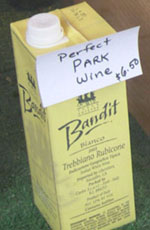 Wine in a box, sans bag |
Dry rosés
| Toad Hollow, The Eye of the Toad, Pinot Noir rose, Sonoma County, 2004. $8 Find this wine “Fine wine at a reasonable price” is the motto of Toad Hollow winery based in Healdsburg, Sonoma. This dry, crisp and refreshing rosé with notes of rose petals and strawberries is indeed easy on the palate and on the wallet (it is probably the cheapest, good Pinot Noir from California given how the prices have taken off post-Sideways. Since it is from their own vineyards, however, it will likely remain affordable unless they decide to divert the juice back to other Pinots that fetch a higher price). The flavors resemble excellent rosés from Europe though it is, surprisingly for a Pinot Noir, more full-bodied. The winemakers tip their hat at this style in the name, the eye of the toad, since French rosés are known colloquially in French as “the eye of the partridge.” A great eye peers through the label. Enjoy with chevre or salads on the deck. | 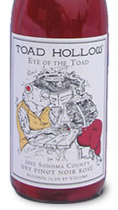 |
Antichi Vigneti de Cantalupo, Il Mimo, (rose) 2004. $11 Find this wine
This mime speaks volumes. On a hot summer day, there is nothing like a bottle of rosé glistening in the middle of an outdoor table surrounded
by excellent salads
| and breads and good company. And with plenty of warm weather being served up this summer across the northern hemisphere, I wouldn’t be surprised if rose sales were up higher than the thermometer. Il Mimo fits the bill very nicely with it crisp acidity and smooth and balanced fruit—it is one of the top value roses from Italy I’ve found this summer. (Importer: Summa Vitis, San Francisco) | 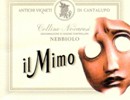 |
Medium-bodied reds
Capcanes, Mas Donis, Barrica 2003. $11 Find this wine
These old vines keep pumping out excellent value vino. Located in Montsant, the value-minded person’s region next door to Priorat, these 60 year old Grenache and Syrah vines produce a profound wine. In the glass, it is transparent and deceptively light in color yet on the palate the complex flavors yield to a finish that is rare among value vino. I would serve this wine with confidence to any guests—and this vintage’s swanky new label helps it further punch above its price point. Importer: Eric Solomon, Charlotte, NC.
| Finca Luzon, Jumilla, 2004. $7 Find this wine Lush and velvety this big red from Spain’s up-and-coming Jumilla region has great bang for the buck. If I had been traveling with a cork screw last week (which I wasn’t thanks to the TSA) this would have been my wine of choice (but since I wasn’t I factored in the corkscrew price and then opted for a screwcap from down under). This monastrell-syrah blend goes well with smoked or grilled meats and is on my list for “transitional reds for the fall” as well as “candidate for best label of the year.” Importer: Jorge Ordonez. |  |
Teatro, Malbec. (NV). $6 Find this wine
This is an Orwellian wine. It states neither vintage nor place and comes from the eerie producer named “bodega A-72107” (though the synthetic cork was stamped “Weinert,” a reputable producer). Why the marketing department at Bodega A-71207 chose the name Teatro and then put some restaurant watercolor scene on the label is known only to them but the wine gets the job done whether you’re having a pre-teatro menu or a BBQ. The wine does exhibit some of the red fruit leatheriness of Malbec but it is really only recommended for bargain hounds who won’t pay a dime over $6 since there are several other good examples still under $10 (viz Alamos). But, hey, if wine half this good were available by the glass in restaurants, wine drinkers would be happy. Importer: Pelloneda, NY.
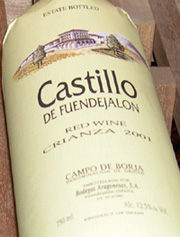
| Castillo de Fuendejalon, crianza, Campo de Borja, 2001 $9 Find this wine We’ve heard of wine in a box. And even wine in a paper bag. Well this wine bottle is packaged pre-bagged! Yes, I am recommending a wine under $10 in a paper bag (and I’m Dr. Vino, not Wino!). You may be familiar with the Rioja packaging of gold wire wrap, but this wine from Campo de Borja comes with all information printed a paper wrap. But it’s not the outside that’s important since the inside holds a pleasantly oaked, medium bodied red with notes of dark fruits and violets. A blend of old vine greache and tempranillo, this wine’s packaging makes it ready to hit the road and bring to friends at the grill. (Scoperta Importing, Cleveland Heights, OH) |
 |
Codice, Vino de la Tierra de Castilla, 2002. $8 Find this wine
This balanced red has notes of irony. It’s ironic because the term “codice” is the old word for Spanish laws and the wine is not from the strictest legal category, the denominacion de origen (D.O.), but instead from the larger and looser Vino de la Tierra de Castilla in the plains southeast of Madrid. However, since I have discovered several yummy, easy-drinking reds from this new area, it does lead wine drinkers to wonder about the values of the D.O.s. From the same family that makes Sierra Cantabria in the Rioja, this balanced, medium-bodied red is not earthshatteringly profound but it’s competently done and a good value. It is sure to be a crowd pleaser by the barbecue. A Jorge Ordonez selection (Tempranillo
Inc, Mamoroneck, NY)
Big reds
Quinta
de Roriz, Prazo de Roriz, Duoro 2003. $12 Find
this wine
This wine is international in style and if that’s ever a bad thing, it’s not in this case since I’ve tasted some pretty rough table wines from unreconstituted winemakers in Portugal. But the Duoro is really looking up and has become one of Europe’s best places for value vino (or vinho) as well as the exoticism of indigenous grape varietals, often unheralded internationally. This wine blends the Tinta Roriz, Tinta Franca, Tinta Barroca and Touriga Nacional to come up with a smooth, fruit forward red wine with excellent aromas of leather (saddle, not jacket) and dark fruit. On the palate, the pleasant tannins also have an X factor that I ascribe to the Touriga but would make it a great match for smoked or grilled meats. Kudos go to the Duoro DOC, which has one of the prettiest certification stickers on the back of the bottle. Importer: Premium Port Wines (San Francisco, CA).
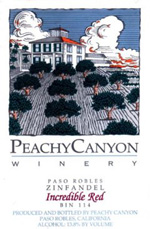
| Peachy Canyon, Incredible red, Bin 114, 2002. $9. Find this wine This will provide the American red for the 4th of July-you can supply the white and the blue. I often like a chilled white or rose in the summer to beat the heat. But then there are those meals, such as BBQ, that just cry out for a big red and the all-American Zinfandel fits the bill (although DNA research has proven the grape has its roots in Sicily and Slovenia). Peachy Canyon, a family-owned winery near Paso Robles, has a line of affordable zins. This “incredible red” is not the most full-throttled example of the grape, but is balanced with dark fruits and a peppery finish. 7,800 cases produced. |
 |
See the previous list including great summer wines
Sep
9
2005
Comments Off on Value vino list fifteen
Great food wines
Is it a slam on a wine to call it a “great food wine”? In today’s NYT dining section, Eric Asimov intimates as much when discussing extreme food – wine pairings with white wines from the Loire:
“Are Bourgueils, along with similar wines from the neighboring villages of Chinon and Saint-Nicolas-de-Bourgueil, great wines? No, but they are great food wines.”
I certainly have called wines great food wines too. But I got to thinking, doesn’t that mean that they are “great wines” since wine is best enjoyed with food? Why cede the title of “great wine” to heavily extracted, hedonistic fruit bombs?
Aug
17
2005
New York state of wine, part iii
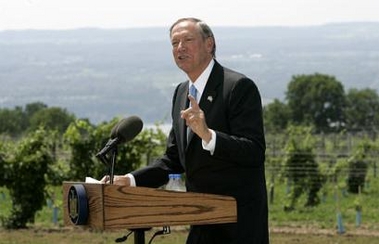 It’s official: Governor Pataki signed the bill into law yesterday that allows New York wine consumers to receive shipments of wine directly from the winery, even out-of-state wineries. (see backgrounder)
He signed the bill at Lamoreaux Landing Wine Cellars on Seneca Lake in a ceremony peppered with local winemakers and other state bigwigs. The Gov sounded a bullish tone for NY wine:
“I have no doubt that the Finger Lakes can certainly match, maybe even surpass†California’s famed Napa Valley someday, Pataki added in an interview. “It is an excellent standard to shoot for but I don’t see any reason why we can’t achieve that.†(full story)
Wow, that’s almost as ambitious as his running for president in 2008.
Others were more sanguine about the change. Willy Frank of Chateau Frank and Dr. Frank’s Vinifera Wine Cellars was fearful of competition.
“I don’t think it’s a wise law,” he said, pronouncing himself as “at best, neutral.” He added: “It will not help our industry.” (story)
Time will tell who is right. NY winemakers are certainly on the cusp of a new, more competitive chapter in the industry’s history. And consumers are becoming better served by a greater range of offerings. Belly up to the mailbox!
Jul
14
2005
Comments Off on New York state of wine, part iii
Value vino list fourteen
Crisp, racy whites
Simonsig, Chenin Blanc. 2004 $8.99 Find this wine
The rapid pace of change in the South African wine industry means that the country’s wines are a blend between old and new. Chenin blanc, for example, has been grown for centuries in the country and marketed under the name “steen” but has only recently been rebranded as Chenin
blanc. This Simonsig Chenin blanc is much more full flavored and lush than the traditional Loire style, but it still has that crisp acidity that makes it an excellent summer quaffer. Since the transition to democracy and the re-opening of the export markets a decade ago, Simonsig has worked to increase the quality of this wine and it certainly is apparent in the wine’s delicious fruit. (28,000 cases made; imported by Quintessential, Napa, CA)
Domaine des Cassagnoles, vdp Gascogny, 2003, $8. Find this wine
This bargain white is likely to become a summer staple around the Dr. Vino headquarters. Gascogny produces many great, rustic wines.
Winemaker and owner Gilles Baumann uses only fruit from his estate in this blend of three grapes that don’t grab the headlines (Colombard,
Ugni Blanc, and Gros Manseng). This crisp and refreshing white should be in everyone’s picnic basket as it matches well with warm weather
and lighter fare such as salads or sandwiches. Beat the exchange rate with this bargain! Importer: Weygandt-Metzler.
Dry rosés
| Crios, rose, Mendoza, 2004. $9.99 Find this wine The Malbec is fast on its way to becoming Argentina’s signature grape. The big, brawny red makes a great accompaniment to grilled meats, abundant in the Argentina. But it is rare that |
Check out the extended profile of Susana Balbo in The Real Wine World |
Malbec makes a rosé. Bleeding this wine off of her old-vine Malbec, Susana Balbo has crafted a serious rosé, dark in color, that would help the most devout red wine drinkers transition to summer. The wine is excellent with grilled calamari—in fact, anything grilled—and particularly great when consumed outdoors! Importer: Vine Connections.
Jean Luc Colombo, rose de Cote Bleue, 2004, $9.99 Find this wine
Summer is a great time to drink pink. It reached 90F (32 C) this week on the Dr. Vino deck and in that kind of heat it’s hard to drink red. So we often think red and drink pink in the heat of summer. Jean-Luc Colombo (who grew up in Provence but now makes most of his wines in the northern Rhone) has rehabilitated this Cote Bleue domain on the hills near Marseilles to make some quite savory rosés. This wine was one of two that struck me as being at the sweet spot in terms of value at a recent Provence rosé tasting. This Rosé de Côte Bleue is a blend of Syrah, Mourvedre and Counoise grapes, all hand-picked and goes great with salads and grilled white fish—under the shade of an umbrella of course! Importer: Palm Bay Imports (Syosset, NY).
Medium-bodied reds
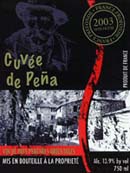
| Cuvée de Peña, vdp Pyrenées-Orientales, 2003, $8. Find this wine The label says Peña and the synthetic cork says Pène (but the name could also be the Catalan “Penya”)—call it what you will, this wine is an excellent bargain. A balanced, medium-bodied blend of Syrah, Grenache and Mourvedre, this un-oaked and unfiltered wine from near Perpignan goes well with grilled meats. The hot 2003 vintage makes it clock in at 13.9% alcohol but it is silky smooth nonetheless. Buy this one by the case! Importer: Hand Picked Selections (Warrenton, VA). |
 |
Caparra & Siciliani, Ciro, Rosso Classico,
2002 $11.99. Find this wine
Are you tired of big reds, high in alcohol? Then this Ciro from Calabria in the boot of Italy is for you. Weighing in at an old-fashioned
12.5% alcohol, this red is light in color but that doesn’t shortchange the flavors of this 100% Gaglioppo. Soft tannins and a light acidity
complement the hint of red berries that make it an excellent and balanced food wine. In fact, I thought of the title of David Rosengarten and Josh Wesson’s Red Wine with Fish as some pan seared halibut would be a great accompaniment to this wine. Importer: Gregory Smolik (S Cubed Selection, Maverick Wine Co., Chicago).
Big reds
Cortes de cima, Chaminé, Vidigueira, 2002. $10.99. Find this wine
Portugal has long been known for Port but the quality of its table wines has been steadily improving over the last decade. There are many compelling examples made from indigenous grapes such as the Touriga, but this one has the unusual combination of blending Tempranillo (which has greater renown in Spain) and Syrah from Alentejo, in the south of Portugal. The result is a silky smooth and full bodied red with rich dark color and unctuous flavors, including notes of plum. The Jorgensen family owns and operates these vineyards using sustainable agriculture.
Importer: Tri-Vin (Mt. Vernon, NY).

Elsa, Barbera, (San Rafael). 2003. $7 Find this wine
Barbera from Argentina? Yes, this classic grape of Piedmont has successfully relocated to the San Rafael district in southern Mendoza. Velvety smooth, with notes of strawberry and cherry and little of the acidity typical of Barberas, this new world interpretation of the old world grape is an excellent value. The single vineyard for this wine lies 2500 feet above sea level and the Bianchis practice sustainable agriculture and harvest the grapes by hand. If this is what Barbera can do in Argentina, Malbec should be shaking in its boots! Importer: Quintessential, LLC. (4,000 cases produced). 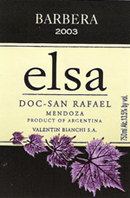
Chateau la Baronne, Corbieres, 2001, $9.99
If you have a hankering for the blends of Syrah, Grenache and Mourvedre from the south of France but have seen the prices rise above $10, then consider this wine currency relief. The 60% Carignan takes away the heft of Syrah and makes it a perfect transitional red for spring weather, lighter in color but full of spice, dark fruits and garrigue from the Corbieres in Languedoc. Hand harvested from a vineyard that practices sustainable agriculture and bottled unfined and unfiltered, this is one good red baronne. Importer: Louis/Dressner.
Ramon Cardova, Rioja, 2003 $11 Find this wine
Noah, Tevel, Judean Hills, 2002 (or 5762 in the Hebrew calendar). $14
About a decade ago Robert Parker reviewed a Spanish white lavishing praise in his prose and calling it “the best white wine
from Spain I have ever had.” Score: 88 points. I had similar feelings about these two kosher wines, which were both very good for Passover but I might not run to get them the rest of the year. However, those Passover-observing wine geeks who can’t bear the sight of Manischewitz ever again can rejoice that the quality of kosher wines has risen to the level on display here. The Ramon Cardova is a competent Tempranillo with traditional dark fruits, oak influence and soft tannins (importer: Royal Wine Corp). The Noah comes from the Judean Hills outside of Jerusalem and is a 60-40 blend of Cab and Merlot (importer Abaranel Wine Co). It is robust and full bodied despite being “mevushal,” a boiling process which previously meant something like “death to quality.” Advances in winemaking now mean simply that this wine can remain kosher even when served by non-Jews. L’Chaim! For more on kosher, click here.

Beyond the grade (but worth it):
Maison Bouachon, Vacqueyras, 2003. $18 Find this wine
Verget, Saint-Veran, “Terres Noires,” 2001. $18 Find this wine
Dehlinger, Syrah, reserve, 1997. $?? Find this wine
Jul
1
2005

Wine Maps
Monthly Archives
Blogroll
Categories
- American wine
- announcements
- Argentine wine
- auctions
- Australian wine
- Beer
- best wines
- Bling
- books
- Bordeaux
- bottled water
- Box wine
- Burgundy
- business of wine
- Celebrity wine
- Champagne
- Chicago
- China
- cocktails
- cognac
- corks
- corkscrews
- dining
- eco wine
- events
- foie gras
- food and wine
- French wine
- German wine
- giveaway
- grapes
- green wine
- guest post
- highlights
- how to
- Italian wine
- leaders and liters
- Mature wine
- meetups
- New York City
- On notice!
- photo captions
- podcasts
- Polls
- Port
- Portuguese wine
- power list
- reader mail
- rose
- sake
- Sommeliers
- South Africa
- Spanish wine
- spirits
- tasting sized pours
- The real wine world
- TV and movies
- Uncategorized
- videos
- vinexpo
- Weather
- wine and health
- wine and sports
- wine and tech
- Wine Blogging Wednesday
- wine blogs
- wine classes
- wine collecting
- wine gifts
- wine in india
- wine labels
- wine picks
- wine politics
- wine quizzes
- wine random
- wine science
- wine scores
- wine shops
- wine technology
- wine travel
- Wine under $10
- wine writing
- winemaking
- winespeak
 Blog posts via email
@drvino on Instagram
@drvino on Twitter
Advertise

quotes
One of the “fresh voices taking wine journalism in new and important directions.” -World of Fine Wine
“His reporting over the past six months has had seismic consequences, which is a hell of an accomplishment for a blog.” -Forbes.com
"News of such activities, reported last month on a wine blog called Dr. Vino, have captivated wine enthusiasts and triggered a fierce online debate…" The Wall Street Journal
"...well-written, well-researched, calm and, dare we use the word, sober." -Dorothy Gaiter & John Brecher, WSJ

Saveur, best drinks blog, finalist 2012.
One of the "seven best wine blogs." Food & Wine,
One of the three best wine blogs, Fast Company
Books for wine geeks

Wine books on Amazon: