Dr Vino's wine blog
wine talk that goes down easy
Commanderie de Peyrassol, rosé
Commanderie de Peyrassol, Coteaux de Provence, rosé, 2005 $13 Find this wine
The other day I had a rosé and it was no fun. Rosé is supposed to be fun. Besides the truncated flavor range, the price made it a further downer: $30. Yikes—talk about a buzzkill! So I was thrilled when, a few days later, I had this Peyrassol. Made by a mother-son duo in the hills of Provence, this wine from syrah, grenache and cinsault offers pale colors but an alluring blend of rose petals and strawberry aromas give way to refreshing crisp acidity. Just what you need on the deck in Provence—-in fact, a deck anywhere. Try this very food friendly with a range or foods from fish to spicy dishes. Shop around so that you don’t over-peyrassol. Importer: Neal Rosenthal.
 tags: wine | tasting notes | wine reviews
Jun
9
2006
4
Pascual Toso Malbec Reserve
Pascual Toso, Mendoza, Malbec reserve 2004. $13 find this wine
On my recent trip to Argentina, the jovial Ernesto Toso picked me up in his beat-up sedan and drove me from downtown Mendoza to his family winery in the Barrancas area, about 45 minutes. Overlooking a dry river bed that had channeled into the ground like a miniature Grand Canyon, I tasted the line of wines made at the winery with Paul Hobbs from Sonoma, California as consulting winemaker. The real sweet spot in terms of quality to price was the Malbec reserve with wonderful aromas of dark fruits and a hint of vanilla to complement a luscious mouthfeel and soft tannins. The straight malbec (about $8) is a good approximation but spring for the reserve if your budget permits. Fire up the grill and pull the cork! I also tried the $100 Magdalena 2002 (find this wine), which was no doubt a powerful and serious wine but at that lofty price point I couldn’t help but think about other wines I could have—or even nine bottles of the malbec reserve. Importer: TGIC imports.
tags: wine | tasting notes | malbec
May
26
2006
Sorbus, cabernet/malbec, 2004
Sorbus, cabernet/malbec, Mendoza, 2004. $6 find this wine
The other day a friend poured me some $6 Borsao, a wine that I discovered several years ago as a go-to value. Well, move over Borsao, here comes something meatier. A phenomenal value, this Sorbus displays the depth that a cab-malbec blend can give and has that same, crowd pleasing “ah” of the Ruca Malen Yauquen. I found it at PJ’s Wine in Manhattan for the bargain price of $5.97. This is one to buy by the case! Importer: Mediterranean Wine Co, Dover, NJ.
tags: wine | tasting notes
May
19
2006
Pinot envy
Pinotfiles assembled in Chicago over the weekend to assess the state of the grape. We traced its social, economic, and viticutural history across three continents and then tasted that variation in the glass.
We compounded the highly variable nature of the grape with yet another factor: bottle age. I was able to source many older vintage wines for the tasting through a local retailer of fine and rare wines so it was with relish that we could taste pinots with more maturity than you can normally find on the shelves of a local shop.
Although this sample was small, I’m tempted to say that California/Oregon pinots tend not to age as well as Burgundy. The 1997 Landmark was just this side of falling into oblivion. The 1995 Williams-Selyem was still very good with supple elegance but I couldn’t help wondering if it would have been better last year. Or the year before. By contrast the 2002 Stoller Vineyards had excellent fruit and lively spice from the tannins. A year or two might bring more balance to the wine but might it also make it less fun? Should American pinot be consumed in its youth?
Of course as soon as I reach for a generalization more data emerge to trounce it. The day before the big pinot tasting I had a 1997 Ken Wright Cellars, Guadalupe Vineyard (find this wine) that had an excellent finesse and was joy to drink. And a couple of weeks ago, I had a 1998 Dehlinger Pinot Noir (find this wine) that tasted as fruit forward as it did on release.
What are you experiences with aged American pinot?
Joseph Perrier, Champagne, NV Cuvee royale (find this wine)
2004 Whitehaven, Marlborough (find this wine)
1999 Daniel Rion, Vosne-Romanee, Les Beaux-Monts, premier cru (find this wine)
1997 Landmark, Van der Kamp Vineyards, “Grand Detour†(find this wine)
2002 Serafin Pere et fils, Gevrey-Chambertin (find this wine)
2002 Stoller Vineyards, Oregon (find this wine)
2004 Loring, Garys’ Vineyard, Santa Lucia Highlands, Monterrey (find this wine)
1999 Maison Champy, Corton-Bressandes (find this wine)
1995 Williams-Selyem, Allen Vineyard (find this wine)
1990 Domaine Leroy, Savigny-les-Beaune, Les Narbantons, premier cru (find this wine)
The 1997 Landmark, Van der Kamp Vineyards, “Grand Detour,†which had Helen Turley as a consulting wine maker for that vintage, did remind me of a line in Steve Heimoff’s book about the Russian River Valley in Sonoma. Local lore says that producers can add $5 that they can charge for each word on the label. But, hey, that could often apply to Burgundy as well.
tags: wine | pinot noir | tasting | wine classes
May
16
2006
Malbec, a backup or a star?
As I headed to Mendoza, I was haunted by a couple of sentences Eric Asimov recently wrote from a Wines of the Times tasting panel on Malbec:
“…words came readily enough to sum up the tasting — two-dimensional, narrow-gauge, simple. Nothing wrong with those words, but not very many thrills among them.”
Chilling stuff for the traveler to Malbec Country! I didn’t really understand what “two-dimensional†meant but it certainly sounded like damning with faint praise. When I was on the ground, I put the question to Manuel Louzada, winemaker at Domaine Chandon. His reply came with a sketch on his tasting mat, which I attempted to recreate here:
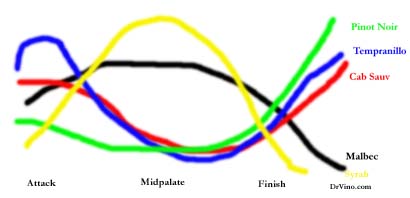
Essentially he said he could understand such a criticism because Malbec has a good attack and very good midpalate while it trails off at the finish. (If you think an attack is a military or a soccer term you’d be right; in wine tasting it also means how the wine tastes when it first enters your mouth—besides wet).
The other various arcs show the profile of other grapes. Tempranillo (blue, above) has a good attack, weaker midpalate, and a strong finish. Cabernet (red) has a similar arc he suggested but not quite as much on the attack. Syrah (yellow) has a broad midpalate but is kind of weak on the attack and the finish. Pinot Noir (green) has a finish that goes on and on—when done right.
This explains why some of the most expensive wines from the region are blends. The $70 Cheval des Andes 2003 (find this wine), perhaps my favorite of the big boy “grand cru†wines I tasted in Mendoza, is a blend of Malbec and Cab to give it a full style. Paul Hobbs added 5 percent Cab to his $100 Magadalena Toso (find this wine). And the $85 Nicolas Catena Zapata 2002 (find this wine) is a 72-28 blend of Cab and Malbec. This makes sense since Malbec has traditionally been a blender in Bordeaux and the Loire. Looking at the graphic above, a blend of the red and the black lines hits all the highs.
“The force of the Cabernet is softened by the Malbec,” José Galante winemaker at Catena said. “We make the best wine that we can in the Nicolás Catena Zapata.”
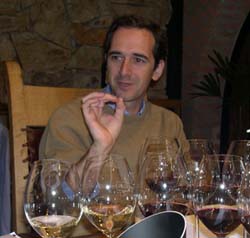
The various vineyard sites also have different tasting arcs for the same variety Galante said (see my notes on tasting Menodoza’s terroir). He works to blend those and give the single varietal wines more heft and character.
But what about Malbec on its own? “Malbec is sexy, it seduces,” said Manuel Louzada of Chandon. Indeed, this traditional backup singer is ready for a starring role. The prolonged growing season for the grapes in this high desert, which can have 50 percent more growing days than cool Bordeaux, makes the tannins in the Malbecs from Mendoza sweet and approachable. For white wine fans who object to the dryness or mouth-chomping tannins in Cabernet, reach for a Malbec from Argentina and you will not only have a wine that is easy on the palate but also easy on the wallet. If Malbec wines are two-dimensional, then the world is flat.
Apr
21
2006
Tasting Mendoza’s terroir
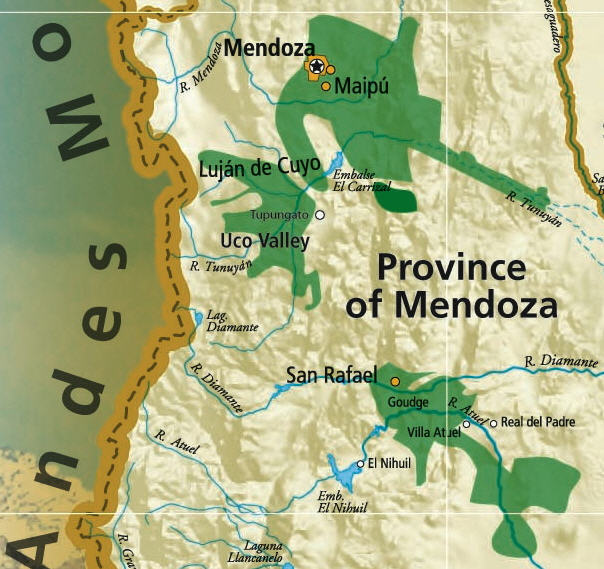
I’m frustrated by the lack of a good wine map for Mendoza. But I guess that’s testimony to the “undiscovered” nature of the destination.
The one above shows the general lay of the land with the main growing areas of Maipu and Lujan de Cuyo moving out from the city of Mendoza (see this topo/satellite/weather map. Further south is the Uco Valley with many wonderful wineries and 200km south of the city lies San Rafael, home to Famiglia Bianchi among others. I didn’t visit San Rafael on my trip but I did visit the other regions.
There’s an incredible vitality to Mendoza. The region is experiencing a boom. Foreign direct investment, particularly from France and Chile, is pouring in to vineyards and fancy new wineries are going up everywhere. Several locals told me that unemployment is at 6 percent, well below the national average of 20 percent. Demand for luxury hotels is such that the Park Hyatt is often full and two other five-star hotels are being built. And there are luxury boutique hotels such as the 14-room Cavas Wine Lodge sprouting in the vineyards themselves.
The Andes provide a dramatic backdrop for the city as well as plenty of activities for tourists, from hiking to rafting. But it’s the wineries that I went for and I wondered, does terroir matter? Or put more simply, are there different microclimates in Mendoza?
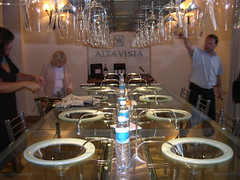 It is always hard to decipher the influence of the vineyard as opposed to the influence of the winemaker. So I had an excellent chance to taste the terroir in the very cool tasting room at Alta Vista with three Malbecs from different vineyards made by the same winemaker. Patrick d’Aulan and family sold the Champagne house Piper-Heidsieck in 1999 and still owns Chateau Sansonnet in Bordeaux, purchased this winery in 1998 and started restoring it and acquiring properties. They now have four vineyard sites including 540 acres in the Clos de los Siete project in the Uco Valley area of Vista Flores (planted in 2002; the d’Aulans have since left the venture).
The other three vineyards are much smaller and run from south to north in Mendoza. La Consulta is a cool-climate, 17-acre vineyard south of even the Uco Valley at the base of the Andes; the Alto Agrelo vineyard is 225 acres an situated in Lujan de Cuyo; and the 17 acre La Consulta is the closest to the city of Mendoza and has a wide temperature fluctuation between high and low. They all lie at more or less the same altidue, about 3500 feet, and about 33 degrees south of the equator. The Alta Vista premium line of Malbec has a limited production of wine bottled from each vineyard site and they are only sold as a boxed set (about $50). While American consumers no doubt have difficulty distinguishing between the various subregions, Argentine laws on place names don’t provide much help since only generic geographic indications, such as Mendoza, are allowed much to the chagrin of many winemakers I met. Alta Vista overcame this problem by including the vineyard name as the brand name for the wine.
I tasted the wines in the order of the vineyards above and they were dscribed as ranging from “elegant and feminine,” to medium, to bold. Well, if the if the La Consulta one is feminine, the woman rides a Harley. While I liked the wine with its aromas of violets, it was still big and lush with a gorgeous mouthfeel. The third wine from Las Compuertas was perhaps more “manly” since on the finish was a rare dose of mouth chomping tannins.
My favorite wine was the middle of the road “Serenade” from Alto Agrelo. Inky purple in color, the attack draws you in with notes of plums, dark cherries, a faint whiff of asado, and lush, velvety mouthfeel. Although the wine sees some oak, it is harmoniously balanced with the fruit and the tannins are sweet.
All in all, the Alta Vista terroir experiment was very instructive and a very good overview of the different vineyard characterisics. It’s a pity it isn’t more widely available in the US–I guess you’ll have to go there to check it out for yourself.
Alta Vista: Alzaaga 3972, M5528AKJ, Chacras de Coria, Menodza, Argentina. Open for visits–check the Alta Vista web site for more info, vineyard maps and photos here. Also, see additional wine maps of Mendoza here.
tags: wine | Argentina | Mendoza | Terroir | Alta Vista | travel
Apr
15
2006
Alta Vista Torrontes
Alta Vista Torrontes, Mendoza, 2004 $9 (find this wine)
The best white wine that I had on my recent trip to Argentina I had on the first day at Cabaña Las Lilas restaurant in the hip Puerto Madera area of Buenos Aires: Alta Vista Torrontes. And it kept popping up on the trip as I tasted it two more times (including at the winery with the 05) and loved it each time. “Aromatic” is a way that Torrontes frequently gets described but perfumed might be more accurate. White peach, honeysuckle blossom, perhaps even lychee conspire in an hugely rich and expressive aroma that is not for the faint of heart. The wine has crisp acidity and is totally dry (2g residual sugar) despite the vortex of aromas. While this wine is a little bit hard to find in the US, an able substitute is the Santa Julia Torrontes, which has wider availability (Whole Foods) can be found for as low as $6. Pair with Asian foods or try it as an aperitif. Either way, a torrent of flavor will be yours!
Apr
14
2006
Flananghina, DeFalco, ABCSBR, WBW#20
 While the ABC (“anything but Chardonnay”) theme is well known by now, for Wine Bloggging Wednesday’s current edition, Wine for newbies tacks on an exclusion on Sauvignon Blanc and Riesling as well. Hence ABCSBR WBW20–how’s that for alphabet soup?! And oh yeah, the assignment calls for the white wine has to be 100 percent of the variety so no blends are allowed.
While I am tempted to write up the best Torrontes I had while in Argentina last week, I will save that write-up for Friday’s value vino since it is under $10.
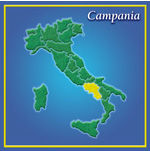
Falanghina is a great “indigenous” grape that grows on the flanks of Mt. Vesuvius outside of Naples. I like its refreshing crispness and fruit–it is the new Sauvignon Blanc for wine geeks. Greg, imports this 2004 Falanghina from DeFalco, says that it “rocks” when paired with fish (find this wine, about $14). I concur. Although Mrs. Vino liked this DeFalco, she preferred the Falanghina from another producer, Feudi (find this wine), which sees some oak. Gabriele DeFalco used to be the winemaker at Feudi but Greg said he left to pursue his own style of wine making that is more authentic and less international. Whichever style you choose, find a Falanghina near you!
tags: wine | wbw | Falanghina
Apr
12
2006

Wine Maps
Monthly Archives
Blogroll
Categories
- American wine
- announcements
- Argentine wine
- auctions
- Australian wine
- Beer
- best wines
- Bling
- books
- Bordeaux
- bottled water
- Box wine
- Burgundy
- business of wine
- Celebrity wine
- Champagne
- Chicago
- China
- cocktails
- cognac
- corks
- corkscrews
- dining
- eco wine
- events
- foie gras
- food and wine
- French wine
- German wine
- giveaway
- grapes
- green wine
- guest post
- highlights
- how to
- Italian wine
- leaders and liters
- Mature wine
- meetups
- New York City
- On notice!
- photo captions
- podcasts
- Polls
- Port
- Portuguese wine
- power list
- reader mail
- rose
- sake
- Sommeliers
- South Africa
- Spanish wine
- spirits
- tasting sized pours
- The real wine world
- TV and movies
- Uncategorized
- videos
- vinexpo
- Weather
- wine and health
- wine and sports
- wine and tech
- Wine Blogging Wednesday
- wine blogs
- wine classes
- wine collecting
- wine gifts
- wine in india
- wine labels
- wine picks
- wine politics
- wine quizzes
- wine random
- wine science
- wine scores
- wine shops
- wine technology
- wine travel
- Wine under $10
- wine writing
- winemaking
- winespeak
 Blog posts via email
@drvino on Instagram
@drvino on Twitter
Advertise

quotes
One of the “fresh voices taking wine journalism in new and important directions.” -World of Fine Wine
“His reporting over the past six months has had seismic consequences, which is a hell of an accomplishment for a blog.” -Forbes.com
"News of such activities, reported last month on a wine blog called Dr. Vino, have captivated wine enthusiasts and triggered a fierce online debate…" The Wall Street Journal
"...well-written, well-researched, calm and, dare we use the word, sober." -Dorothy Gaiter & John Brecher, WSJ

Saveur, best drinks blog, finalist 2012.
One of the "seven best wine blogs." Food & Wine,
One of the three best wine blogs, Fast Company
Books for wine geeks

Wine books on Amazon: