Dr Vino's wine blog
wine talk that goes down easy
Lucarelli Primitivo 2004
Lucarelli, Primitivo 2004 from Puglia. $6.97 (find this wine)
In the heel of the boot that is the Italian peninsula, the hot plains of Puglia have typically produced prodigious quantities of wine. Quality is creeping in now as the effects of the world wide glut are being felt. This Lucarelli Primitivo is an intersection of the two themes: good quality at a low price. These 60 year old vines yield primitivo, a grape that is a relative of zinfandel. The resulting wine is a real crowd pleaser with round fruit followed by persistent, faintly spicy finish. It’s light enough to try with pasta, but would love some grilled meat. What are you waiting for? Start searching for this value vino!
 tags: wine | wines under $10
Oct
27
2006
1
Texier, Cotes du Rhone, 2004
 Texier, Cotes du Rhone, 2004. $10 find this wine
I pulled out this wine as a “third bottle” one evening because I expected it to be big. But it was lean. And very food friendly. I poked around the web and found this comment from the importer: “Eric Texier and his wife, Laurence, studied nuclear science in France and in Illinois.” Oops, that wasn’t the important part. Take 2: “He vinifies all of his Rhones as if they were Burgundies. His touch is therefore light, and involving cold maceration of all reds…and the gentlest, non-filtered, gravity powered bottling possible.” Aha! Well, it certainly is an unusual CDR, but good nonetheless–and Texier is tres sexier at $9.99! Importer: Louis/Dressner.
tags: wine | tasting notes
Oct
20
2006
Comments Off on Texier, Cotes du Rhone, 2004
Wine Century Club, express
I’ve blogged before about the Wine Century Club, the club that challenges you to drink off the beaten path. Try wines from 100 different grape varieties (blends included) and you’re in! You even get a handsome certificate to commemorate your wanderlust.
Well, yesterday I found the express route to membership. Consider it a mileage run, one of those trips that road warriors sometimes fly just to get the miles for elite status on airlines. In a word: Portugal.
Portugal, like Greece and Italy, is a treasure trove for people stuck at 75 on the way to the Century. Turn to these lands of plentiful indigenous grape varieties and your membership becomes a cakewalk.
Yesterday I tried the Quinta do Vale Dona Maria 2004, a “field blend” of 41 grape varieties (find this wine). Almost half the way there in one glass! While the wine did have some of the charming, rustic qualities that I like in the best wines from the Duoro (more to come on that next week), this one had a little too much oak for my taste. But, hey, if it takes you almost half-way to learning the secret handshake of the Wine Century Club, put it on your list!
tags: wine | wine century club | grape varieties
Oct
20
2006
Blogcast: Gregory Smolik and the wines of COS, Sicily

I tasted with Gregory Smolik yesterday at the Domaine Select portfolio tasting in New York City. You may remember Greg from last year’s Real Wine World project. Greg is now the Midwest Regional Manager at Domaine Select.
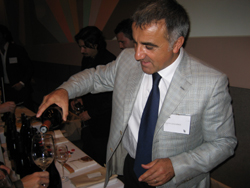 Although he’s no longer on his own, he still has his passion for the wines of Italy. I recorded us tasting the wines from the biodynamic producer COS from Sicily. COS owner Giusto Occhipinti (pictured right) was there but he does not speak English. As with the philosophy of biodynamics, the wines are made in an extremely natural style complete with respect for the lunar cycle. These wines from indigenous grape varieties are also fermented in terra cotta amphoras.
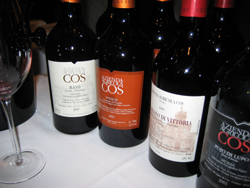 We taste three wines:
1. Rami 2005, a white wine made from insolia and grecanico grapes (find this wine)
2. Pithos 2005, a light red made with nero d’avola and frappato. This was my favroite wine of the three. (find this wine)
3. Cerasuolo di Vitorra, a red aged in old oak barrels (find this wine)
Listen to Greg from the floor of the tasting talking about food pairings, using wood in winemaking, and descriptors such as “the inside of a walnut shell.” Find out which wine Greg says “you and I could drink three bottles each of this and we wouldn’t get a headache!”
Listen here (12 minute mp3 file)
Thanks for the audio help, Tim!
tags: wine | biodynamic| Sicily
Oct
18
2006
Mourvedre: the next big red?
A dozen intrepid tasters gathered at the Dr. Vino World Headquarters on Saturday to answer two pressing questions: (1) is mourvedre the next grape “for men†and (2) if we see more of it thanks to global warming, is that a good thing?
The two questions are interrelated. Because mourvedre (minus one for machismo—French name) has a long hang time (plus one!) it can produce powerful red wines (plus two!) that are high in alcohol (plus three!).
Further, the late bud break and late ripening mean that it does well in warmer climates, such as its ancestral homeland, Spain. The grape has grown so well in Provence that the appellation Bandol mandates that all reds must have at least 50 percent mourvedre. As the world heats up, are we going to see more mourvedre?
Mourvedre is popping up around the world. Originally named after the Spanish town of Murviedro, it came to cover much of southern France. In the late 19th century when phylloxera devasted vineyards, mourvedre lost out since it was difficult to graft, the successful remedy against the louse. Only in the last 50 years was mourvedre able to be grafted and as a result it has swung back into favor though it still lags the other big reds.
It is often blended with grenache and syrah in the Southern Rhone. Chateau de Beaucastel has had as much as 70 percent mourvedre in the blend. Known for giving brambly, rustic, gamey or animal aromas it can take a wine to the wild side. Australia also makes blends known as “GSM†after the three grape varieties although I found it hard to locate one with a significant amount of M.
The best wines from mourvedre are known to improve mightily with age. So I wanted to be sure to include some with age as well as from various growing areas. And it tends to be good in its inexpensive incarnation from Spain, so I wanted to include a few of those too.
I bought ten wines that were mostly mourvedre—or monastrell as it is known in Spain or mataro as it is known in California. Seven of our wines are currently available on the market. One, the Castano Solanera 2001 had been in my cellar for the past couple of years since I purchased it for about $10. The two others, the Tempier and the Ridge, I purchased from Hart Davis Hart in Chicago.
They came from Spain (5), California (3), Washington State (1), and France (1). I bagged them that morning so the tasting would be free of prejudice.
The tasting (in my order of preference)
Ridge, Mataro, Evangelo Vineyard, ATP, 1993. $25 find this wine
An excellent example of aging gracefully. Soft and delicate tannins, notes of forest floor, brambles, dust, leather and some tart cherry, this bottle was quickly emptied. With only seven barrels made, this was a small production that is now out of production.
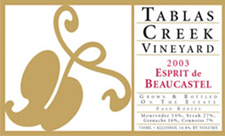 Tablas Creek, Esprit de Beaucastel, Paso Robles, 2003. $38 find this wine
Wonderfully balanced with notes of earthy rusticity. The luscious black fruits, supple tannins, and mouth-filling charm with layers of complexity including faint clove, briars, and sage made this my favorite of the young wines. 50 percent mourvedre.
Rafael Cambra, Valencia, 2003. $30 find this wine
Modern in style, this wine exhibits the intensity of the grape in its youth: a slight minerality and acidity followed by solid but fun tannins from the oak as well as the grape. This one could do with 3-5 years in the cellar.
Castaño Solanera, Yecla, 2001. $10 find this wine
Although this wine had a couple of years of age on it, the tannins were still serious. But they made it seem more grown up. Sadly, a second bottle opened after the tasting was corked.
Juan Gil, Jumilla, 2003. $15 find this wine
This highly praised wine from importer Jorge Ordonez is fun and approachable with big concentration and supple tannins and notes of dark fruit, bacon fat, and vanilla. Many tasters enjoyed it, as did I. But I couldn’t help wondering if, in the future, if it wouldn’t be just a tad dull? Still it was the best performer of the currently available under $15 group.
Domaine Tempier, La Migoua, Bandol, 1998. $35 find this wine
Still very dark in color, this single vineyard Tempier with eight years of age was a disappointment. It exhibited musty, skunky notes with licorice and fatigue. I tried it again after the unveiling. A half a bottle remained at the end of the evening.
McCrea, Mourvedre, Red Mountain, Washington State, 2003. $13/375ml find this wine
Bottled in clear glass, the wine has a bright, Jolly Rancher color. It was a prelude to a taste: odd sweetness permeated the wine. Well made and improved with some of the cheeses, but oddly sweet finish remained.
Casa Castillo, Jumilla, 2004. $11 find this wine
No great complexity, no tannic backbone left me thinking, “eh.â€
Luzon, Jumilla, 2005. $7 find this wine
With the previous vintage receiving huge praise (although my experience was one good one bad), I had thought that this would be a ringer. Unfortunately it was not to be. There was an odd mustiness that would not blow off, bright berry up front and oak that was not well integrated.
Garretson, mourvedre, “la graosta,†Paso Robles 2004. $30 find this wine
This 100 percent mourvedre had odd notes of sea salt and sulfur that took a while to blow off. Bright cherry and wet dog notes also present. Perhaps blend in some grenache or syrah? The alcohol too was perceptible with 14.8 percent on the label.
Returning to our two questions, mourvedre may not be too manly since men and women enjoyed the wines equally. And if we do see more of it in an era of global warming, it is able to produce exciting wines, particularly when blended with the fruitiness of grenache and the spiciness of syrah. On its own, a great site and top winemaking skills appear needed to make a good one. If game or fowl is on your plate this fall, try matching it to a mourvedre in the glass.
Oct
11
2006
Evesham Wood, Blanc du Puits Sec
Evesham Wood, Blanc du Puits Sec, Eola Hills, 2005. $13 find this wine
While I was in Oregon recently, I tried this excellent organic pinot gris. Russ Raney adds depth to the wine by blending in 15 percent gewürztraminer, which makes it a terrific aperitif wine. It has the floral notes of pinot gris with a hint of the lusciousness of gewurtz all with minerality and refreshing acidity—I’d like to taste it blind against some Alsatian whites, or forget that, with some seafood! The only bad news is the limited availability of the wine. But based on this taste, I’d be very willing to cobble together an order of his very reasonably priced wines from Russ at the winery directly. Pinot gris, as only Evesham Wood! eveshamwood.com (503) 371-8478. Organic.
tags: wine | wine reviews
Oct
2
2006
Comments Off on Evesham Wood, Blanc du Puits Sec
What the Woot?!
wine woot! Have you discovered the loot?
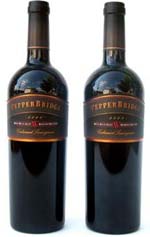
I just placed my first order since I was unable to resist two bottles of 01 Pepperbridge Cab from Walla Walla for $59.99 + $5 shipping. It’s usually $50 a bottle. (find this wine)
After punching in my order the delivery message was a little cryptic about when I would actually get the wine. I doubt that Woot handles the inventory but somehow shipping is always $5. I’ll keep you posted as to how long my order takes to reach me in NY. This is, of course, the beginning of the frugal wine buyer’s window for shipping wine by ground across the country. The summer heat is gone and the tundra has yet to freeze.
What is woot? Besides being yet another made up name since all existing domain names were taken, they offer a deal-a-day on general merchandise and a deal-a-week on wines. So every Sunday at midnight, they put up a new deal and the old deal is gone forever. The writing is hilarious. To wit:
Hey, taxpayer! Get ready to hand over some more of your hard-earned wages to those clowns in Washington! Only this time we’re talking about ye merrie winemakers at Pepper Bridge Winery in Washington state. And if you enjoy ultra-premium, critically-acclaimed wines like the Pepper Bridge 2001 Cabernet Sauvignon, this is one bill you’ll happily pay.
With a sales pitch like that it’s not hard to believe that the winery has sold 1200 bottles through Friday. I just stumbled on this news item where one of the Pepperbridge owners implies they are selling it as a loss leader, saying “Just given that it is a one week deal and nationwide exposure on a popular site to our wine, its been worth it for us.”
As of midnight tomorrow, though, the deal is over. And then the next one starts. Woot!
tags: wine | woot | online wine shopping
Sep
23
2006
Comments Off on What the Woot?!
Turcaud, Entre Deux Mers, white, 2005
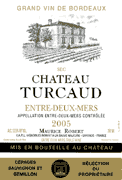 Chateau Turcaud, Entre-Deux-Mers, white 2005. $11 find this wine
The Entre-Deux-Mers region of Bordeaux is a misnomer. It’s not between two seas, as the name states, but between two rivers. This wedge of flat land between the Garonne and the Dordogne Rivers used to produce a lot of boring wines but the economic crisis in the area is starting to invigorate the area as a whole. This dry white, a blend of sauvignon blanc (50%), semillon (45), and muscadelle (5) is great value vino from Bordeaux. Luscious notes of pineapple layer on top of crisp acidity giving the wine a great mouthfeel. It’s an excellent companion to potato-leek soup. Mmm, fall is here. Consider this a wine for between two seasons, not seas.
Importer : Fleet Street Wine Merchants
tags: wine | wine reviews
Sep
22
2006
Comments Off on Turcaud, Entre Deux Mers, white, 2005

Wine Maps
Monthly Archives
Blogroll
Categories
- American wine
- announcements
- Argentine wine
- auctions
- Australian wine
- Beer
- best wines
- Bling
- books
- Bordeaux
- bottled water
- Box wine
- Burgundy
- business of wine
- Celebrity wine
- Champagne
- Chicago
- China
- cocktails
- cognac
- corks
- corkscrews
- dining
- eco wine
- events
- foie gras
- food and wine
- French wine
- German wine
- giveaway
- grapes
- green wine
- guest post
- highlights
- how to
- Italian wine
- leaders and liters
- Mature wine
- meetups
- New York City
- On notice!
- photo captions
- podcasts
- Polls
- Port
- Portuguese wine
- power list
- reader mail
- rose
- sake
- Sommeliers
- South Africa
- Spanish wine
- spirits
- tasting sized pours
- The real wine world
- TV and movies
- Uncategorized
- videos
- vinexpo
- Weather
- wine and health
- wine and sports
- wine and tech
- Wine Blogging Wednesday
- wine blogs
- wine classes
- wine collecting
- wine gifts
- wine in india
- wine labels
- wine picks
- wine politics
- wine quizzes
- wine random
- wine science
- wine scores
- wine shops
- wine technology
- wine travel
- Wine under $10
- wine writing
- winemaking
- winespeak
 Blog posts via email
@drvino on Instagram
@drvino on Twitter
Advertise

quotes
One of the “fresh voices taking wine journalism in new and important directions.” -World of Fine Wine
“His reporting over the past six months has had seismic consequences, which is a hell of an accomplishment for a blog.” -Forbes.com
"News of such activities, reported last month on a wine blog called Dr. Vino, have captivated wine enthusiasts and triggered a fierce online debate…" The Wall Street Journal
"...well-written, well-researched, calm and, dare we use the word, sober." -Dorothy Gaiter & John Brecher, WSJ

Saveur, best drinks blog, finalist 2012.
One of the "seven best wine blogs." Food & Wine,
One of the three best wine blogs, Fast Company
Books for wine geeks

Wine books on Amazon: