Dr Vino's wine blog
wine talk that goes down easy
Decanting the critic: Tasting with Dr. Jay Miller, the right hand of Robert Parker
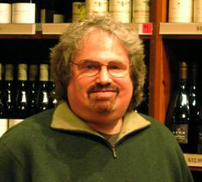 We all know that Robert Parker’s The Wine Advocate essentially sets the market for wine. But how do the critics there taste the wines that they will make or break with their ratings?
Last week I had the chance to taste with Jay Miller, Ph.D., whose duties include vast swathes of the wine world ranging from Australasia to Iberia to the Pacific Northwest. I met with him to taste wines of Argentina. Dr. Jay and Dr. Vino, mano a mano. Or at least Riedel a Riedel.
I didn’t have to travel to Monkton, Maryland. The setting was actually the Argentine Consulate in midtown Manhattan. I walked into the palatial room, which must have been 40 x 25 w 12 ft ceilings, complete with friezes. On one side, Jay Miller was seated at a table with two settings. On the other side were hundreds of wine bottles, even more hundreds of Riedel glasses, and a small flock of people to pour. Read more…
May
21
2007
23
Reader mailbag: which wines for a BBQ on Mother’s Day?
Dear Dr. Vino,
 Which wine would you recommend for a Mother’s day barbecue?
Thanks,
Erin
Dear Erin,
Hmm, that’s a tough one. When I think BBQ I think “big red” to go with the grilled meat. But “mom” and “big red” are not the first wine and people pairing that leaps to mind.
 Since mom is the star of the show on Sunday, I’d check with her to see if she likes big reds. If not, I’d consider structuring the menu toward lighter fare such as grilled fish and vegetables.I’d try the Pazo de Senorans albarino 2005 from northwestern Spain. It’s a bit more expensive than entry-level albarino at $20 (find this wine) but it has a beautiful mouthfeel thanks to aging “on the lees” (dead yeast cells–don’t ask) to round out the minerality and acidity. It’s a great complement to grilled white fish.
If you wanted to do some ginger grilled shrimp, I’d try some bubbly or faintly spicy gewurztraminer. On the bubbly side, you could go for the value play with the wonderful, dry Bisol “crede” prosecco for $15 (find this wine) or pay a bit more for the Falmet brut Champagne, a full-bodied bottle of champers thanks to being 90 percent from pinot noir and pinot meunier. For a gewurz, I’d try the Zind-Humbrecht to really hit a home run (find this wine).
If your mom likes reds and grilled meats, then I’d try a mencia from Bierzo for around $12. At that price point the wines are unoaked and lots of food friendly acidity and fruit. Try the Peique (find this wine–or the Abad dom Bueno). For a lush red, try the Terra Rosa malbec for $12 (find this wine) or the Castillo de Jumilla monastrell for same price (find this wine). I had an excellent Gigondas recently, the 01 Domaine Le Mas des Collines Regis de Taxis, for about $21 that would be great with heartier grilled meats (find this wine). If you really wanted to splurge, go for the Ridge Lytton Springs zin (find this wine) to leave your relatives and mom with a lasting impression.
Fingers crossed for good weather on Sunday!
Cheers,
May
11
2007
Reader mailbag: what to get a colleague to celebrate a promotion? (budget edition)
Dear Dr. Vino,
I’m finishing my Ph.D. and my committee advisor has just been appointed the new Dean of Liberal Arts at [name withheld]. I’d like to get him a nice bottle of wine (he loves Spanish wines normally, he travels to Latin America frequently, and is an American history buff) that can be afforded on a grad student budget (~$30). What would you recommend?
Thanks!!!
Amy
Hi Amy, Read more…
May
8
2007
Cameron Hughes, a bird on the back of a hippo

One of the oldest and most dubious sales pitches in the wine trade might be “this wine comes from the vineyard right next to [insert prestigious winery name here]. Similar quality, a fraction of the price.”
Uh huh.
So it was with my eyebrow duly raised that I met with Cameron Hughes. He lures Costco shoppers down the aisle to try his wine by telling them that he’s got a “$30 wine for $9.99.†Based on some rhapsodic reviews of his wines on wine web sites, the claim sounded plausible enough to lure me to meet with him for a coffee one morning on his recent trip to New York City.
Hughes is not a wine maker. He is part wine finder, part marketer, and and part salesman. And he’s introducing an innovative way of making and selling wine that is delivering cost-savings to consumers in the form of some easy-drinking, value vino. Read more…
May
3
2007
Green wine: the zen forest of Matassa, Roussillon
Perched in the hills and nestled in the forest not far from the sea lie the vineyards of Matassa. But the vigneron farming the land in Rousillon, on the French side of the Pyrenees, is distinctive for two reasons. First, he’s young. And, second, he’s from South Africa.
Tom Lubbe lives near the vineyards with his family. He developed Matassa with Nathalie Gauby and Sam Harrop, MW, who used to be the head buyer for Marks & Spencer. At a recent tasting where I tried their wines, Tom told me that the Rousillon is one of the few places in France where a young person can afford to start out since real estate in many other wine growing areas is horrendously expensive.
Tom has several vineyard parcels and he farms them all biodynamically, a sort of organic plus method. He aims to make the wines as naturally as possible and even do a preliminary foot crush and use only indigenous yeasts. The prized vineyard, in Tom’s eyes, is one of 112 year old carignan at 1,800 feet above sea level. It’s surrounded by a forest so Tom doesn’t have to worry about pesticides from a neighbor blowing into his vineyard.
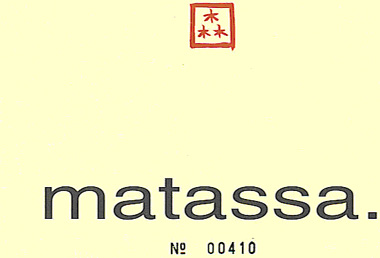
The labels have two surprising things on them. First, simplicity. Many French labels are cluttered with confusing terms such as superieur when the wine is not actually all that superior. These labels have zen-like minimalism and in fact include a kanji character on them (the one for forest). Second, Harrop and Lubbe are some of the rare quality wine producers who have thumbed their nose at the appellation system and make only vin de pays wines, specifically vin de pays Cotes des Catalanes. There are no grape varieties on the labels, however, since vdp regs state that a wine has have a 100 percent truth claim to state the variety on the label.
 The Cuvee Marguerite is a blend of viognier and petit grain muscat aged in old Burgundy barrels. It has huge araomatic intensity and an intriguing minerality underneath. (find this wine)
The Matassa blanc is a white of rare intensity from the region. Surprisingly pleasant acidity, the wine has a wonderful well-balanced and waxy texture with great minerality and hint of Key lime and a drop of honey. (find this wine)
Moving to the reds, the “Cuvee Romanissa” 2004 is a surprisingly light and lively blend of mostly grenache with a dollop of carignan, mourvedre, and cabernet sauvignon (find this wine). Dark fruits and an alluring savory character make this a great food wine, calling out for grilled meats. The piece de resistance is the Matassa rouge, made from all 112 year old carignan (find this wine). Surprisingly light in color in the glass, the wine has a sort of rusticity on the nose that compliments dark fruit notes. On the palate the wine has a light weight yet great intensity and balance between fruit, acid, minerality and lightly peppery tannins. Really an extremely attractive red wine. And to think it is from the humble carignan…
Environmentally friendly. Good packaging. Great product. Other French producers should take note and follow the lead of Matassa (it’s just a pity about the price, but hey, you can’t have it all).
Total production: 20,000 bottles. Importer: Eric Solomon.
Apr
20
2007
Put your money where your mouth is
 Eric Asimov’s trying to eliminate my job!
In his column yesterday (which is currently the #3 most emailed on the site), the NYT chief wine critic and chief wine blogger says that the best thing for wine newbies to do is find a trusted wine shop and put $250 of your wine budget in their hands and walk out with a case of wine. It’s better than even taking a class he argues.
As a wine educator (with three classes this week), I have to object! But he does make a good point–two good points, actually.
First, my objection. In my classes, I select wines, organize them thematically or stylistically, pair them with food (granted, just cheese, bread, and occasionally olives not a full meal), show maps, images, and talk about the politics, people and history of a wine. We also talk about how to find the best wine buys locally, wine-friendly restaurants, where to taste wines for free, how to serve, and much more. The two hours fly by. And all participants get to talk, sip, and discuss, so there is a social aspect as well. So don’t write off classes too quickly, even for newbies! They can have much to offer.
But Asimov still has a fundamentally good point: there’s no substitute for learning through tasting. Not everyone will have wine classes available near them or perhaps the time to take a class so then I absolutely agree that you should put your money where your mouth is via a local retailer. This lowers the barriers of entry so that anybody can do it, regardless of level of wine geekdom.
The second good point that Asimov makes is to trust a local retailer, hopefully two retailers. Why? Well, for one, they have the wines available to sell you. Many times you can read about great sounding wines on the web or in print but then you can’t find them near you. Trusting the retailer doesn’t lead to that frustration.
Moreover, you can have feedback. Unlike a critic whom you may never meet, you might visit your retailer once a week or once a month. So there’s accountability. They want to make you happy and keep you coming back, not sell you wine a hedonistic fruit bomb if your preferences run more toward the earthy and the minerally.
But one subtle distinction: the custom case is the way to go over the pre-fab case. Many wine shops put together cases at various price points or for different flavor preferences. While these sometimes can be good, I’m always leery that they are putting wines that need to “move” in such cases. When you choose a staffer to put together your case for you, not only is it more customized, but it’s more likely to be wines chosen simply on their merits, rather than economic reasons.
So, why are you still in front of your computer? Get thee to a shop!
Related:
“Add some juice to your wine dollar: buying tips” [Dr. V]
“Making a case: 12 gift wines” [Dr. V]
Apr
12
2007
The elusive green ruby: Fonseca organic port
At a press event last week in New York City, the Fladgate Partnership announced a first for Portugal: organic port.
David Fonseca Guimaraens told the assembled group that the vineyard had been farmed organically since 1992. Since port is made by fortifying fermenting wine with the addition of a distilled spirit (brandy), the breakthrough for this new port was finding an organic distilled spirit. This paves the way for organic labeling in Europe as certified by Socert.
 Guimaraens said that the port would not be labeled as organic in the United States but instead “made with organically grown grapes.” Even though sulfites naturally occur in wine, adding sulfites, as Fonseca does, prevents the producer from calling it “organic” in America.
The port, with a ruby hue, has aromas of dark cherries and blackberries with a hint of the 20 percent alcohol. The mouth feel is pleasantly balanced between sweet and acid as well as being luscious–thanks to the advances in automated crushing, no doubt, since it is piston fermented–and the finish long and sweet. It’s the equivalent of a premium ruby port, Guimaraens said.
But does it taste any different? Or is it any better for you? Guimaraens said that the organic distillate that was added had more fruity notes than the non-organic one but that may also have to do with a different source the of raw materials. As far as the health effects, Guimaraens said that the residues of any fertilizer or pesticide are non-existent. But it makes a difference for labor, since he said that organic viticulture has a “much greater benefit to vineyard workers.”
Available on the US market in June, the Terra Bella port will retail for $22. I’ll be looking to pick some up. (search for retailers)
Apr
5
2007
Bringing closure? A screwcap-cork showdown
Five years ago, Randall Grahm staged a funeral for the cork. The great marketer and label designer behind Big House Red and Ca del Solo among other brands staged a processional for his last cork at Grand Central Station of all places. From then on, all of his wines have been bottled “en screw.â€
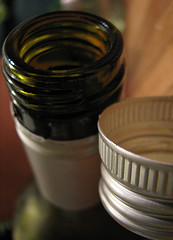 Since enjoying wine is in many ways a race against time (and oxygen), how a bottle of wine gets sealed is of utmost importance. Corks have their detractors since they can introduce the noxious chemical TCA that makes wines “corked.†Further, the pieces of tree bark can lose their elasticity as they age letting in wine’s nemesis, oxygen.
Screwcaps, by contrast, can provide such a tight seal that no oxygen gets in and there is no problem with TCA. Many proponents of screwcaps (or Stelvin closures, if you must) might suggest that the only thing standing between them and domination of the wine world is consumer resistance since wines bottled “en screw†have typically been seen as more downmarket. And what would you do with your $100 corkscrew if you only had to twist the cap off?
Screwcaps appear to be so controversial with their partisans for and against, you might think it impossible to find a producer who goes both ways. Fortunately the Wine Media Guild was able to find several examples of the same wines bottled under both closures for the March tasting.
Michel Laroche attended the tasting as speaker to share his experiences as well as several of his wines bottled under both closures. Laroche is a fifth generation winemaker from Chablis who has run his family firm since 1967 and now also makes wine in the Languedoc, Chile and South Africa.
For Laroche the transition to screwcaps started in 2001 when an unacceptably large amount of his wine was sold unknowingly with TCA that came through corks. Placing the estimate at 10 percent of his production that year, he expressed frustration because he said that consumers never complained so he didn’t know if they thought that flawed wine was actually his style.
So in 2002 he took action. He set up an alternative bottling line and bottled three percent of his production under screwcaps. He bottled the same day and from the same vats. He brought four of his wines that run the gamut of his line for us to taste, with a bottle under each closure.
The difference was shocking. Read more…
Mar
26
2007

Wine Maps
Monthly Archives
Blogroll
Categories
- American wine
- announcements
- Argentine wine
- auctions
- Australian wine
- Beer
- best wines
- Bling
- books
- Bordeaux
- bottled water
- Box wine
- Burgundy
- business of wine
- Celebrity wine
- Champagne
- Chicago
- China
- cocktails
- cognac
- corks
- corkscrews
- dining
- eco wine
- events
- foie gras
- food and wine
- French wine
- German wine
- giveaway
- grapes
- green wine
- guest post
- highlights
- how to
- Italian wine
- leaders and liters
- Mature wine
- meetups
- New York City
- On notice!
- photo captions
- podcasts
- Polls
- Port
- Portuguese wine
- power list
- reader mail
- rose
- sake
- Sommeliers
- South Africa
- Spanish wine
- spirits
- tasting sized pours
- The real wine world
- TV and movies
- Uncategorized
- videos
- vinexpo
- Weather
- wine and health
- wine and sports
- wine and tech
- Wine Blogging Wednesday
- wine blogs
- wine classes
- wine collecting
- wine gifts
- wine in india
- wine labels
- wine picks
- wine politics
- wine quizzes
- wine random
- wine science
- wine scores
- wine shops
- wine technology
- wine travel
- Wine under $10
- wine writing
- winemaking
- winespeak
 Blog posts via email
@drvino on Instagram
@drvino on Twitter
Advertise

quotes
One of the “fresh voices taking wine journalism in new and important directions.” -World of Fine Wine
“His reporting over the past six months has had seismic consequences, which is a hell of an accomplishment for a blog.” -Forbes.com
"News of such activities, reported last month on a wine blog called Dr. Vino, have captivated wine enthusiasts and triggered a fierce online debate…" The Wall Street Journal
"...well-written, well-researched, calm and, dare we use the word, sober." -Dorothy Gaiter & John Brecher, WSJ

Saveur, best drinks blog, finalist 2012.
One of the "seven best wine blogs." Food & Wine,
One of the three best wine blogs, Fast Company
Books for wine geeks

Wine books on Amazon: