Dr Vino's wine blog
wine talk that goes down easy
Can Chilean wines age? A Montes challenge
Just over thirty years ago, Chilean wines entered the world wine stage. As with the export trajectory of Japanese car manufacturers, Chilean wine makers started by exporting inexpensive but reliable offerings. And as with the Japanese car manufacturers, they eventually became so proficient at the low end that they began to target the high end and focus on quality.
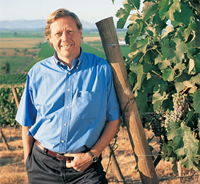 Montes is one of the more recent quality producers, more Lexus than Toyota (although they do have reliable wines at $10). Started in 1987 as a partnership between Aurelio Montes and Douglas Murray, the company now makes wines in Argentina under the Kaiken brand and in Napa, from Rutherford and Coombsville, to be released in 2008.
At a recent tasting in New York City with Aurelio Montes, a key question for me was: can Chilean wines age? With eight vintages of the Alpha M (a cabernet-dominant blend, generally about $80 retail) in front of me dating back to 1997, I tasted through to find the answer to be yes but the record is short and mixed. I also found out about the mysterious phenomenon of the “annual rhythm.” Read more…
Oct
3
2007
1
Go native – indigenous varieties – WBW 37 roundup!
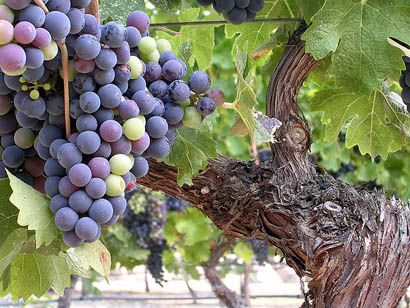
For the latest edition of Wine Blogging Wednesday, 54 bloggers around the world accepted my mission to “go native.” Each one chose a wine made from a grape variety indigenous to where it was grown.
The result was a terrific listing of many unheralded yet rewarding wines. Tannat, for example, featured prominently with no few than four bloggers tasting this burly red grape and three of them tasting it both from its native France and comparing it with versions from Uruguay. Bloggers explored many remote corers of Italy, the country that produced the most tasting notes. Even the good old USA got some grapes written up, though only one Norton and assorted hybrids and clones developed to become indigenous.
Bonus points were awarded to those bloggers who dared to compare–two versions of the grape, from the homeland and a new home. The bonus points committee also rewarded bloggers who were able to try the grape in its growing area since, they too, were going native.
Without further ado, let’s go to the roundup! Read more…
Sep
16
2007
Touriga Nacional up the Douro, WBW 37
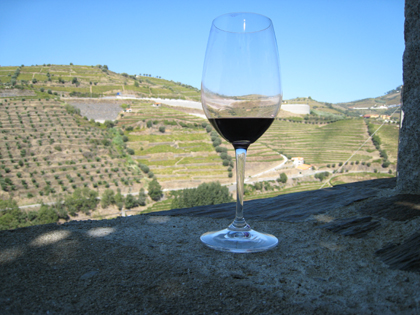
When I attended a tasting last fall in New York and tried a serious wine from the Douro, I inquired as to the the grape variety.
“Field blend,” came the reply.
I laughed. What’s this “field blend” stuff? Can’t these Portuguese keep track of which grape vines they have in their vineyards? Well, after my trip to the region last week, I learned there’s a method to the apparent madness: many of the oldest vineyards were intentionally planted with a row of this and a row of that to be harvested at the same time and go into port. Table wine producers have tended to keep that same old vineyard blending to make lovable mongrel blends instead of purebreds, single varieties of the New World. Hey, if it works in Chateauneuf, why not elsewhere?
In planting new vineyards, some vineyard owners aim to repeat the traditional “field blend” approach of co-mingling varieties in the vineyard while others take a single vineyard, single variety approach. Thus many of the single vineyard wines from the region tend to be from newer vineyards.
The grape variety touriga comes in various forms in the region but none seems more prevalent than Touriga Nacional–it’s “national” for crying out loud! Read more…
Sep
12
2007
Rioja in a nutshell: Bodegas Muga, Prado Enea to Aro via the Torre
 La Rioja, the Grande Dame of Spanish wine regions, has seen the theme of modernists versus traditionalists playing out in winemaking circles. One house that captures this all in one portfolio is Muga.
In a recent blind tasting of 42 Riojas, ranging in price from $10 to $300 a bottle, I tasted through a good portion of the wines from this venerable estate. This producer encapsulates the dual trend in the region, looking both forward and backward. While the I found the new style wines to be overly extracted, the old style wines displayed a beautiful touch. Read more…
Aug
28
2007
Get your Bojo working – cru Beaujolais in the height of summer
 In 1395, Philip the Bold, Duke of Burgundy, was so afraid of gamay that he banned it. That’s right: a man named “the bold” feared a grape. You need to use his fear to your advantage.
Philip was afraid that gamay would encroach on the turf of pinot noir, the native red grape of his home area. And indeed it might: high in acidity with red fruit notes and very food friendly, you could easily see why the Duke of Burgundy might be running scared.
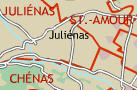 So over the weekend, we had some friends over to the Dr. Vino World Headquarters and tried a dozen Beaujolais. There are ten small appellations, or growing areas in the region, and we didn’t quite cover all of them. But it was a representative enough sample to get a lay of the land, something that definitely merits your attention, as blogger Neil is doing tasting through two wines from each appellation.
Since we live in a capitalist economy, I let the invisible hand take control of structuring the tasting, letting the friends bring whatever they found instead of trying to dictate which wines to bring. The distribution was surprisingly even with good representation of the appellations. I should note, however, that it wasn’t always easy finding them. For example, one friend reported that he asked for some cru Beaujolais at a respected store and the first clerk didn’t know what he meant (fortunately another did). And I went to an off-the-beaten-path store where the owner told me that he didn’t stock much French wine in part because the dollar made it more expensive (the other part was for patriotic reasons–does that sentiment still exist?!?). While that may be true from a currency exchange standpoint, it’s hardly the case for cru Beaujolais, which is almost entirely between $12 and $25. Read more…
Aug
13
2007
BREAKING: Mrs. Vino no likey lambrusco!
There’s a funny gag in the indie movie Scotland, Pa. where Christopher Walken, playing a (vegetarian) detective, is gently interrogating a suspect. The suspect receives a Styrofoam cup of horrendous coffee that he nervously sips during the interrogation. Finally, after what is his third sip or so, he blurts out something to the effect of, “why do I keep drinking that stuff!?!”
When the whole Vino family grabbed panini at ‘Inoteca recently, that was about the reaction of Mrs. Vino to my glass of lambrusco, purple fizzy wine. Dry tannins on the finish and a grapey quality made it not exactly her cuppa tea–or glass of wine.
Why? Although the wine was on the tannic side, I think it has to do mostly with food pairings–lambrusco craves meat. Mrs. Vino is a vegetarian.
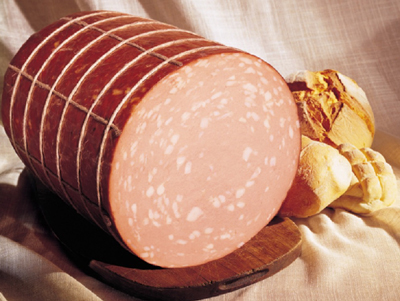
“It would be great with mortadella,” I suggested, knowing that was going nowhere.
“Mozarella?”
“No, some bologna-like meat thing from Emilia-Romagna.”
Bottom line: dry lambrusco, like dry rosé, could be a wine that depends on context for maximum enjoyment. And that might just include a meat pairing.
Jul
29
2007
Fighting back the rosé backlash! In defense of the pink drink
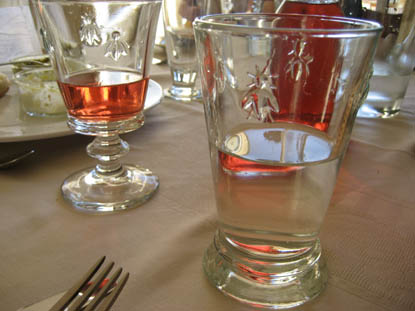
OK, which wine category is hot? Sooo hot? As in up 39 percent nationally for the first six months of this year? That’s right, folks, we’re talking about rosé! Dry rosé!
Just as America is warming up to dry pink wine, Papa Bear Eric Asimov tells us it’s jumped the shark. It’s over. Before it even began! Rosé, we hardly knew ye! EA cries out for rosé therapy on his blog:
But doc, why am I so unhappy about rosés? I don’t want to buy them. I don’t want to drink them. I don’t hate them. I’m just not interested. But I know I’m supposed to care. That is, I’m supposed to be carefree, which is the proper attitude for rosés. You know, lunches in Provence, tapas in Spain, let the rosé flow. But I’m not carefree about rosé. I’m grumpy. What’s wrong with me?…I hate to be a killjoy, doc. Isn’t there anything you can do for me?
Don’t be grumpy, Eric! Just get into the vibe! Although I’m not the kind of doctor you’re looking for, here are some tips for starting to think pink:
1. Context matters: rosé could be the ultimate wine where context matters. When it’s hot, chill it and have it on the deck, at a sidewalk cafe, under a tree, in a hammock–wherever there’s no air conditioning! The hotter you are, the better it will taste. 😉
2. A halfway house for whites and reds: dyed in the wool partisans of whites and reds may not often overlap but rosé may just prove that common ground.
3. Tired of serious wine? It’s a quaffer, easily downed. Refreshment is key. Rosé is almost a state of mind more than it is a wine. (Is this sounding New Age-y yet?)
4. Food friendly: high-acidity dry rosé pairs with a lot of foods, including some hard ones like salads and gazpacho and, of course, anything meaty.
5. Wallet friendly: I’d be grumpy too if I paid a lot for rosé–$15 is my max. This is the first press of some wine or from red vines that aren’t mature enough to do anything interesting so there’s an economic argument for it’s being cheap too. Last summer when we were in the south of France we got a 5L box of the hearty Bergerac rosé for 12 euros, which brought down our per glass costs to practically nothing. It makes you extremely generous when the wine is always cold and your per glass cost is less than a postage stamp–and wine is for sharing!
Some of my favorite dry rosés from this summer:
* Chateau Peyrassol. At $17 it is in my grump-zone, but still very nice light Provencal style. (search)
* Commanderie de Bargemone: Yummy, fresh strawberry notes, good acidity and $12 (search).
* Domaine Houchart (St. Victoire): This wine just makes me think about lunch, outside under an umbrella. $15 (search)
* Domaine Sorin, Terra Amata (Cotes de Provence): Sustainably grown; wonderful with fried calamari (search)
* Chateau d’Aqueria (Tavel): Darker in color and bolder in taste, this is a good one for enticing people from the red side as I did last weekend with a guy who “only drinks red.” Though at $17, it’s into my grumpy price range (search)
* Bodegas Muga (Rioja): easy to find, this one is an even better value at $10 (search)
* Bernard Baudry (Chinon): pleasant, but a tad too serious for mindless summer fun with it’s dollop of minerality (search)
Preppy is back. Drink pink.
Jul
24
2007
Chillin and grillin: tips for summer wine
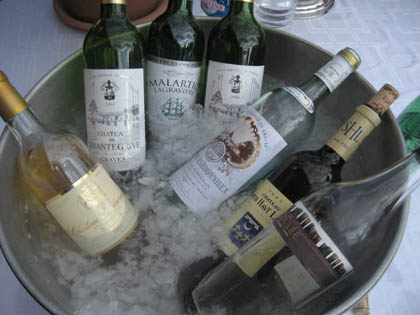
* Water cools faster than air. For urgent chilling needs: bucket, ice, cold water, and some salt. Dunk bottle. Or try one of those sleeve things, which are also very good.
* Small pours. When it’s hot out and the wine is cold, just do small pours since wine in the bottle keeps colder (see above). If cold is your goal, that is (see next).
* Experiment with temperature. Of course, some whites can be served too cold, which closes down the aromatics. Try chilling some young reds with higher acidity, such as sangiovese or Beaujolais.
* Think light thoughts. Save the cabs for winter by the fire. On the deck, go for whites when you’re not drinking rose.
* Think pink. Cast aside any lingering prejudices and catch the hot wine of summer, a dry rosé. They are so food friendly and offer something with more substance than a white. I like ones from Provence, such as Domaine Sorin, but they actually come in a range of styles.
* Venture off the beaten path. Try a Soave (much improved in recent years; try Pieropan). Or a Moscato d’Asti (sweet, lightly fizzy dessert wine; try the Giovinale). Or a lambrusco (purple or pink fizzy wine such as the Vezzelli). And those are just some Italian ideas!
* Put the stem in stemware. Try the “impact resistant” crystal glasses from Schott Zwiesel. Sure beats Solo plastic cups! If you do have to drink en plastique, try to make it thin and clear. (Note: the crystal glasses are impact “resistant” not “-proof”)
* Forget the corkscrew. Go on a hike or a boat and leave the corkscrew behind–choose a wine with a screw cap or possibly even in a TetraPak (lighter to carry back out empty). Or go for the ultimate no-corkscrew-needed wine–champagne! (Caution–not so great on hikes though.)
* Hit the sauce. It can be hard to match the sweetness of BBQ sauce. Try a sweet red fizzy wine, the Sangue di Giuda by Verdi (find this wine).
* Cocktails without corn. OK, this is a wine web site, but if you’re doing a gin and tonic, you can either make your own tonic water or buy a new brand, such as Q tonic, which is made without high fructose corn syrup. Taste the difference.
Jul
12
2007

Wine Maps
Monthly Archives
Blogroll
Categories
- American wine
- announcements
- Argentine wine
- auctions
- Australian wine
- Beer
- best wines
- Bling
- books
- Bordeaux
- bottled water
- Box wine
- Burgundy
- business of wine
- Celebrity wine
- Champagne
- Chicago
- China
- cocktails
- cognac
- corks
- corkscrews
- dining
- eco wine
- events
- foie gras
- food and wine
- French wine
- German wine
- giveaway
- grapes
- green wine
- guest post
- highlights
- how to
- Italian wine
- leaders and liters
- Mature wine
- meetups
- New York City
- On notice!
- photo captions
- podcasts
- Polls
- Port
- Portuguese wine
- power list
- reader mail
- rose
- sake
- Sommeliers
- South Africa
- Spanish wine
- spirits
- tasting sized pours
- The real wine world
- TV and movies
- Uncategorized
- videos
- vinexpo
- Weather
- wine and health
- wine and sports
- wine and tech
- Wine Blogging Wednesday
- wine blogs
- wine classes
- wine collecting
- wine gifts
- wine in india
- wine labels
- wine picks
- wine politics
- wine quizzes
- wine random
- wine science
- wine scores
- wine shops
- wine technology
- wine travel
- Wine under $10
- wine writing
- winemaking
- winespeak
 Blog posts via email
@drvino on Instagram
@drvino on Twitter
Advertise

quotes
One of the “fresh voices taking wine journalism in new and important directions.” -World of Fine Wine
“His reporting over the past six months has had seismic consequences, which is a hell of an accomplishment for a blog.” -Forbes.com
"News of such activities, reported last month on a wine blog called Dr. Vino, have captivated wine enthusiasts and triggered a fierce online debate…" The Wall Street Journal
"...well-written, well-researched, calm and, dare we use the word, sober." -Dorothy Gaiter & John Brecher, WSJ

Saveur, best drinks blog, finalist 2012.
One of the "seven best wine blogs." Food & Wine,
One of the three best wine blogs, Fast Company
Books for wine geeks

Wine books on Amazon: