Dr Vino's wine blog
wine talk that goes down easy
How off-dry it is! Schafer-Frohlich, Steinmetz, and Francois Chidaine
Off-dry, sweet–call it what you will, but a little residual sugar in a white wine is not always a bad thing. Yes, it has to be balanced. But when it’s right, how sweet it is! (Well, not too sweet.) Consider these three excellent examples for around $20:
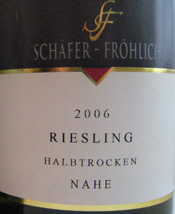 Schafer-Frohlich, Nahe, halbtrocken, 2006 $19. (find this wine) Importer: Rudi Weist.
It’s taken me a while to warm up to the whole off-dry Riesling phenomenon. But this wine will convince any doubters. Truly amazing purity, great weight and Nahe-style fullness with a just a hint of sweetness. I tried it at home with some Asian food and it was a great match. Consider it a steal even at $20 since since it is the lowest price wine in the US from this producer, whose star rises every year higher and higher.
Steinmetz, “Alte Reben,” Feinherb, 2005 $16. (find this wine) Importer: Mosel Wine Merchant
Again, another killer, off-dry Riesling. I tried this with some mediocre Thai food initially and my dinner memories consisted almost entirely of Riesling. But going back to another bottle on another occasion, it was an excellent pairing of delicate sweetness and balanced acidity to offset the spicy take-out. I recommended it to a non-Riesling loving friend and he loved it with takeout–consider it a gateway to off-dry world. Try it with the salty sweet of honey glazed ham over Easter and let us know how it goes.
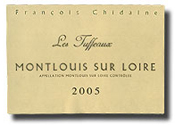 Francois Chidaine, Les Tuffeaux, Montlouis sur Loire, 2005 $21. (find this wine) Importer: Louis/Dressner. Certified organic.
If you’re used to getting your slightly off-dry wines in the Riesling category, you need say hello to chenin blanc from the Loire if you haven’t already. This wine is a great place to start. The aromas of white flowers and honey are terrific. The wine has a delicate attack that expands to a massive midpalate with a touch of honey. For around $20, this a spectacular wine from a Loire master that will make wonder if there’s a hole in the glass since it disappeared so quickly. Try with chevre as an aperitif. Irresistible.
Mar
21
2008
1
More pinot envy – three pinots under $16!! Stadlmann, St Michael, Ninth Island
Ever since Miles told everybody to get pinot noir, it’s been hard to find a good value. We’ve taken the plunge before and came up with several good American ones under $20. Now we raise the degree of difficulty–times two!–by bringing down the price to $16 AND heading overseas where our currency usually now needs to be accompanied by something of material value such as gold coins to make a purchase. Without further ado…
 Stadlmann, Pinot Noir, 2005. $16 (find this wine)
Usually a key to finding good value is finding words that people can’t pronounce. Usually Teutonic Pinot Noir goes by “Blaubergunder,” which is not as melodious as pinot noir and thus discounted. But this Austrian Pinot has “pinot noir” on the label! And it’s still a value! (They keep the unpronounceable stuff for the back such as the region of Niederosterreich in Thermenregion.) Great balance between fruit and acidity, this wine left Mrs. Vino asking why don’t stock more of this in the house.
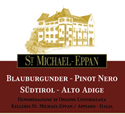 San Michele Appiano, Blaubergunder/Pinot Noir, Alto-Adige, 2006. $15 (find this wine)
I tasted the wines recently from this producer (aka, confusingly, St Michael-Eppan) and they range from quite good to excellent. The entry level Pinot Noir is a steal with bright fruit, good acidity and subtle tannin that made me crave some fried food — I actually enjoyed it more than their riserva, which had too much oak. Their Sauvignons blancs are excellent but we can talk about those another time.
Ninth Island, Pinot Noir, Tasmania, $15. (find this wine)
I’d like to know more about the island of Tasmania–with global warming, it’s probably the terroir of the next few decades for Australia. I had a sparkling wine from there recently that was quite interesting; this pinot has straight-forward, tart cherry character of the grape and gets off easy in the oak department. Don’t save it for junior’s graduation from college; rather, drink it soonish, with dinner.
Mar
5
2008
Stony Hill Chardonnay, Gewurztraminer, Riesling — and Syrah?
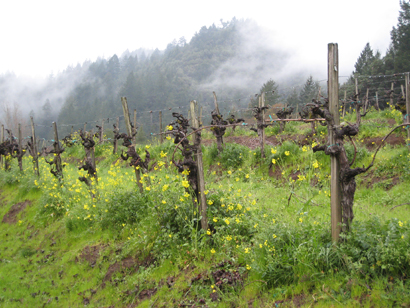
Sixty-year-old, dry farmed Riesling vines at Stony Hill Vineyards, Napa Valley
“We make a red wine.â€
Normally that’s not the sort of statement that raises an eyebrow in Napa Valley. But when one vintner told me that at dinner one night last week, I had to taste it for myself.
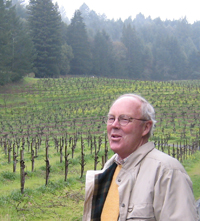 The vintner in question was Peter McCrea who owns Stony Hill. While most Chardonnay in the region receives lavish oak treatments and has high alcohol levels, Stony Hill Chardonnay is aged in 40-year-old (and therefore neutral) barrels and has 13 percent alcohol. His other two wines, a Gewurztraminer and a Riesling, roll in at 11.24 and 11.65 percent alcohol respectively. And at $21 a bottle, the wines stood out for another reason from the Napa wines.
Not your average California whites. Which is why I jumped in a car with another wine writer and drove up to the winery the next day in pursuit of the red nobody has ever tasted outside of the winery: Stony Hill Syrah. Read more…
Feb
29
2008
Paitin, Serra Boella, Barbera d’Alba – WBW 42 – red in seven words
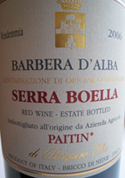 WBW 42: The assignment, describe an Italian red in seven words.
The wine: Paitin, Serra Boella, Barbera d’Alba, 2006 $20. (find this wine)
My seven words, in alphabetical order!
Acidity, berry, cherry, delicious, earthy, food-friendly, gonzo!
Feb
13
2008
Q&A Stephen Bitterolf, riesling fan and wine buyer at Crush Wine

Stephen Bitterolf is one of two wine buyers at Crush Wine & Spirits for “the wall,” an undulating display for the store’s wines under $55. (Wines over $55 are in “the cube.”) He went on a trip to Germany last fall and is a huge fan of riesling. Here he shares his favorite value and splurge rieslings, best value regions, the most “impossible” food-wine pairing that he has overcome, and discover why he keeps his cellar hundreds of miles from where his mouth is. He’s pictured above with venerable importer Rudi Wiest and keeps a blog of his tastings and travels as “Drinking at work.”
Riesling: It’s not just for grandmothers anymore. Why are you so into it? Read more…
Feb
7
2008
Cazin romorantin and cave aged gruyere
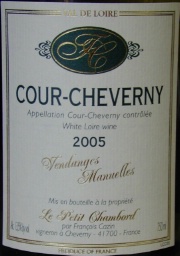 Have you ever tried a rare romorantin? The grape is a little off the beaten path. But that’s good.
From Cour-Cheverny in the Loire, the Francois Cazin, Le Petit Chambord 2005 is an attractive wine–excellent balance between acid, minerality, and subtle tropical fruits. Sort of splits the difference between chenin blanc and sauvignon blanc. It’s limited availability, as you might imagine since romorantin is hardly made by the tanker, but I found this bottle for $15 (find this wine).
Then I paired it with a piece of “cave aged gruyere” from Trader Joe’s. It was one of those wine-food pairings where you take a good wine and a good food and make a great pairing. A Ratatouille moment, if you will.
One question for you: is cave aged gruyere from Trader Joe’s really aged in a cave? (or just come guy’s basement?) What are the norms of production on that? The greatest cave aged cheese, Roquefort, doesn’t even bother mentioning that it was aged in a cave. So I’m suspicious…I want pictures of spelunking regulators! And while we’re talking terms, what’s up with “vendages manuelles” (hand harvests)?
Jan
24
2008
Give the gift of big, green wine
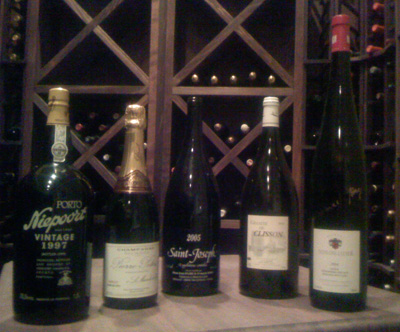
Last year at this time, I wrote a post called “Give the gift of big red,” which suggested giving wines big in flavor profile and in heavy bottles. However, since my research into the carbon footprint of wine, I’m reformed. Now I know that magnums (1.5 liters) produce less carbon dioxide emissions per ounce of wine than regular bottles because of the more favorable wine-to-glass ratio.
So this year, here’s a list of impressive magnums that will impress your friends and relatives–and even with the bigger bottle, they’ve got a smaller carbon footprint. Providing they drink it all, of course.
While there are many magnums that are ridiculously priced since they are a favorite of collectors, these are in the realm of reasonable, under $100. All prices are for magnums.
Pierre Peters champagne, $90 (find this wine). This champagne is a “grower champagne,” made by the people who grew the grapes (unlike the big houses who buy grapes from the 10,000 growers in the region). It’s from Mesnil, the home to big names such as Krug and Salon, so the vineyard site is excellent. So is the resulting Champange, a blanc de blancs, which I have served many times this year to guests and once from magnum to a class. Great bling at a fraction of bling price! Magnums are particularly good for aging so feel free to keep it for a few years.
Pepiere, “Granite de Clisson,” Muscadet 2005, $40 (find this wine). This producer is a leading quality in the area where the Loire river meets the sea. The wine is his richest and smoothest thanks to two years of aging but it still has good, zippy acidity to compliment seafood such as oysters. It’s also a doubly green wine because the grapes are hand harvested from an organic vineyard.
Schloss Lieser, Riesling Spatlese, Mosel, 2004, $68 (find this wine). I stumbled on this bottle in a wine shop and couldn’t resist it. The Riesling magnum is long and fluted and towers above other magnums. I served it at a party last weekend and the crowd loved it and had fun pouring from such a long neck. The wine has a whiff of flintiness on the nose but had a beautiful balance of light sweetness and acidity on the palate.
Dard & Ribo, Saint-Joseph, 2005, $68 (find this wine). I almost didn’t get a chance to taste this wine because I served it at a party and the revelers almost finished it off before I got to it. But fortunately I did since the wine inside the magnum is terrific with a great balance of red berry fruit, tannin and acidity. This is also a “double green” wine since it is totally natural and this producer is a staple in the trendy natural wine bars of Paris. It makes an especially good gift for someone named Joseph as I found out at the party where a friend named Joe tried to run away with the bottle.
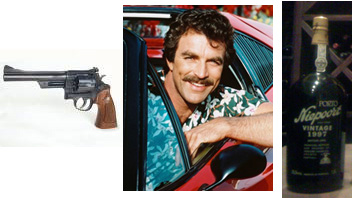
Niepoort, 1997 vintage port, $65 (find this wine). Vintage port is generally very expensive with recent vintages pushing $100 a bottle. Magnums, however, get a significant discount presumably because nobody can drink that much sweet wine in one sitting. Tip: have a party and serve it at the end with some Stilton and it will be an amazing farewell. Another tip: drink as much as you are able and decant it into a regular sized bottle and recork where it will stay good for a good while longer. Whatever you do with it, the stout bottle is an impressive gift.
Choose your Christmas magnum wisely.
Dec
19
2007
Holiday wines at the new Astor Center – wrapped up!
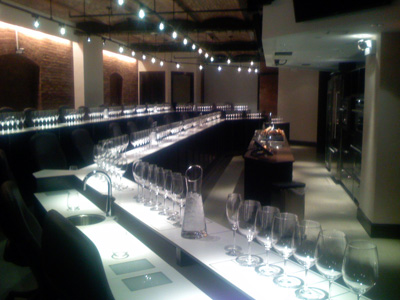
Thanks to all of you who came out and packed the beautiful room at Astor Center on Friday. It was a great time and fun to see so many participants from my NYU classes of semesters gone by. Many people won prizes! The wines were tasty. But since not all blog readers could fit in the 36 seats, here was our lineup of wintry wines:
1. Col Vetoraz, Prosecco NV. Light, fun, bubbly and $13 (find this wine). A good party wine especially when the party is about things other than the wine.
2. Domaine de la Pepiere, “Granite de Clisson,” Muscadet 2005 (about $20; find this wine). Marc Ollivier is a leading quality producer in this region. This particular bottling is an effort that sees a lot of time on the lees (dead yeast cells that are natural), which gives it more richness than his $9 bottling, which is great for summer since it is more zingy.
3. Saxon Brown Semillion, Casa Santinamaria 2006 ($27; find this wine. A field blend from an old vineyard in Sonoma. It’s a wonderful example of a an aromatically intense wine that is unoaked and people liked the acidity on the palate. Goes great with brown sugar baked ham, I would imagine.
4. Joguet, “Les Petites Roches,” Chinon 2005 (find this wine). Quite tannic so probably needs at least a year in the cellar. Nonetheless, it was good to show an example of tannins in the mouth. Good fruit and good acidity save the wine — one participant remarked how the piave cheese really improved it. Yay, it gets better with food!
5. Rene Rostaing, Cuvee Clasique, Cote-Rote 2004 ($50; find this wine). From this “legend” of the Cote-Rotie, this wine from the syrah grape was subtle and restrained in classic (classique?) old world style. Paired well with the epoisse.
6. Broc Cellars Syrah, Dry Stack Vineyard 2004 ($30; find this wine). I wanted a wine to contrast with the Rostaing and this Broc fit the bill nicely. Quite modern in style, it helped show the difference of new oak on the same grape. In a rough poll, the Rostaing edged this one out by a narrow margin.
7. Dow’s Late Bottled Vintage 2000 port. ($19; find this wine) This wine really was a big surprise–people loved it! They thought it was in the $40 – $60 range so when I told them it was under $20, I had to restrain them from stampeding for the port section. Paired it with a Stilton.
Look for more one evening events in 2008! And I hope to see you there!
Dec
19
2007
Comments Off on Holiday wines at the new Astor Center – wrapped up!

Wine Maps
Monthly Archives
Blogroll
Categories
- American wine
- announcements
- Argentine wine
- auctions
- Australian wine
- Beer
- best wines
- Bling
- books
- Bordeaux
- bottled water
- Box wine
- Burgundy
- business of wine
- Celebrity wine
- Champagne
- Chicago
- China
- cocktails
- cognac
- corks
- corkscrews
- dining
- eco wine
- events
- foie gras
- food and wine
- French wine
- German wine
- giveaway
- grapes
- green wine
- guest post
- highlights
- how to
- Italian wine
- leaders and liters
- Mature wine
- meetups
- New York City
- On notice!
- photo captions
- podcasts
- Polls
- Port
- Portuguese wine
- power list
- reader mail
- rose
- sake
- Sommeliers
- South Africa
- Spanish wine
- spirits
- tasting sized pours
- The real wine world
- TV and movies
- Uncategorized
- videos
- vinexpo
- Weather
- wine and health
- wine and sports
- wine and tech
- Wine Blogging Wednesday
- wine blogs
- wine classes
- wine collecting
- wine gifts
- wine in india
- wine labels
- wine picks
- wine politics
- wine quizzes
- wine random
- wine science
- wine scores
- wine shops
- wine technology
- wine travel
- Wine under $10
- wine writing
- winemaking
- winespeak
 Blog posts via email
@drvino on Instagram
@drvino on Twitter
Advertise

quotes
One of the “fresh voices taking wine journalism in new and important directions.” -World of Fine Wine
“His reporting over the past six months has had seismic consequences, which is a hell of an accomplishment for a blog.” -Forbes.com
"News of such activities, reported last month on a wine blog called Dr. Vino, have captivated wine enthusiasts and triggered a fierce online debate…" The Wall Street Journal
"...well-written, well-researched, calm and, dare we use the word, sober." -Dorothy Gaiter & John Brecher, WSJ

Saveur, best drinks blog, finalist 2012.
One of the "seven best wine blogs." Food & Wine,
One of the three best wine blogs, Fast Company
Books for wine geeks
Wine books on Amazon: