Rocks for shocks: geologists don’t “debunk” terroir; minerality questioned

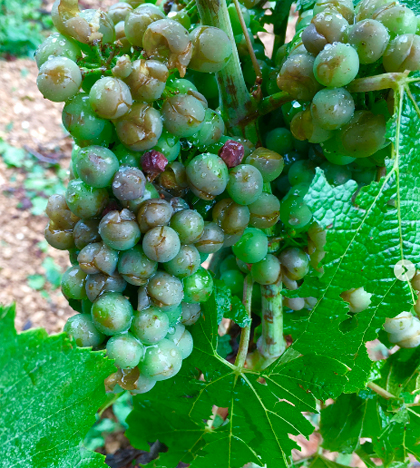
lanzarote_vineyard
Many geologists object to two things: misusing “minerality” and being misquoted.

Site reader and distributor Damien Casten sent in an AP story (with no byline) yesterday entitled “Geologists debunk soil impact on wine at Ore. talk.” The Oregon event was a special session at the annual conference of the Geological Society of America.

At the meeting, Alex Maltman presented a paper with this to say about minerality: “The widely cited direct, literal connection between vineyard geology and wine taste seems scientifically impossible. Whatever “minerality” in wine is, it is not the taste of vineyard minerals.” He calls any perceived connection a “romantic myth.”

Fair enough, there may not be a transfer of minerals from substrate to the glass, but is terroir debunked? Not quite, argued Jonathan Swinchatt in a paper that cites the indirect influences of drainage, accessibility to water, microbiology, soil temperature, and trace element chemistry. He argued that unraveling these links is “devilishly” complex and thus “the connections between geology and wine will remain elusive for some time to come.”

Terroir: clear as mud!

After the jump, Greg Jones, a climatologist from Southern Oregon University (and son of the founder of Abacela Vineyards and Winery in Roseburg, OR) chimes in with his thoughts from the conference and the reporting of it. Read more…

Shattered Myths – from the Gourmet archive

tongue-mapA great piece of wine writing has just become accessible: oddly, with the closing of Gourmet magazine, Gourmet.com has made the classic article “Shattered Myths” available for free.

Written by NPR contributor Daniel Zwerdling back in 2004, the story starts at a tasting with Riedel stemware, which the attendees loved and bought $1,000 worth of the crystal afterward. Then the author reviews some scientific studies about taste and olfactory analysis of wine in different vessels, which clashed with the what he had seen at the Riedel demonstration. So the author put the question to Georg Riedel. Click through to see Riedel’s reply.

The article then turns to a fascinating and important discussion about perceptions and wine, much of which we have discussed since 2004 in various ways here and elsewhere. The now-available article is an oldie but a goodie and well worth the read if you haven’t already seen it.

Related: “Shattered Myths” [Gourmet]
Varietal stemware: genius or hucksterism?
The Tongue Map: Tasteless Myth Debunked” [LiveScience]
Wine’s Pleasures: Are They All in Your Head?” [NYT]

Amazon stops selling wine before it ever starts; Wine blogs on Forbes.com

logjamBack in March 2008, when word leaked out about Amazon’s possibly selling wine, Mike Steinberger asked, hopefully, whether Amazon.com could end the war over direct wine deliveries. He continued: “the entry of the Internet retailing colossus into the business seemed just the thing to finally break the logjam over interstate wine shipping.”

Instead, the logjam crushed Amazon (AMZN). Late Friday, winebusiness.com ran a story that Amazon was putting its wine retailing business on hold, citing correspondence between amazon and wineries. I contacted members of the AmazonWine team for comment and they were either away on vacation reply or said that they could not comment. The Wall Street Journal got through to a spokesman who confirmed the wine trial was over.

The intractable logjam was the interstate shipping laws that govern interstate wine shipping. You can get 200 pages or so on it in my book Wine Politics: How Governments, Environmentalists, Mobsters, and Critics Influence the Wines We Drink. Or you can check out Tom Wark’s post for a more concise background on the logjam known as the three-tier system. Further, California law on unlicensed “third parties” may have affected the group’s plans.

I look forward to the final analysis of how exactly Amazon attempted to achieve a different structuring of interstate wine retail and why, sadly, it flopped. While AmazonWine kept program was kept under wraps, conventional wisdom is already blaming the bankruptcy of New Vine Logistics, which put the domestic wine component in jeopardy (imported wines were also to be available).

Given the economics of shipping wine, the company may have been targeting higher-priced bottles. In that regard, the economic backdrop didn’t help the plan as high-end wine sales have softened in the past year even though overall consumption of (lower-priced) wine is slightly higher.

In other news, Forbes.com ran a piece late Friday piece entitled, “Must-read wine blogs.” It’s a must-read itself and will give you some tips on some more blogs to add to your feed reader, if those good ones mentioned are not in yours already.

Charles Heidsieck wants to burst your bubble – decanting Champagne


The flute has been the glass of choice for champagne enthusiasts for decades. If the folks at Champagne house Charles Heidsieck have their way, the flute’s days are numbered.

In New York on Wednesday, they poured their entry-level, Brut NV in both a classic flute as well as a white wine glass. The aromas in the wine glass were much richer in large part because you can actually stick your nose in a wine glass, which is not the case with a flute.

“The Champagnois have communicated around the bubbles, not the wine,” said a spokesman.

The flute accentuates the bubbles coming off the bottom because of a “poil mousse,” or a roughened “scratch point,” said Maxmilian Riedel, also on hand for the event. Regular wine glasses do not have a scratch point, thus any bead tends to be a bit willy nilly, if even present at all. (See the scintillating 15-second video above for comparison of the bubbles!)

riedel_amadeoThe thrust of the presentation, however, was the unveiling of a “uniquely designed decanter” by Riedel for Charles Heidsieck. The “organic lyre ‘U’ shape” is handmade and mouth-blown and bears a striking resemblance to the “Amadeo” Riedel decanter with a Charles Heidsieck badge. A bottle of the Charles Heidsieck Blanc des Millenaires 1995, a lovely wine, comes with the decanter in a presentation box for $600.

“I think there’s nothing better than aged Champagne,” Riedel said. “And that’s what happens in the decanter. I decant to enrich the wine, not to lose the bubbles.”

Are you going to throw out your flutes and start serving your Champagne in white wine glasses? Or from a lyre-shaped decanter?

White wine, red wine, the frontal cortex, spooky store – sipped and spit

SIPT: white wine
White wine has not ridden the good-for-you train as far, fast or as well as red wine. Yesterday, white wine almost suffered derailment. First, German researchers said that the higher acidity in white wine could damage teeth! (Vigonier begs to differ.) Then, another study of suggested that of all alcoholic drinks, white wine had the biggest impact on women’s fertility in IVF. The Worldwide White Wine Council will issue a new statement shortly.

SPIT: Iron and SIPPED: tannins
Tannins have always gotten the bad rap for mucking up red wine pairings with fish. But it turns out that it’s actually the iron! Read Ray Isle’s funny take on the research.

SPIT: the frontal cortex
“we shouldn’t expect our poor olfactory cortex to be able to reliably assign an exact point score…” [Scienceblogs]

SIPPED: Spooky decorations
TheSnarkHunter points us to this seasonal wine shop display at Biondivino in San Francisco; if you know of other good ones, hit the comments!

Home field disadvantaged – NYT on SF wine lists

american_winelist
In a piece entitled, “Eat Local; Drink European,” Eric Asimov of the NYT tackles the apparent paradox at the core of some San Francisco restaurants: while the menus extol fresh local produce, the wine lists are often dominated by wines from Europe.

Why? One wine director, Chris Deegan of the restaurant Nopa, says “I find myself drinking European wines most of the time and pairing European wines more successfully with the food.” Mark Ellenbogen, wine director of a top Vietnamese restaurant, says, ““At Slanted Door, you need low-alcohol, high acid wines with residual sugar, and they don’t come from the New World.”

Asimov continues the topic of the unwieldy pairings many American wines make with food over on The Pour. He writes, “the riper and riper styles of wine that have become popular in this country simply are not versatile with food, so restaurants look elsewhere.” He also notes some exceptions that he has found.

Wine style aside, I crunched some numbers for the piece based on my previous research on the carbon footprint of wine. Even though container shipping offers greater efficiency from a greenhouse gas perspective than trucking, a 9,500 mile sea journey still comes out higher than a 60 mile truck trip.

By way of an offset reminiscent of our bottle-for-bottle challenge, several restaurants in the Bay Area have discontinued serving water bottled in the Alps and now serve local, tap water, still or sparkling. And you can even try this at home.

Speaking Francly: the polarizing grape sparks debate

Writing in Friday’s Globe and Mail of Toronto, Beppi Crosariol, the paper’s wine columnist, weighs in on the topic of Cabernet Franc. Provocatively, he writes “Most cabernet francs resemble red sangria that has been steeped with bell peppers and unlit cigarettes instead of fruit, but I’ve found three Canadian ones I like very much.”

He’s not a fan of the grape. Talking about the two top growing areas in the Loire, Chinon and Bourgueil, he writes, ironically: “Virtually all the people I know who rave about Chinon and Bourgueil are wine geeks, the kind of people who champion varieties nobody else does precisely because nobody else does. You can find many of these same people downloading unsigned artists to their iPods.”

guion_bourgueilFunny, I like great Chinon and Bourgueil but I’ve never downloaded an unsigned artist to my iPhone! I just like them for the low alcohol, high acidity for food friendliness, and the low prices–the “undiscovered” discount. Take the delicious but, yes, slightly herbaceous, Domaine Guion, Cuvee Prestige 2006, which I just bought for about $12.50 (with case discount)–a tasty bargain if there ever were one, but certainly not one for fruit bomb lovers.

I tweeted about the article at 8:56 AM today and the responses came flooding in; here is a selection. (Follow along on Twitter) If you haven’t weighed in, do you love or hate Cabernet Franc? Which actor is the most apt comparison?

gonzogastronomy @drvino ouch! I happen to love cab franc!
candidwines @drvino Your Cab Franc critic cites “cedar, tobacco + vanilla” in the CF he loves. My description of him: “Starts w/ J, rhymes w/ mackass”.
Randall Grahm @drvino There are truly 2 populations of wine drinkers, those who love and those who detest cab franc. One generally wishes to avoid latter
voxinferior RT @gonzogastronomy: @drvino ouch! I happen to love cab franc! (I like it too, but there’s some pretty legit. criticism in that piece)
James Molesworth @RandallGrahm @drvino Cab Franc is an acquired taste. Acquired at birth or never…
Lauren-BacallHoward Goldberg @RandallGrahm @drvino When I think of cabernet sauvignon, I think of Catherine Deneuve. And when I think of cabernet franc, Lauren Bacall.
candidwines @drvino @RandallGrahm Overcropped, machine harvested Cab Franc is to real CF as January tomatoes are to garden heirlooms: worlds apart.
theconcierge @drvino I think the ‘Globe and Mail’ statement on Cabernet Franc is harsh, there are bad wines made with any varietals
Randall Grahm @howardggoldberg @drvino Deneuve is Burgundy; Bruce Willis is Bordeaux. But I like the smoky, peppery Bacall association w/ cab franc
Randall Grahm @jmolesworth1 @drvino @howardggodberg What gets me is the absolute vehemence of cab franc’s detractors. But francly, I don’t give a damn
megmaker @RandallGrahm @howardggoldberg @drvino Agree Cab Franc is Bacall, or maybe K Hepburn: throaty, acerbic – but what a woman.
tallywineguy @drvino I think pinotage is more divisive than CF. RT There r 2 populations of wine drinkers, those who love & those who detest Cab F

What’s in a score? [audio]

I recently posted about blind tasting Bordeaux 2005 with Robert Parker. Last week, via the “inaugural edition” of his monthly e-newsletter, he produced his own summation of the public tasting, which included new, “official” scores for all the wines tasted. At the event, he had not scored any of the wines. But when a member of the audience asked him, “Bob, what were your three votes,” he stated:

“I went back and I was a big fan of 9 and 8 and 3. And then I think 13 and 14 are right up there…I can’t forget eight and nine. I had six wines that blew me away tonight: 1, 3, 8, 9, 13, and 14.”

To recap from the other post, those wines were Le Gay (9), L’Eglise Clinet (8), and Pape Clement (3) as his top three wines of the night, followed closely by Lafite (13), Troplong-Mondot (14), and Pavie (1). I’ve uploaded my own audio recording of the event to the right.

Yet in the e-newsletter, there were some surprises among the ratings. Le Gay, one of his top three wines of the night, received a score of 99 points, certainly outstanding but, oddly, only fourth that evening. L’Eglise Clinet received “99+ points.” But two wines scored 100. One was Troplong-Mondot. And the second was La Mission Haut Brion, which was not among the six wines that “blew him away” that evening.

mission_haut_brion_2005What makes a wine worth 100 points? A couple of years ago, Parker told a Florida newspaper the key to difference separating a 100-point wine from a 99- or a 98-point wine. He said, “I really think probably the only difference…is really the emotion of the moment.”

Obviously, anyone could and perhaps should be influenced by emotions during a tasting of excellent wines. But doesn’t it undermine the pretense of (psuedo-)objectivity that scores represent? Isn’t scoring wines meant to “call it like you see it” and dispense with extraneous information such as labels and context?

How can a professional taster explain such a change in rankings from a public event to subsequent write-up? In the case of 05 La Mission, the wine clearly did not send a chill up Parker’s spine that evening since it was not in his top six. In a thread that emerged on his site about the discrepancies, Parker concluded one of his comments with a plea to “KEEP IT REAL.” Indeed.

Read more…

Le Vigne: opening a new wine shop in the West Village

le_vigne
You’d have to be crazy to open a wine shop in a recession. But don’t tell Carlo Orrico.

The enthusiastic, 26 year old proprietor of Le Vigne in Greenwich Village opened the door to his tiny wine store in late July. But that was the culmination of the lengthy license application process, which lasted almost a year. Read more…


CWC-300x250Holiday
ayow150buy

winepoliticsamz

Classes

Holiday wines on 12/10 Register now!

Wine Maps

Recent Comments

Recent Posts

See my op-eds in the NYT
"Drink Outside the Box"
"Red, White, and Green"

Highlights

Monthly Archives

Categories


Get a daily dose of Dr. Vino's wine blog by Email!
rsssmtwitlogo

150x600affordablew

150x600fununiquew

09rioja150x250_win1aw


Subscribe

Subscribe via RSS


Follow on Twitter! twitter-logo2

quotes

One of the “fresh voices taking wine journalism in new and important directions.” -World of Fine Wine

“His reporting over the past six months has had seismic consequences, which is a hell of an accomplishment for a blog.” -Forbes.com

"“News of such activities, reported last month on a wine blog called Dr. Vino, have captivated wine enthusiasts and triggered a fierce online debate…” The Wall Street Journal, 5/26/09.

jbf07James Beard Foundation awards

One of the "seven best wine blogs." Food & Wine,

One of the three best wine blogs
Fast Company,

"There's a new guide in town..." New York Sun

See more media...