Orson Welles, in his cups

“Ahhhhhh, the French!… Champagne…” The outtakes of this Orson Welles ad make the rounds periodically, with this one racking up 854,000 views thus far. And, yes, it is funny when you turn on the outrageously bad closed captioning…

RedNek glasses, Vinturi tested, duty free shopping — sipped and spit

red nek wine glasses
SIPPED: anti-snobbery
What might just be the best-selling wine glass this holiday season? Why, the RedNek wine glass, a Mason jar on top of a candlestick holder as a base. Launched this year, sales have hit $5 million already. Good thing it comes with the lid, making it the travel mug of wine glasses. [CNN]

SPIT: Vinturi aerator
A panel of sommeliers blind tastes wines that have been put through the Vinturi aerator. They admit that it transforms the wine but give three out of four the thumbs down. [bonappetit.com]

SIPPED: bubbly
The NYT tasting panel has some good picks for all your blanc de blancs needs.

SIPPED: malbec, DrBigJ & Stone Temple Pilots?
A new wine shop in Prospect Heights suggests music pairings on their shelf talkers (too bad they also borrow heavily from at least one DrBigJ tasting note without attribution and slap on point scores, instead of pursuing the point-free path). [Village Voice]

SIPPED: carry on
A traveler at Charles De Gaulle airport dropped $60,000 on six bottles of wine. Come on, didn’t he know that there are better values in town? [Metro.co.uk]

SIPPED: investigations
Robert Parker has launched an “investigation” into only what transpired in Murcia. And the Institute of Masters of Wine has initiated an investigation into whether Pancho Campo MW has violated their code of conduct. [DrinksBusiness.com]

Wine jobs: Director of Hospitality, retail store general manager, new store sales associate, magazine intern and more!

A tasting of hipster wines

hipster wines
I recently tweeted that I’d be leading a tasting of hipster wines. “Will you wear a wool hat?,” someone asked in response. Another tweep asked if there would be any PBR on hand for afterward.

The tasting on Manhattan’s Upper East Side came and went and I didn’t wear a woolen cap, flannel shirt, or use empty 40-ounce cans of PBR as decanters. But we did taste some fine and fun wines, if quirky and hard to find (though not in Brooklyn).

We started with the Cedric Bouchard, Inflourescence, “Val Vilaine” V09 Read more…

The Finest Wines of Rioja and Northwestern Spain

rioja book After so much discussion of the Parker-Miller-Campo imbroglio (see a thorough recap from Monday here), it’s refreshing to read about the wines of Spain again without thinking of “no pay – no Jay.”

The new book, The Finest Wines of Rioja and Northwestern Spain, made me do just that. Up-to-date, with gorgeous photos, the book is by a trio of writers and tasters, well-known in Spain and possibly outside: Jesus Barquin, a criminology professor and sherry lover whose passion led him to co-found Equipo Navazos, a boutique producer of excellent sherries; Luis Gutierrez who recently started contributing to jancisrobinson.com; and Victor de la Serna, deputy editor of El Mundo, a leading Spanish daily, who heads El Mundo Vino.

Although the book is largely a collection of 85 producer profiles, the authors open the book with several good discussions, one about the grape varieties (they acknowledge the resurgence of indigenous varieties in the northwest) and another about traditional versus modern winemaking. This latter discussion is of most importance in Rioja where modern style has been ascendant. The authors dispute the notion that the modern style of dark, extracted, fruity wines has been a “curse” for the region and are surprisingly accommodating of it saying that the best of the moderns “will in turn become classics.” I guess it would have been a short book if they didn’t adopt a non-partisan, ecumenical stand on the modern-traditional issue. They also admit that their personal collections have many examples of traditional producers from the best vintages.

The profiles bring the producers to light in one to six pages and include traditional producers (Lopez de Heredia and La Rioja Alta), modern (Roda), mixed (Muga) and up-and-coming (Olivere Rivière). They also discuss Txakoli, Albarino and wines from Ribeira Sacra and Bierzo. Throughout the book, they highlight a top wine from a producer with a star; I agreed with enough of their starred wines that I will look for some other of their suggestions to try. They also tuck in a list of restaurants and shops with good supplies of aged Rioja (though how many will be modern?) that would be helpful to travelers to the region. In fact, with its wealth of practical information and advice, I wouldn’t head to the region without it.

Rise of “le binge drinking” — and tighter policy

What causes binge drinking? It’s hard to say but in Europe, it does seem to predominate in northern countries where public policies coincidentally can limit hours and sales channels, sometimes with a dose of high taxes to boot. Southern European countries have generally consumed more alcohol, had more lax policy but have lower rates of binge drinking. Maybe it’s that the drink of choice is wine in the south. Or maybe it has to do with more permissive parenting, where tasting wine is not forbidden, but rather encouraged in moderation at table with parents.

The whole constellation is being called into question now that “le binge drinking” has arrived in France. Surprisingly, an NPR story specifically mentions the arrival of youth binge drinking as a failure of permissive parenting. I still cling to the idea that learning about wine en famille can provide a good base for moderation–these teens are slamming vodka, after all. Binge drinking is a complex phenomenon with many influences ranging from physiological, social, economic to even policy itself (some argue that a more restrictive policy fuels the binge mentality). Still, its rise in France means that national policy now allows only those 18 and up to purchase drinks. And some towns such as Lyons are placing bans on the sale of alcohol from 10 PM – 6 AM. Even though wine has been considered different from other alcoholic beverages–it has even been considered as food in France–it is obviously affected by the new policies.

It’s sad to see that France, where wine has been seen as the national drink and even as a part of the national image, has now ended up shifting closer to where we are in practice and policy. But they do have a president who doesn’t even drink wine. Who knows, maybe they will even have a list of party schools soon.

Holy sh*t: Australia approves laxative agent in wine

wine sniff Australian wines have gained huge market share over the past few decades. But nobody has accused them of dumping. Until now.

The Australian government has approved the addition of sodium carboxymethyl cellulose, which has “has long been prized by the medical world for its anti-bulking and laxative properties.” The cellulose gum prevents crystallization and cloudiness in white and sparkling wines.

Wines containing the additive will not be labeled as such. A spokesperson for the Wine Institute in California said, “I don’t think the levels that are approved for use in wine in the EU and Australia will give that laxative effect.”

Just in case, they’re now putting wine in cans.

Over on Twitter, wine Twitterati declared that “the bottom fell out of my world when I read that” and to being “down in the dumps” after hearing of the “sad tail.” Or, “Imagine a discreet Times hed: For Australian Wines, the Beginning of the End.”

IKEA bed frame as wine rack – aged sur lit [DIY]

wine rack diy

Sometimes, opportunity lies right in front of you. Or, if you’re Jeremy S. Walworth, it lies in your neighbor’s pile of recycling.

Jeremy hauled the wood from a broken IKEA bed frame out of his neighbor’s driveway and set about making a wine rack for his basement. With help from his daughter, he cut, sanded and glued a 60-bottle wine rack complete with bottle slots. Nice wine rack hack! Wine and family bonding taken to a new, productive level.

Now that’s some wine aged sur lit.

More wine DIY: corks as Christmas tree ornaments

Wine deals: what’s the best buy now?

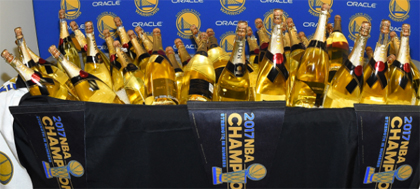
champagne deals
Lifehacker ran a piece that urged readers to buy wine after Thanksgiving and during the first two weeks of December to “lock in pre-holiday bargains.” Really? Perhaps I live under a rock but I hadn’t noticed seasonal discounting that disappears as the holidays approach. Have you? Instead, I see a parade of deal-of-the-day web sites and closeout offers from wine shops–constant sales, rather than seasonal. Or the old “mark it up to mark it down” type of “sales,” which also never go out of season.

Lifehacker attributes their seasonal nugget to Food & Wine editor Ray Isle. Queried via Twitter, Ray pointed me to this original story from whence this wisdom came. He asked Jeremy Noye of Zachys for some suggestions for deals and his seasonal sale advice was limited to Champagne, not wine in general as Lifehacker stated. I have noticed some of this Champagne discounting, but it is generally later in the month, *closer* to the holidays, when stores might sell well-known brands just above cost simply to get people in the store. Anyway, if you do see Champagne on sale that you like, plug it in to wine-seracher.com and pull the trigger if it is a real deal. (Especially, eegad, what if there are shortages next year?)

I do find that it is a good time of year to buy wine accessories and stemware, as retailers smell the competition and reduce prices. I still like my Schott Zwiesel “impact resistant” glasses ($60 for a 6 pack on Amazon) and, in fact, need to reload after some met the maximum threshold of their resistance. Well, it had been a few years


Featured jobs:


wine jobs

winepoliticsamz

ayow150buy

Wine Maps

Recent Comments

Recent Posts

See my op-eds in the NYT
"Drink Outside the Box"
"Red, White, and Green"

Highlights

Monthly Archives

Categories


Dr. Vino via email


@drvino


Subscribe

Subscribe via RSS
Dr. Vino's daily dose


Follow on Twitter! twitter-logo2

Wine industry jobs

quotes

One of the “fresh voices taking wine journalism in new and important directions.” -World of Fine Wine

“His reporting over the past six months has had seismic consequences, which is a hell of an accomplishment for a blog.” -Forbes.com

"News of such activities, reported last month on a wine blog called Dr. Vino, have captivated wine enthusiasts and triggered a fierce online debate…" The Wall Street Journal, 5/26/09.

"...well-written, well-researched, calm and, dare we use the word, sober." -Dorothy Gaiter & John Brecher, WSJ

jbf07James Beard Foundation awards

One of the "seven best wine blogs." Food & Wine,

One of the three best wine blogs
Fast Company,

See more media...