Dr Vino's wine blog
wine talk that goes down easy
Where in the wine world are we?
Comments are open.
UPDATE: Read more…
Aug
24
2007
11
Free lunch, no. Reduced price, yes!

Economists love to point out that there is no free lunch. But there is something else nearly as good: fine dining for lower prices at lunch time.
On a vacation with your partner or family, splurging on lunch can have many benefits, first of which is clearly money. Many top restaurants offer lower prices for lunch than for dinner. Consider Paris, where a quick scan of some top spots shows the spread: Taillevent has a 70 euro lunch compared with 140 or 190 euro dinner menus. At the summer dining room at the Hotel Bristol, there’s a 90 euro lunch menu as opposed to the more expensive a la carte in the evening. And at Pierre Gagnaire, it’s 90 euro prix fixe lunch vs 225 for dinner.
You might have noticed that this is still dropping over $100+ on lunch–and we haven’t even gotten to the wine yet (tax and tip are included, however!). But I chose these high-end restaurants because they illustrate the cost-savings that are available at many restaurants in Paris and beyond.
In New York, reasonable gourmet lunches abound and are a fraction of Parisian prices. Read more…
Aug
23
2007
The Wines of France, by Jacqueline Friedrich
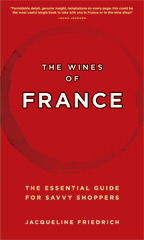 The wines of France in 360 compact pages? Heck, I’ve read a book longer than that on one region, the Loire! That was my incredulous reaction when I first spotted The Wines of France: The Essential Guide for Savvy Shoppers by Jacqueline Friedrich across the room at Barnes & Noble.
But upon closer inspection, what this svelte paperback ($13.75 on Amazon) sacrifices in depth, it makes up for in breadth. Friedrich has no shortage of tasting experience–or opinions–and wheels around her quick tour de France in what is essentially an annotated directory. She dispenses with such page-consuming graphics as maps, label images or chateau pictures. Divided into regions, each section leads with a one page overview and then heads straight into an alphabetical listing of producers and subregions. Her favorite producers receive a star, ones to watch get an up arrow, and she usually notes in the text if a producer is “eco-friendly” or not.
This is great for skimming and finding an instant nugget of information, as I could see a flummoxed sommelier or shopkeeper doing. Or you can say “hey what is this Vouvray region I’ve been reading about?” for example. Bam–a couple of ‘grafs on Vouvray and a list of her favorite producers including a paragraph on her six faves (Aubuisieres, Champalou, Chidaine, Gaudrelle, Huet, and Clos Naudin/Foreau for all you Vouvray junkies out there). This can be great for setting up an itinerary. But once there, you may want more info on the producers, which is possible in this case to get from Friedrich since she wrote that 400-page book on the Loire. So when can we expect other regional guides from Friedrich?
So just how are those opinions that she hands out with such ease? Well, they seem quite good on the whole–to wit, I had not tried the Chateau des Jacques wines from Beaujolais that she was rhapsodic about and included them in my recent Bojo tasting and I was very glad I did. However, the parsimony of the star system on display in the tiny Vouvray breaks down in areas where there are many good producers. Consider St. Emilion, where no fewer than 28 producers receive stars. This isn’t an undue amount, but it’s just that fast simplicity is lost. She goes some distance to making up for that with her “Bordeaux crib sheet,” which again narrows the field and includes many worthwhile producers. She seems to punt on the extracted/not-extracted issue, starring the likes of Bon Pasteur and Pavie, while commenting that the controversial 03 Pavie tasted “port-like.”
Ten months on from the publication date, as the 06s have been harvested and the 07s are about to be, I have only one question: what are the chances of getting a 2008 update to this handy little reference?
Aug
15
2007
Seven tips for great eating and drinking in Paris
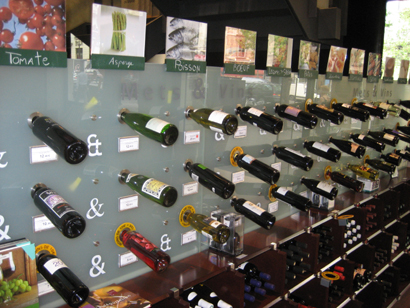
I have been meaning to write up a few Paris odds ‘n ends from our recent family trip. They’re a few wine related, and a few that aren’t. 😉
Great carafe: Le Comptoir du Relais. We enjoyed a great lunch (excellent salads all around) at Yves Camdeborde’s hot spot right by the Odeon. The wine highlight was a one liter carafe of “KO” Puzelat cabernet franc for 15 euros! (find this wine) Amazing. It’s pretty much gone from NYC where the wine was available for $23 a bottle in a store, making that carafe all the tastier. If only US restaurants could have this quality of wine this cheap. Sigh. (6th arr; 33 1 44 27 07 97)
Great lunch: Chez Michel. Thierry Breton cooks the food of his home region, Brittany, in this homey place in the shadow of a church near the Gare du Nord. We had excellent white asparagus, mouthwatering clams and mussels cooked in a rich, herbed broth, and the largest–and very tasty–rice pudding I’ve ever seen. Solid wine list. Prix fixe: 30 euros. (10, Rue Belzunce, Paris 10e – +33 1 44 53 06 20)
Great wine shop: Caves Augé Manager Marc Sibard stocks some great bottles in this cramped shop (now actually owned by the same owners as Lavinia). The emphasis is on natural wines and it is a treasure trove for wine geeks. Be sure to ask for things if you don’t see them since there is also a large storage area in the basement. Great spirits selection, particularly Armagnac. Read more from my visit last year. And be sure to check out their blowout tastings with producers in the spring and fall. 116, Boulevard Hausmann, Paris 75008
Another great wine shop: La Derniere Goutte. American owner Juan Sanchez presides over a small but well-chosen selection of wines from the growers themselves, including Champagnes. He has weekly tastings with visiting producers on Saturday afternoons. And being a good American, he opens the shop on Sundays. English spoken by everyone in the store. 6, rue de Bourbon le Chateau, 75006 Paris
Best falafel sandwich: l’As du falafel (rue des Rosiers, Le Marais). Great street food, which made me want to sit down and pair it with wine. 4 E 50. I tried come of the competition on the street and the lines in front of l’As are there for a reason.
Best ice cream: Berthillon. Though the now ubiquitous “Amorio” chain does a nice job, their floral presentation of the gelato seems to have slipped since last year as the number of outlets have increased. We tried a chocolate and a mint from Amorio and Berthillon on the Ile Saint Louis and Berthillon won each category. Deep dark chocolate! Fresh mint! A no-brainer. Although the original Berthillon store is closed most of the summer (!), the ice creams are sold throughout the city through various resellers.
Best mille feuille pastry in Paris: Pierre Hermé. Mrs. Vino and I were lamenting the downgrading of the mille feuille pastry as it no longer appeared to have quite the “thousand” layers of its billing. Thanks to a tip from our friend Mike, who is a Pierre Hermé junkie, we discovered their deux mille feuille–inflation! Swallow your pride about not wanting to look like a touron (tourist-moron) and ask for a fork. See if you can make it past the square in front of the church St. Sulpice before you tuck into this absolutely delicious treat. 72, rue Bonaparte 75006
More of my wine odds ‘n ends from Paris and France.
Some of these places may be closed in August.
Aug
3
2007
Looking for a $1 corkscrew? Try Georgia!
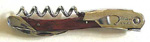 Since I have sacrificed too many corkscrews to the TSA, I now know where to find them: Georgia! Well, if I ever flew through Georgia that is. The WSJ had a quite hilarious piece yesterday on the bounty that the TSA collects from (presumably) clueless travelers including 12,295 “clubs, bats and bludgeons” and 1.6 million “knives and blades” collected last year.
It turns out that states, not the feds, can dispose of the stuff and many of them have decided to sell it directly. Pennsylvania, which, oddly, sells the 2.5 tons of goods a month collected from JFK airport and others, has a wall of items that they won’t sell just to demonstrate for the sheer outrageousness of what people tried to bring on board: “deer antlers, a foot-long fish hook, nunchucks, a medieval flail and a hand grenade with the explosive drilled out.” As the reporter says, what were they thinking?!?
Anyway, Georgia sells corkscrews it collects for less than a $1. Score! Anyone found any good corkscrews from such piles of miscellany? Ebay? Apparently states do use Ebay to dispose of some stuff. I would love to get a Laguiole for $1.
And remember, it’s only the tiny blade of the foil cutter that makes the corkscrew illegal (why, I’m not sure since they allow metal scissors “with pointed tips and blades” up to four inches in your carry-on. ‘Tis not mine to wonder why.). Pack a cork screw without a foil cutter and you’re good to go this summer!
“Carry-On Items Taken at Airports Find Happy Homes” [WSJ]
Jul
18
2007
Wine over water, Oregon, Michigan, the dollar — sips and spits
Sipped: Peter Singer, Princeton ethicist
“And buying the merlot may help sustain a tradition in the French countryside that we value–a community, a way of life, a set of values that would disappear if we stopped buying French wines. I doubt if you travel to Fiji you would find a tradition of cultivation of Fiji water.” Excellent! He’s clearly been reading his Dr. Vino! [great piece on bottled water in Fast Company]
Sipped: NYC tap water
The NYT gives NYC tap water a thumbs up for taste and price, pointing out that eight glasses of tap water a year has a total tab of $0.49. [NYT]
Sipped: Oregon wine tourism
Oregon Wine has a new interactive map for plotting your next trip to the state. Good stuff–we love maps! [Oregon Wine]
Sipped: Michigan wine country(?)
“There’s a quiet revolution happening here,†Joel Goldberg, a local wine writer, told the NYT about the burgeoning wine life in Michigan. “Go off a side road and through the woods and you’ll find a vineyard here, a vineyard there — hundreds of acres of new vineyards are going in all over the place. And there are some real quality wines.†[NYT travel]
 Spit: the US Dollar
Touched a record low versus the Euro on Friday as it fell to $1.3814.
Spit: EU wine reform, in Central Europe
“If this EU reform is passed, I think the size of the vineyards under cultivation in Hungary will be halved. It could create a dramatic situation,” Laszlo Kiss, president of Hungary’s National Council of Wine Communities. [AFP].
Spit: California Rhone-style wine under $10
“Why can’t California deliver the same kind of terroir [as a Cotes du Rhone] for $10? “[SF Chron]
Jul
16
2007
Wine: you CAN take it with you when you go!
How much wine can you bring back from your foreign travels? More than I thought, it turns out.
I just got back from a great couple of weeks in France, first at Vinexpo, and then with my family. Of course, we found lots of great wines to drink while we were there and even bought too much, and were forced to bring some back.
But I was apparently mistaken about the limit on just how much we could bring back–I thought we were allowed only one liter each, so we were forced to drink almost all the wines we got while we were there. I’ve written up one already — more notes forthcoming.
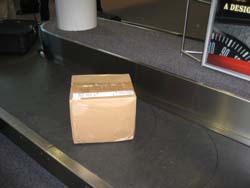 It turns out that all that guzzling might have been avoided if I had studied up on the US rules first. Customs and Border Protection limits you to one liter of alcohol free of tax. But beyond the one liter, the useful “Know before you go” Customs pamphlet elaborates that “Federal regulations allow you to bring back more than one liter of alcoholic beverage for personal use, but, as with extra tobacco, you will have to pay duty and Internal Revenue Service tax.”
While they don’t mention the IRS tax rate, anyone care to guess what the Customs duty is? Three percent! That’s it!
Despite the inconvenience of traveling with wine, us wine geeks can revel in bringing back wines that are not commercially imported to the US or are much less expensive overseas! Consider these examples: Read more…
Jul
6
2007
Poll: wine on cruise ships, good or bad?
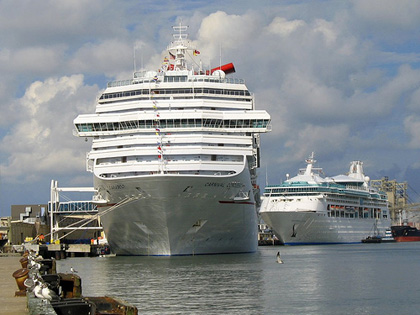
“We have a captive audience as most cruises last at least 11 days,” said Toni Neumeister, vice president of food and beverage at Crystal Cruise Lines was quoted in the current issue of Wine Business Monthly. Mmm, captive audience. Monopoly provider. And a new policy not allowing any alcoholic beverages on board. If you’re thinking what I’m thinking, then your cruise will have a poor selection of wines with high prices.
But the story then proceeds to say that wine on cruise ships has a gentler markup than restaurants with 1.5x cost instead of two or three times. So which is it? Share your experiences in the latest poll!
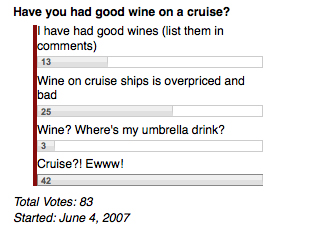
poll now closed
(image)
Jun
4
2007

Wine Maps
Monthly Archives
Blogroll
Categories
- American wine
- announcements
- Argentine wine
- auctions
- Australian wine
- Beer
- best wines
- Bling
- books
- Bordeaux
- bottled water
- Box wine
- Burgundy
- business of wine
- Celebrity wine
- Champagne
- Chicago
- China
- cocktails
- cognac
- corks
- corkscrews
- dining
- eco wine
- events
- foie gras
- food and wine
- French wine
- German wine
- giveaway
- grapes
- green wine
- guest post
- highlights
- how to
- Italian wine
- leaders and liters
- Mature wine
- meetups
- New York City
- On notice!
- photo captions
- podcasts
- Polls
- Port
- Portuguese wine
- power list
- reader mail
- rose
- sake
- Sommeliers
- South Africa
- Spanish wine
- spirits
- tasting sized pours
- The real wine world
- TV and movies
- Uncategorized
- videos
- vinexpo
- Weather
- wine and health
- wine and sports
- wine and tech
- Wine Blogging Wednesday
- wine blogs
- wine classes
- wine collecting
- wine gifts
- wine in india
- wine labels
- wine picks
- wine politics
- wine quizzes
- wine random
- wine science
- wine scores
- wine shops
- wine technology
- wine travel
- Wine under $10
- wine writing
- winemaking
- winespeak
 Blog posts via email
@drvino on Instagram
@drvino on Twitter
Advertise

quotes
One of the “fresh voices taking wine journalism in new and important directions.” -World of Fine Wine
“His reporting over the past six months has had seismic consequences, which is a hell of an accomplishment for a blog.” -Forbes.com
"News of such activities, reported last month on a wine blog called Dr. Vino, have captivated wine enthusiasts and triggered a fierce online debate…" The Wall Street Journal
"...well-written, well-researched, calm and, dare we use the word, sober." -Dorothy Gaiter & John Brecher, WSJ
Saveur, best drinks blog, finalist 2012.
One of the "seven best wine blogs." Food & Wine,
One of the three best wine blogs, Fast Company
Books for wine geeks
Wine books on Amazon: