Dr Vino's wine blog
wine talk that goes down easy
Tipsy gamers: Wine Tycoon
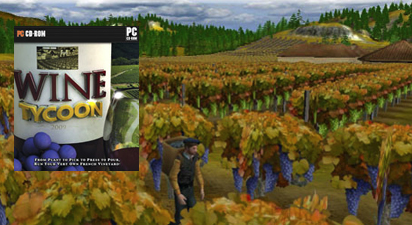
Via goodgrape, we learn of the impending release of a new The Sims-like computer game called Wine Tycoon. The producer’s description:
Create the vineyard of your dreams in 10 of the most important wine regions of France. Commanding operations from your very own French chateau, build your winery, plant and tend your vines through all four seasons of the year, and hire staff to harvest and process your grapes. Produce 50 French wines such as Bordeaux, Burgundy, Pinot Gris and Champagne from more than 40 different grape varietals, all in the ultimate goal of becoming a wealthy wine baron!
Reactions:
* In this age of Wii and PS3, people still play PC games? If it’s going anywhere, it had better be massively multiplayer!
* Does naked pigeage count as a plus or a minus in the game?
* Who stirs the Biodyanmic preparations?
* Do the vignerons-tycoons have to learn about selling into the three tier system in America?
* And don’t forget the goal of wine making: become rich as Croesus! But I thought you had to start with a large fortune to make a small one in the wine biz…
Sep
30
2009
17
Wine prices – beating the spread online and in-store
 One of my friends told me that he recently was looking to get three bottles of one Chateauneuf du Pape. He found it online for $47.99 at a store in New Jersey, coincidentally, near where his mother lives. So he called the store and asked them to hold three bottles for his mom to pick up. But when confirming the transaction, the clerk told him that the wine was $58 a bottle.
My friend replied that it was actually $48 on their web site. The clerk said that was a web-only price and the price via phone and in-store was actually $57.99.
So he hung up and placed the order on the web for in-store pick-up. Read more…
Jun
29
2009
New sugar free wine – have your say!
 A new series of wines from Indiana (search for “Slender” wines) claims to be sugar free, using a non-caloric sweetner instead for all their wine sweetening needs. As their press release states, “even though [the sweetner] has the identical flavor spectrum as sugar, it has no side effects because it cannot be metabolized by the human body.”
Mmm! Nothing says good times like putting indigestible things that you put in your mouth–or a Chenin Blanc rosé (?!?) or a glass of sweet Rubired, the rosé and the red in the lineup of so-called Slender wines. Just to crank it up a notch, they also note that it “prevents tooth decay.” And, people, we might have a new finalist for this year’s worst wine label contest!
But since most of wine’s calories actually come from the alcohol in it, perhaps the ultimate diet wine is a dealcohlized wine with some indigestible sweetner?
Site reader James wrote in with the tip and side order of outrage: “It’s got a Splenda nose! A real Sweet ’N’ Low note on the finish. AAAAAHHHHHHH. File it under Wine of the Apocalypse.”
Riffing off the famed late harvest wine, I’d have to go with Trockenbeerensaccharinelese. And you?
Feb
3
2009
Screwcaps, scores, riesling, the Loire, Cali cab: John Gilman part two
 We’re back with Part Deux of our interview with John Gilman, author of the newsletter A View from the Cellar (part one is here). John has offered a free issue from his backlist to any Dr. Vino reader so surf on over to his site and check it out. In this part of the Q&A, I had intended John to give a quick thumbs up or thumbs down on a number of hot-button issues in the wine world today as well as some things that I’ve heard him express unusual views about. In case you thought you were done gorging during the holidays, you can now feast on John’s 7,000+ words in this second part. So buckle up and get ready to hear his thoughts on what’s wrong with Riesling from Austria and Australia, screwcaps and their problems, the Loire, California cab then and now, indigenous yeasts, roto-fermenters, small oak barrels, wines over 14% alcohol and why he uses scores!
German Riesling
To my mind this is clearly the most singularly misunderstood and underappreciated region for great wines in the world. Read more…
Jan
5
2009
iBeer exists, but where’s iWine?
This is my first ever posting from the Apple Store. Sadly, I’ve just stopped by the Genius Bar and the diagnosis for my hard drive was fatal. Sad news to be sure, but it’s still under warranty. Let’s have three cheers for Time Machine backups!
Speaking of cheers and Apple, have you seen the iBeer application in the new App Store? If not, check out the video above for a demo of the #11 most downloaded app to the iPhone.
I’m still waiting for the wine equivalent! (Let’s just hope it’s not corked.)
Jul
27
2008
Nuvo Vino wine thermometer – superfluous but wonky fun
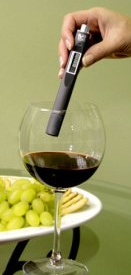 “I bet this wine is sixty-two degrees,” I confidently proclaimed. Seconds later, I used the Nuvo Vino infrared wine thermometer to check by pointing it at the surface of the wine and pushing a button. The instant reading was sixty-one degrees. Close.
The company sent me their $37 device for testing recently. I started testing the temperature of red and white wine in my glass at the table. But quickly that got tiresome and I found my son’s hand was eighty-three degrees. His ice water, thirty-three degrees. The next morning, my coffee was 149 degrees.
Is it necessary to know the exact serving temperature of your wine? No. But it is true that many whites are served too cold (fridge temp) and many reds served too hot (room temp). I don’t think you need a $37 thermometer to tell you that a wine is colder than room temp or warmer than the fridge. On their site, they have a detailed chart for recommended serving temperatures, which generally good (I particularly like their advice “cheap sparkling wine is best served quite cold.”). The excessive detail of the chart and the suggestion that there are yet more rules to follow for wine consumption though, I fear, risk confusing the average consumer who is just warming up to the fact that it’s OK to have pinot noir with salmon.
On the other hand, if you are looking for a gift to give the wine lover who has everything, has a hankering for James Bond-style gadgets, likes wonking out with experiments in wine service, and wants to annoy everyone with repeated temperature readings, then throw it in your shopping cart.
Apr
28
2008
Turn your iPhone into a winePhone
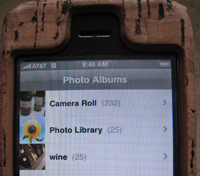 Did you know you can store your wine label images in a separate folder on your iPhone? When you are stumped in front of a sea of bottles at your wine store, you can flick through and see ones that you’ve enjoyed before. Or, if you can’t remember which wine you had with dinner last night (ahem), just snap a pic and store it for jogging the memory later. You could even download label images as a wish list!
Scroll through for a brief photo tutorial. I’m sure you can get something similar to work on other phones too, if you have to. How do you store your label images? Read more…
Feb
27
2008
Poll: banning high alcohol wines
Darrell Corti has banned the sale of high alcohol wines in his food and wine emporium in Sacramento, CA according to a story on AppellationAmerica.com. Corti says:
At our store, after a tasting on the 29th of March, I put on top of the Zinfandel section, “This is the last tasting Corti Brothers will do for over 14.5 percent Zinfandels. These wines will no longer be sold at Corti Brothers. There will be no exceptions…They (high alcohol wines) make you very tired. My idea of a really good bottle of wine is that two people finish the bottle and wish there was just a little bit more. Some of these wines with high levels of alcohol — you can’t finish the bottle. You don’t want to finish the bottle.â€
What do you say? Is Corti a hero or a villain?
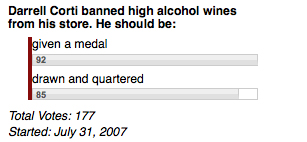
poll now closed
Aug
1
2007
Wine Maps
Monthly Archives
Blogroll
Categories
- American wine
- announcements
- Argentine wine
- auctions
- Australian wine
- Beer
- best wines
- Bling
- books
- Bordeaux
- bottled water
- Box wine
- Burgundy
- business of wine
- Celebrity wine
- Champagne
- Chicago
- China
- cocktails
- cognac
- corks
- corkscrews
- dining
- eco wine
- events
- foie gras
- food and wine
- French wine
- German wine
- giveaway
- grapes
- green wine
- guest post
- highlights
- how to
- Italian wine
- leaders and liters
- Mature wine
- meetups
- New York City
- On notice!
- photo captions
- podcasts
- Polls
- Port
- Portuguese wine
- power list
- reader mail
- rose
- sake
- Sommeliers
- South Africa
- Spanish wine
- spirits
- tasting sized pours
- The real wine world
- TV and movies
- Uncategorized
- videos
- vinexpo
- Weather
- wine and health
- wine and sports
- wine and tech
- Wine Blogging Wednesday
- wine blogs
- wine classes
- wine collecting
- wine gifts
- wine in india
- wine labels
- wine picks
- wine politics
- wine quizzes
- wine random
- wine science
- wine scores
- wine shops
- wine technology
- wine travel
- Wine under $10
- wine writing
- winemaking
- winespeak
 Blog posts via email
@drvino on Instagram
@drvino on Twitter
Advertise

quotes
One of the “fresh voices taking wine journalism in new and important directions.” -World of Fine Wine
“His reporting over the past six months has had seismic consequences, which is a hell of an accomplishment for a blog.” -Forbes.com
"News of such activities, reported last month on a wine blog called Dr. Vino, have captivated wine enthusiasts and triggered a fierce online debate…" The Wall Street Journal
"...well-written, well-researched, calm and, dare we use the word, sober." -Dorothy Gaiter & John Brecher, WSJ

Saveur, best drinks blog, finalist 2012.
One of the "seven best wine blogs." Food & Wine,
One of the three best wine blogs, Fast Company
Books for wine geeks
Wine books on Amazon: