Dr Vino's wine blog
wine talk that goes down easy
New, alternative packaging resolves carbon footprint, food-wine dilemmas
In an effort to solve two of wine’s largest problems, the food pairing conundrum and the carbon footprint, Franzia has today announced the ideal solution: wine in an edible box.
The box is made from lightweight materials, which reduce the carbon dioxide emissions during transportation. But the packaging materials are also edible since they are made from a corn-based corrugated cardboard with a soy-based plastic bag on the inside. The wine brand is called Food n Wine Box.
“We wanted to do more than have a low carbon footprint,” said Anthony J. Franzia, Senior Vice President of Product Development, in a press release. “We wanted to have zero need for recycling the box and bag. With the packaging of Food n Wine Box, whoever squeezes off the last glass has the first dibs on digging into the delectable box.”
The boxes of the wine are available in different flavors. Robust Red has a hint of BBQ sauce embedded in its molecules. The Summer Sippin’ White has notes of grapefruit.
Chef Homaro Cantu was a consultant in the product design.
For more details, click here.
Apr
1
2008
13
Climate change and wine event, a wrap!
About 150 people attended The Nature Conservancy talk and tasting on Tuesday night–it was great to meet so many site readers! Dominique Bachelet of TNC, Scott Pactor of Appellation Wine & Spirits, and I started off a discussion about climate change and wine that then spilled into a Q&A. We all then tasted four “natural” wines provided Michael Skurnik. Although I didn’t select them, I did enjoy the wines: the Hofer Gruner Veltliner in the carbon-efficient one-liter bottle (find this wine), Mittnach pinot blanc from Alsace (find this wine), Domain de Gourgonnier’s biodynamic red from Provence (find this wine), Amber Knolls/Beckstoffer 1975 that I have seen everywhere and had no idea that the grapes are organically grown (find this wine).
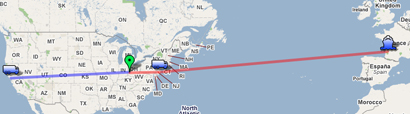
Since I love maps, I added more color to the “green line” map for my slide show using Googlemaps. Although I presented it on Tuesday evening, it still has that new map smell. Check it out here.
Anyway, not much more to report here since you, no doubt, are familiar with my joint research on the carbon footprint of wine. Cruise on over to The Nature Conservancy web site and check them out if you’re not familiar with them. They’re doing good things.
Mar
20
2008
Nicole Kidman, French sails, global warming – sipped and spit
SIPPED: French wine sales
Sales of French wine rose seven percent in 2007. Is the 2003 Iraq-induced hangover finally over? [IHT]
SIPPED: French wine sails
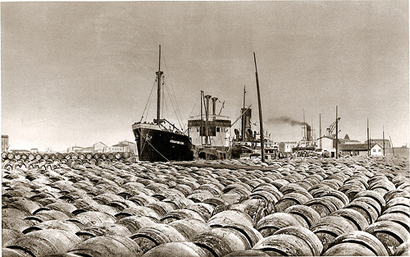
Belem, a three-masted barque first launched in 1896, will begin transporting 60,000 bottles of wine by sail from the Languedoc to the British Isles in an effort to reduce wine’s carbon footprint. Will gerbils power the refrigerated containers? [AFP]
SIPPED and SPIT: climate change and wine
A big shindig in Barcelona attracted some cult winemakers to discuss global warming and wine; although Al Gore could only make an appearance via satellite, wine bloggers Alice Feiring and Catavino were on the scene.
SPIT for SIPPING: Nicole Kidman
Nicole Kidman caused an uproar because she mighta, coulda had a glass of wine during the Oscars last Sunday. Unlike Gisele who caused a stir by sipping wine at the Super Bowl, the big deal with Keith Urban’s wife was not the wine selection itself; rather, she is pregnant. Kidman’s agent has defended her client, denied the allegation, and called the accuser an “idiot.”
Related:
-“Knocked up: expecting moms and defying expectations”
– All abord the Tesco barge
(image)
Feb
29
2008
This blog came THIS close to a mention in the NYer, WSJ!
 This excellent New Yorker article examines the phenomenon of measuring carbon emissions. The author, Michael Spector, mentions the study on the carbon footprint of wine that I wrote with Pablo Paster. And we were THIS close to a mention! Roll the tape:
Last year, a study of the carbon cost of the global wine trade found that it is actually more “green†for New Yorkers to drink wine from Bordeaux, which is shipped by sea, than wine from California, sent by truck. That is largely because shipping wine is mostly shipping glass. The study found that “the efficiencies of shipping drive a ‘green line’ all the way to Columbus, Ohio, the point where a wine from Bordeaux and Napa has the same carbon intensity.â€
It’s good the research is getting out there! The WSJ blog Environmental Capital also mentioned it here and the New York based authors were delighted to raise a glass of Bordeaux to the finding. Foreign Policy also mentioned it in passing this time around but actually did mention it before.
Anyway, if this has made you thirsty for more on the topic, check out a summary of our research findings, my op-ed in the NYT suggesting a local drink, and be sure to come to the March 18 free talk and tasting benefiting The Nature Conservancy! Hope to see you there!
Feb
20
2008
Wine and climate change: a panel for The Nature Conservancy (free wine!)
Are you interested in climate change and wine? How about a free tasting of natural and organic wines? Then you need to put March 18 at 7 PM on your calendar and come to West 26th St.
I’ll be joining a panel to benefit The Nature Conservancy. Dominique Bachelet, director of climate change science at The Nature Conservancy, and Scott Pactor, owner of Appellation Wine & Spirits, and I will be on the panel. The wines will be provided courtesy of the excellent importer/distributor Michael Skurnik.
Even though the event is free and open to the public, you’ll need to register because space is limited. I hope to see many of you there!
“Message in a Barrel: Drinking Wine in a Changing Climate.” Details and registration.
In other Dr. Vino green news, there are still a few spaces left in my afternoon seminar at UC Berkeley (but held in their SF SoMa location) on Saturday, February 23. “Red, white and green wine: can you taste the difference?” Image: istockphoto.
Feb
11
2008
In Wine & Spirits talking about wine’s carbon footprint
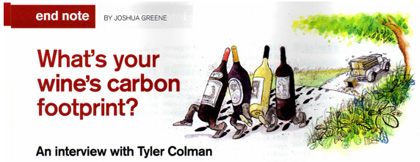
Welcome readers of the Wine & Spirits magazine! If you’re looking for some bullet points and discussion of my research with Pablo Paster on wine’s carbon footprint, check here. Consider subscribing to the site feed or the monthly email updates on the right sidebar.
And if you haven’t seen the issue that is hitting mailboxes and newsstands now (but not the web), check out the Syrah extravaganza issue with reporting and reviews from Australia, the US (Santa Cruz), Chile and France. There’s also an interview on the back page that I did with editor and publisher Josh Greene.
While some of it covers familiar ground to blog readers, there’s some new material and great art (I wasn’t Simpsonized)! And I also make a proposal for later in the year: because air freight has such a big effect on a bottle’s carbon footprint and much Beaujolais nouveau is sent around the world by plane, how about saying no to nouveau and making the third Thursday of November a global celebration of local wine? Hit the comments with your initial thoughts on this idea. We’ll come back to it later in the year.
One point of clarification: the story ran a chart from our paper that reflects the various amounts of carbon dioxide emissions for bottles from different places. Napa looks horrible with even more than Australia! What was reflected in the text of the paper but didn’t make it into the chart in this story is that all the bottles were being sent to Chicago via differing modes of transport. The Napa one was sent sent by air. Sending it by truck would bring it down slightly below the CO2 emissions of the French bottle.
Jan
8
2008
HOWTO: make a furoshiki wine carrier
My friend Kazuma, whom I met in my NYU wine class last year, gave me a gift of two furoshiki recently. They are traditional, decorative cloths used for wrapping and carrying. They’re popular now in Japan since they are reusable and give you the chance to say goodbye to plastic bags. In fact, the environmental minister made one from fiber of recycled soda bottles to boost awareness of furoshiki. The Ministry even has graphics of suggested foldings!
Kazuma says they can serve as a handy wine tote for two bottles. He sent along this video of him showing how to tie one on, furoshiki style. (If you’re reading this in a feed reader, click here to view.)
Jan
4
2008
In the New York Times with a suggestion to “drink local”
 Welcome readers of the New York Times who saw my op-ed today. If you’re looking for some bullet points and discussion of my research with Pablo Paster on wine’s carbon footprint, check here. Consider subscribing to the site feed or the monthly email updates on the right sidebar.
If you’re a regular reader and wondering what I’m talking about, surf on over to the NYT where you can check out my op-ed in today’s paper. I suggest drinking local this New Year’s Eve if you are making it a resolution to turn a new, greener leaf in 2008. Local wines have a small carbon footprint because of minimal transportation, which is carbon intensive. And, heck, locavore is the word of the year according to the Oxford English Dictionary, so it’s trendy too!
Be sure to check out my maps of NYC wine shops and NYC wine bars if you’d like info on where to find local wines in the city. If you’re looking to find the Lieb blanc de blancs, click here to find it at stores.
But since it is a big bar night, a few places specialize in local fruits of the vine. The two branches of Vintage New York pour exclusively the wines of New York. Borough Food & Drink, which opened this past summer at 12 E. 22nd St., highlights–you guessed it–food and drink from the Empire State and has about 40 NY wines on its list. Home Restaurant (20 Cornelia St.) is a cozy West Village restaurant focusing on local food and wine and is owned by the couple that owns Shinn Estate Vineyards. The wine list has 30 selections from New York State, including two sparklers.
If you have some favorite places for finding local wines in the City or are a big fan of a certain local winery, feel free to hit the comments. And whatever it is you raise in your glass tomorrow night, may it be a happy new year!
Dec
30
2007
Wine Maps
Monthly Archives
Blogroll
Categories
- American wine
- announcements
- Argentine wine
- auctions
- Australian wine
- Beer
- best wines
- Bling
- books
- Bordeaux
- bottled water
- Box wine
- Burgundy
- business of wine
- Celebrity wine
- Champagne
- Chicago
- China
- cocktails
- cognac
- corks
- corkscrews
- dining
- eco wine
- events
- foie gras
- food and wine
- French wine
- German wine
- giveaway
- grapes
- green wine
- guest post
- highlights
- how to
- Italian wine
- leaders and liters
- Mature wine
- meetups
- New York City
- On notice!
- photo captions
- podcasts
- Polls
- Port
- Portuguese wine
- power list
- reader mail
- rose
- sake
- Sommeliers
- South Africa
- Spanish wine
- spirits
- tasting sized pours
- The real wine world
- TV and movies
- Uncategorized
- videos
- vinexpo
- Weather
- wine and health
- wine and sports
- wine and tech
- Wine Blogging Wednesday
- wine blogs
- wine classes
- wine collecting
- wine gifts
- wine in india
- wine labels
- wine picks
- wine politics
- wine quizzes
- wine random
- wine science
- wine scores
- wine shops
- wine technology
- wine travel
- Wine under $10
- wine writing
- winemaking
- winespeak
 Blog posts via email
@drvino on Instagram
@drvino on Twitter
Advertise

quotes
One of the “fresh voices taking wine journalism in new and important directions.” -World of Fine Wine
“His reporting over the past six months has had seismic consequences, which is a hell of an accomplishment for a blog.” -Forbes.com
"News of such activities, reported last month on a wine blog called Dr. Vino, have captivated wine enthusiasts and triggered a fierce online debate…" The Wall Street Journal
"...well-written, well-researched, calm and, dare we use the word, sober." -Dorothy Gaiter & John Brecher, WSJ
Saveur, best drinks blog, finalist 2012.
One of the "seven best wine blogs." Food & Wine,
One of the three best wine blogs, Fast Company
Books for wine geeks
Wine books on Amazon: