Dr Vino's wine blog
wine talk that goes down easy
Vote Emmanuel Macron! A blind tasting
The French presidential election is heating up. Polls show Emmanuel Macron defeating Marine Le Pen in the decisive second round on May 7 by 62-38 (yes, polls have been deceiving ahead of recent elections but this is a big margin).
We are single-issue voters around here and that issue is wine! Actually, that’s not true but we will roll with it. Recent French presidents have hovered at or near zero when it comes to passion for wine. Jacques Chirac’s tipple of choice was reportedly Corona. Nicolas Sarkozy famously didn’t even like wine. Current president Francois Hollande sell off a chunk of the presidential wine cellar–but he also canceled a lunch with the Iranian president after the guest insisted no wine be served.
Macron, a former minister of Finance who is a mere 39 years old, exhibits some wine savvy. Although he was raised in Picardy, not a region known for wine growing, he says that his grandparents told him that red wine was “guilt-free” since it is an antioxidant.
The journalists from Terre de Vins and Sud-Ouest conducted a wide-ranging interview about wine. Among other things, Macron admitted that a meal without wine would be “a little bit sad because wine is a part of the French table…our civilization.” He even talks about the pleasure of food-wine pairings! It may not seem like it since you’d expect all French presidents to support wine. But these are kind of fighting words right now as the rate of wine consumption has been in decline and the health crowd that takes a dim view of wine has been ascendant in policy circles.
Macron then submitted himself to a blind tasting with the journalists! (Video above) Can you imagine a leading presidential candidate doing that here? Usually they run away from it, heading toward beer, if anything. And a blind tasting? That’s high-risk stuff for anyone!
But Macron comports himself amazingly well, showing a breadth of knowledge (even though he did offer that the likes Miraval rosé, which comes from the estate of erstwhile Brangelina) as well as taste preferences (says he doesn’t like high-acid whites). He correctly guessed both a Bordeaux blanc and a Coteaux de Provence by region, and even the red he guessed as a Bordeaux but was off by a few appellation (trust me, it’s easy to make mistakes…). I’m sure he will pour some fun wines at the Elysée Palace over the next five years.
Mar
20
2017
Comments Off on Vote Emmanuel Macron! A blind tasting
Clos Rougeard sold to billionaire
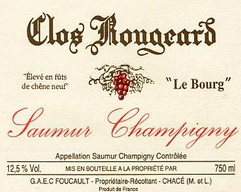 “Winery X, in family for generations, sold to billionaire” is a headline that would normally barely raise an eyebrow. But the winery in today’s news is Clos Rougeard from the Loire.
Located in Saumur, Clos Rougeard is the Bentley of the Loire. The wines, almost all red, are expensive, rare and of exceptional quality–the kind of wines that can turn haters of cabernet franc into ambassadors. (search for Clos Rougeard at retail)
The 27-acre estate was owned by the Foucault brothers Bernard (a.k.a. Nady) and Jean-Louis (known as Charly). They were the eighth generation to run the estate and made it a pioneer of organic viticulture in the area as well as hands-off winemaking.
After Charly’s death in 2015, La Revue de Vin de France reports, the family resolved to sell the domaine. The buyer is Martin Bouygues, French telecom billionaire and 481st richest person in the world.
In a way it is kind of surprising that a billionaire is attracted to the Loire, which is generally a region that favors low-key wines and hasn’t attracted big fortunes to be tossed around since the day of Francois I. Perhaps that is changing? Doubtful. Clos Rougeard is arguably the pearl of the Loire, now snatched up as bauble for a billionaire. But at least he is discerning! And the estate doubtless cost less than one in Musigny. Bouygues owns Chateau Montrose in Bordeaux.
LARVF doesn’t report on changes in the wine making.
UPDATE: Yes, another “Winery X sold to billionaire” story appeared today–at this rate, will there be any family-owned and operated top wineries by the end of the year?? Stan Kroenke, owner of Arsenal football club and the LA Rams and Screaming Eagle, is said to have bought a majority stake of Bonneau de Martray. [Decanter]
Jan
4
2017
UNESCO recognizes Burgundy’s “climats” and Champagne’s hills

UNESCO added wine regions to their list of World Heritage sites at Saturday’s meeting in Bonn. The 1,247 “climats” of Burgundy as well as the Champagne hillsides received official recognition as cultural sites.
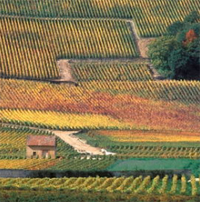 Campaigns in each French region supported the bids as well as the French government since UN member states are limited in nominating sites in their own boundaries. Burgundy’s campaign video appears below (in English) with more details on their site. Aubert de Villaine of Domaine de la Romanée-Conti led the campaign for Burgundy’s inclusion; above he is congratulated after the vote in favor.
The vineyards in the regions now receive an extra level of protection from future development and they qualify for additional financial aid for preservation and may get a fillip from additional tourism. A new Cité des Vins is slated to open next year in Beaune with the aim of welcoming 90,000 tourists. What do you think: will this make you want to visit more? I was pretty much sold at the word Burgundy…
St. Emilion in Bordeaux received World Heritage status in 1999, the Mosel in 2002, and Barolo and Barbaresco were recognized last year. There are 1,031 sites now on the list. Read more…
Jul
6
2015
Things heating up in Europe
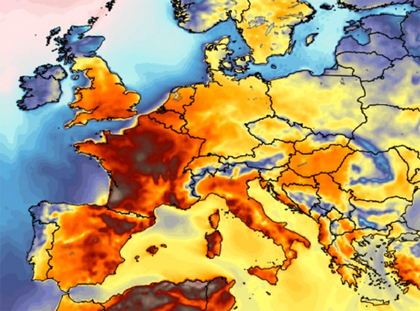
Things are heating up in Europe–not just in Greece. A searing heatwave has the continent in its grasp.
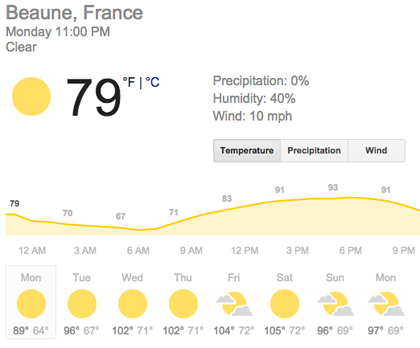
Burgundy, which is known for producing wines more winsome than boxum, will have four days in the 100s (39C+) this week–and the balance in the 90s. Yikes. Searing temperatures are expected in Bordeaux, Barolo, Brunello and Britain as well to name a few places starting with “B.”
Generally, grape vines don’t like excessive heat. The later in the grapes’ ripening process the heat wave comes, the more difficult it can be to manage. This pamphlet (pdf) from Australia–no stranger to heat waves with a monster one in 2009 that pushed temperatures up over 100 for 14 days–states that the main effects are a loss of crop and reduction of quality. Mitigation strategies include irrigating vineyards during heatwaves, which may be an option in Barossa but not in Burgundy.
The last heat wave that had in impact on French wine was 2003, which was the hottest summer since 1540. The wines from that vintage got a lukewarm reception initially (except for the shootout at the St. Emilion Corral over the Pavie 2003) and they have aged poorly. Sadly, the 2003 heat wave also accounted for tens of thousands of deaths across France. Fortunately, that isn’t likely to be the case this time around.
Sadly, such hot summers in Europe are likely to become more frequent, even “commonplace” by the 2040s. In a study released last year, researchers from the Met Office, Britain’s weather service, predicted that once every five years Europe will have “a very hot summer.”
While it is too soon to tell how the 2015 vintage will work out, the vines will be under heat stress the next few days. Bonne chance.
Jun
29
2015
China’s vineyard area vaults past France
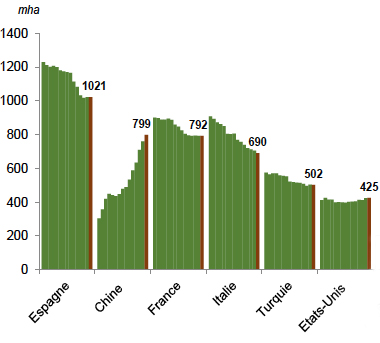
More acres of grapes are now in China than France. The total vineyard area in China is 1.97 million acres (799,000 hectares) according to new stats presented yesterday in Paris by the OIV, the International Office of Vine and Wine.
Although vineyard area includes grapes for both winemaking (what we’re interested in) and table grapes (those can be good too), the rise of plantings in China over the past 14 years is staggering. Vineyard area in the EU is part of the Common Market Program and is governed by EU agricultural policy, which has been moving to reduce marginal vineyards through a policy known as “grubbing up” and limiting new plantings through a zero-sum formula of planting rights. Unhindered by such policies and with wine consumption rising, China’s vineyards were bound to overtake key EU countries one day. So far, however, it is in quantity only. Oh, this headline caught my eye the other day: “The head of China’s biggest wine brand admits its wines are terrible.”
The US remains the world’s largest wine consuming country. Check out our interactive chart below–be sure to click to see whether each market is growing or shrinking!
Data from OIV
Apr
28
2015
Depardieu drinks 14 bottles of wine a day
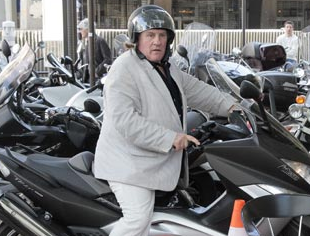 French wine consumption has been declining for the past fifty years. But one man seems to be taking it upon himself to single-handedly reverse this trend: Gerard Depardieu.
The Frenchman-turned-ruski told the British site So Film, “I can absorb 12, 13, 14 bottles…per day. But I’m never totally drunk, just a little pissed.”
“All you need is a 10-minute nap and voilà , a slurp of rosé wine and I feel as fresh as a daisy!” He added.
He’s not likely to run out of wine since Depardieu owns Chateau de Tigne in Anjou. He once joked that his mother’s amniotic fluid was wine.
Sep
22
2014
Faiveley buys Billaud-Simon in Chablis
 Domaine Faiveley of Burgundy has announced the acquisition of Billaud-Simon for their first vineyard purchase in Chablis. The 50-acre estate includes 4 acres of Grand Cru sites in Vaudésir, Les Clos, Les Preuses and Blanchots. They also have 22 acres of premier cru sites. Domaine Faiveley now has 350 acres in Burgundy.
I have always liked Billaud-Simon’s wines, so it is sad to see the end of an era. However, Erwan Faiveley (who chatted with us a few years ago), has really steered S.S. Faiveley in a good direction since taking the helm. So I will look forward to seeing the results of this acquisition.
Aug
6
2014
Comments Off on Faiveley buys Billaud-Simon in Chablis
Veuve Clicquot tablets sparkle on the internets
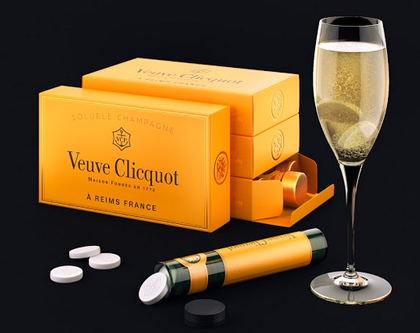
How would it sound if you could carry tablets of Veuve Clicquot in your handbag and drop then in water to make a glass of the famous bubbly? To those who drive popular brand to sales of over a half a million cases a year in the US, that sounds like their kind of “plop, plop, fizz, fizz.”
Photos of Veuve Clicquot tablets have surfaced on the internets today and some have latched on to the story as real. But it is actually a hoax, put out by a “Russian communication agency.” So there you have it. Apparently the muckety mucks at LVMH are none-too-happy about this. But given the legs the story has had, maybe it’s an idea they should explore commercially? Well, maybe some producer in another region will…
Aug
5
2014
Wine Maps
Monthly Archives
Blogroll
Categories
- American wine
- announcements
- Argentine wine
- auctions
- Australian wine
- Beer
- best wines
- Bling
- books
- Bordeaux
- bottled water
- Box wine
- Burgundy
- business of wine
- Celebrity wine
- Champagne
- Chicago
- China
- cocktails
- cognac
- corks
- corkscrews
- dining
- eco wine
- events
- foie gras
- food and wine
- French wine
- German wine
- giveaway
- grapes
- green wine
- guest post
- highlights
- how to
- Italian wine
- leaders and liters
- Mature wine
- meetups
- New York City
- On notice!
- photo captions
- podcasts
- Polls
- Port
- Portuguese wine
- power list
- reader mail
- rose
- sake
- Sommeliers
- South Africa
- Spanish wine
- spirits
- tasting sized pours
- The real wine world
- TV and movies
- Uncategorized
- videos
- vinexpo
- Weather
- wine and health
- wine and sports
- wine and tech
- Wine Blogging Wednesday
- wine blogs
- wine classes
- wine collecting
- wine gifts
- wine in india
- wine labels
- wine picks
- wine politics
- wine quizzes
- wine random
- wine science
- wine scores
- wine shops
- wine technology
- wine travel
- Wine under $10
- wine writing
- winemaking
- winespeak
 Blog posts via email
@drvino on Instagram
@drvino on Twitter
Advertise

quotes
One of the “fresh voices taking wine journalism in new and important directions.” -World of Fine Wine
“His reporting over the past six months has had seismic consequences, which is a hell of an accomplishment for a blog.” -Forbes.com
"News of such activities, reported last month on a wine blog called Dr. Vino, have captivated wine enthusiasts and triggered a fierce online debate…" The Wall Street Journal
"...well-written, well-researched, calm and, dare we use the word, sober." -Dorothy Gaiter & John Brecher, WSJ

Saveur, best drinks blog, finalist 2012.
One of the "seven best wine blogs." Food & Wine,
One of the three best wine blogs, Fast Company
Books for wine geeks
Wine books on Amazon: