Dr Vino's wine blog
wine talk that goes down easy
Liquid Memory by Jonathan Nossiter – reviews
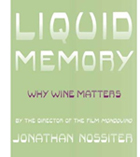 Jonathan Nossiter’s new book, Liquid Memory: Why Wine Matters, has gotten two major reviews in the first two weeks since publication. One was lukewarm. The other was a kick in the solar plexus.
Even though its themes were widely discussed in the wine world, audiences did not flock to see Nossiter’s 2004 documentary, Mondovino, which racked up only $200,000 in box office gross according to IMDB. (Sideways was north of $100 million, by contrast.) I found Mondovino to be shaky, not stirring.
The first review of Liquid Memory came in the NYT Book Review, written by Jim Holt (who is credited as “writing a book about the puzzle of existence”). He offered this warm beer as criticism: “Nossiter didn’t completely win me over.” Despite this, the book soared on Amazon’s sales rankings.
Now get a hold of Mike Steinberger’s review, just published on Slate.com. He writes that the ”solipsism, self-regard, and preening” on display in the book would make the subtitle “Why I Matter” more apt. He also catches Nossiter displaying faux populism both in Nossiter’s lexicon for talking about wine that (literature) as well as the high prices of the wines that Nossiter recommends (Roumier, Roulot, and Dominique Lafon). And he accuses Nossiter of fighting yesterday’s battles.
A great line line from the review summarizes Nossiter’s regrettable tendency to paint his villains with a partisan brush: “The wine world is certainly no Eden, but at least among the grape nuts I know, there seems to be a tacit understanding that politics should end at the rim of the glass—that arguments over wine are spirited enough without injecting politics into the discussion.”
Oct
30
2009
14
Embarrassing moments in bottle opening – The Rabbit and Benito’s blog
Ben Carter writes a wine blog from Memphis known as Benito’s wine reviews. In the same spirit as our impossible food wine pairings, his series “Benito vs. ___”, he takes on such crazy foods as cactus or an MRE. Check them out! And while you’re there, you can check out his kind words about my book A Year of Wine–as well as a few words from me since we did a Q&A.
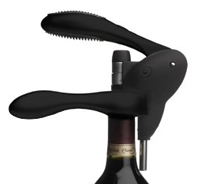 One of the questions he asked me was about a time when I had trouble opening a bottle. Being smoother than Rico Suave with corkscrew, I could only think of crumbly corks as difficult-to-open situations.
But later, Mrs. Vino reminded me of The Rabbit!
I haven’t ever confessed this to you, but The Rabbit and I are not friends. We once brought a celebratory bottle of red over to some friends at their new home. New as in brand new. And freshly painted. They presented me with The Rabbit to open the bottle and I confidently pushed down on the lever in such a manner as to thrust the cork into the bottle and force a geyser of red wine up to the ceiling. Whoops! Fortunately the painter was due back soon. But still, not one of my finer bottle opening moments.
What about you? Do you have any embarrassing moments in bottle opening that you’d like to share?
Aug
6
2009
Giveaway: Au Revoir to All That by Michael Steinberger
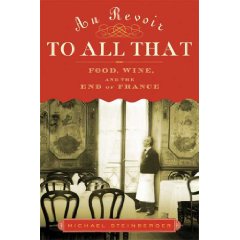 At the G8 summit in the UK in 2005, reporters overheard Jacques Chirac murmur about the British hosts to some fellow world leaders, “One cannot trust people whose cuisine is so bad.”
The irony of this comment was not lost on Mike Steinberger. In his new book, after noting that London is now, actually, a great food city, he turns the tables on Chirac, saying, “Where once the mere mention of food by a French leader would have elicited thoughts of Gallic refinement and achievement, its invocation now served to underscore the depths of France’s decline. They’ve even lost their edge in the kitchen.”
Mike is probably best known to wine geeks as the wine columnist for Slate.com. But in Au Revoir to All That: Food, Wine, and the End of France, available on Amazon today, he broadens his focus to include food, specifically, haute cuisine in France. Unlike much food writing, which is prone to sometimes excessive praise, Mike takes up the task of analyzing the decline of French food through the lens of a love lost. Imbued with nostalgia and occasional bafflement at the new French ability to turn gold into lead, Mike wolfs down raw milk camembert and praline mille feuilles, talks with leading chefs and restaurateurs, probes the inner workings of the Michelin Guide, cross examines bureaucrats, journeys to Spain, has a glass of water with the head of McDonald’s Europe, meets a struggling vintner who sold his house in order to keep his winery, and contemplates the lack of ethnic diversity in French restaurants with a Pakistani-born chef.
It’s a meaty tale that provokes thought and stimulates the palate: wine and food lovers will want to savor it this summer.
Thanks to Bloomsbury, the publisher, we have three signed copies of the book to give away to readers of this site. To qualify for the drawing, hit the comments below and tell us where you had your best (or at least a great) meal, restaurant and city. If you’re not feeling in an haute cuisine spirit, tell us about your favorite street food experience. Enter by Thursday to qualify; randomly selected winners will be announced here on Friday morning.
UPDATE: Slate has just posted an excerpt about “How the Michelin guide crippled France’s restaurants.”
Jun
23
2009
Signed books and Chicago event
 I’ll be in Chicago at the end of the month for a Saturday seminar at the University of Chicago Graham School. The class will explore in greater depth some of the themes related to my book Wine Politics: How Governments, Environmentalists, Mobsters and Critics influence the Wines We Drink. We’ll also be tasting through some excellent wines as we have done in previous installment of this course. No previous knowledge of wine is necessary and the session is non-degree and noncredit. It’s Saturday, June 27, 2:30 – 6:30 PM just off Michigan Avenue.
  On another book related note, in case you are puzzling what to get for Father’s Day, I’m happy to reinstate my offer of signed gift copies. Send me via PayPal the amazon price, tax, and shipping (say, $25) of either Wine Politics or the practical guide, A Year of Wine: Perfect Pairings, Great Buys, and What to Sip for Each Season (which actually has more wine-related Father’s Day gift ideas in it), and I’ll send a copy of either book inscribed as you please to whatever domestic address you like. So much more interesting than a tie! Don’t delay since Father’s Day is rapidly approaching! There’s also a Kindle edition of A Year of Wine but I can’t sign that one for you without smudging your screen.
Jun
15
2009
At the James Beard House to discuss A Year of Wine
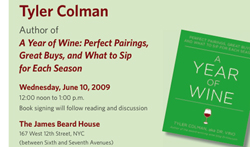 Next Wednesday I’ll be at the James Beard House to talk about my new book, A Year of Wine: Perfect Pairings, Great Buys, and What to Sip for Each Season. It’s part of their monthly author series called Beard on Books.
I was fortunate enough to have been able to give a talk there last year for my other book, Wine Politics, and the turnout was great and the discussion was excellent. Because A Year of Wine dovetails on the seasonal food movement by suggesting varying the wines you drink with the seasons, I’m thrilled to be heading to this gastronomic institution for this discussion. Hope to see you there!
Wednesday, June 10, Noon – 1 PM
167 W. 12th Street
Suggested donation: $20; students free. Event page on their site.
Jun
4
2009
Koreans work fast – and other book news
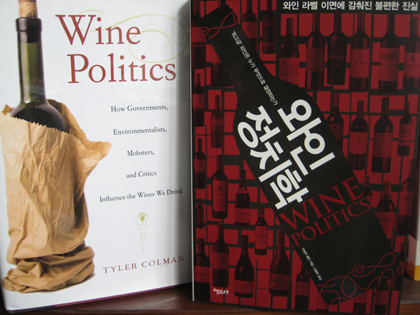
Yesterday, the UPS man dropped off a box of books in Korean. I was amazed. Not so much at the fact that I got a stack of books in Korean. But the books had my name on the front–or so I understand.
It was only November when I first heard about the Korean edition of my book, Wine Politics: How Governments, Environmentalists, Mobsters, and Critics Influence the Wines We Drink. And now it has been printed–and with a better cover, I might add. Wow, that was fast.
In news about my other book, A Year of Wine: Perfect Pairings, Great Buys, and What to Sip for Each Season, we have blog reviews!
Jeff at goodgrape.com writes: “It has ascended to the top of my intro. guide favorites list…Not only is his crystalline writers voice clear, concise and accessible, but he’s truly done something inventive with the introductory wine guide genre by interspersing his wisdom very suitably within the context of the calendar.”
Cathy Huyghe writes: “…this book makes wine fun. Relevant. Not stodgy. Easy reading. And by the end of it – or by the end of the month if you prefer – you’ll have learned something new. When it comes to books on wine, you cannot ask for anything more.”
Vinography posts Tim Patterson’s review of Wine Politics: “Dr. Vino knows his stuff–and rest assured, the writing is clean, clear and lively, not the least pedantic, and in no way requiring an advanced degree in econometrics.”
And, finally, you can check out a video Q&A with me done by the good folks at Organic Wine Journal. They also have some other vids there about cow horns with Mike Benziger or how to spit with Lyle Fass so you might just click away from mine to surf around their site.
May
1
2009
Spring is coming! Are you ready for a change?
Up in Toronto, where the winter had been long, Beppi Crosariol is finally uncorking a Soave. Spring officially begins on Saturday and many of us are ready to embrace it–enologically speaking.
Beppi also happens to the be wine columnist for the Toronto Globe and Mail. His column today is about changing what’s in your wine glass with the seasons, which is the heart of my book, A Year of Wine: Perfect Pairings, Great Buys and What to Sip for Each Season. It’s a really good article that is part book review, part profile and part wine picks. Be sure to check it out!
Which wines are you looking forward to having in your glass as the weather warmer, the days get longer and more vegetables become available?
(image)
Mar
18
2009
Review roundup – A Year of Wine
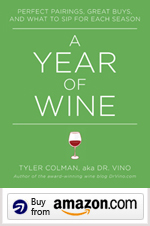 Time for a review roundup! Simon & Schuster, the publisher of my book, A Year of Wine: Perfect Pairings, Great Buys and What to Sip for Each Season, submitted it to the Amazon Vine program. In this program, Amazon sends review copies to some of their customer reviewers who may review it on the product page on Amazon. So far there are twenty-two customer reviews on the site; feel free to click through, check them out and add yours if you like.
As the author, it is slightly nerve-racking to see reviews coming in right at the point of sale. Fortunately the reception has been excellent. But this point-of-sale review is the future (er, present?) of online retail. As more wine sales shift online in coming years, particularly through the prospect of Amazon entering wine retail, wineries will have to adjust to this form of popular criticism, which could certainly serve as a sharp break with the dominant sales model of the past couple decades, selling wines based on the scores of critics.
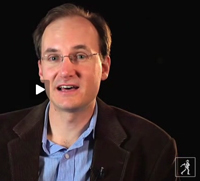 There’s also a new video embedded on the Amazon page. In the still shot, my head looks like that member of the Jedi Council with the enormously long head. But if you roll it, things get proportional.
The book is now also available on the Amazon e-reader, Kindle!
To balance my appearance on Fox Business in December, I went on The Lionel Show on Air America last month. The segments are available here and here.
Wine & Spirits magazine wrote in February that “”this is a guide you’ll want to keep near the top of your reference pile.”
>Pittsburgh Post-Gazette flagged it on their Santa short list, calling it a “user-friendly book…[where] pairings can venture from the ordinary.”
Joe Roberts, aka One Wine Dude, provides a soaring endorsement of the Year of Dr. Vino. Even his baby daughter had her own tasting notes on the book (or chewing notes). Thanks, Joe!
Wine in the ‘Peg recommends A Year of Wine as their first wine book ever recommended! They dig the seasonal enjoyment of wine and say, “His writing style keeps your attention and he brings a fresh perspective to the topic of wine. I’m about a third of the way into it and am just loving it. It’s a fabulous read and is highly recommended.”
The Balanced Grad even stumbled on this wine book saying “has a great writing voice and talks about wine in a relaxed and totally unimposing way. He looks at wine from a seasonal approach, hammering down the point that wine should complement the mood and temperature of each season. I’m really into seasonal eating (hello, Animal, Vegetable, Miracle!) so I can’t help but gravitate towards this idea…”
And don’t forget my other book, good old Wine Politics: How Governments, Environmentalists, Mobsters, and Critics Influence the Wines We Drink, which got a very positive review in the Journal of Wine Economics.
Send in your comments on either book and we will link ’em up! See previous review roundups.
Feb
23
2009
Wine Maps
Monthly Archives
Blogroll
Categories
- American wine
- announcements
- Argentine wine
- auctions
- Australian wine
- Beer
- best wines
- Bling
- books
- Bordeaux
- bottled water
- Box wine
- Burgundy
- business of wine
- Celebrity wine
- Champagne
- Chicago
- China
- cocktails
- cognac
- corks
- corkscrews
- dining
- eco wine
- events
- foie gras
- food and wine
- French wine
- German wine
- giveaway
- grapes
- green wine
- guest post
- highlights
- how to
- Italian wine
- leaders and liters
- Mature wine
- meetups
- New York City
- On notice!
- photo captions
- podcasts
- Polls
- Port
- Portuguese wine
- power list
- reader mail
- rose
- sake
- Sommeliers
- South Africa
- Spanish wine
- spirits
- tasting sized pours
- The real wine world
- TV and movies
- Uncategorized
- videos
- vinexpo
- Weather
- wine and health
- wine and sports
- wine and tech
- Wine Blogging Wednesday
- wine blogs
- wine classes
- wine collecting
- wine gifts
- wine in india
- wine labels
- wine picks
- wine politics
- wine quizzes
- wine random
- wine science
- wine scores
- wine shops
- wine technology
- wine travel
- Wine under $10
- wine writing
- winemaking
- winespeak
 Blog posts via email
@drvino on Instagram
@drvino on Twitter
Advertise

quotes
One of the “fresh voices taking wine journalism in new and important directions.” -World of Fine Wine
“His reporting over the past six months has had seismic consequences, which is a hell of an accomplishment for a blog.” -Forbes.com
"News of such activities, reported last month on a wine blog called Dr. Vino, have captivated wine enthusiasts and triggered a fierce online debate…" The Wall Street Journal
"...well-written, well-researched, calm and, dare we use the word, sober." -Dorothy Gaiter & John Brecher, WSJ
Saveur, best drinks blog, finalist 2012.
One of the "seven best wine blogs." Food & Wine,
One of the three best wine blogs, Fast Company
Books for wine geeks
Wine books on Amazon: