Dr Vino's wine blog
wine talk that goes down easy
A lighter shade of Pinot
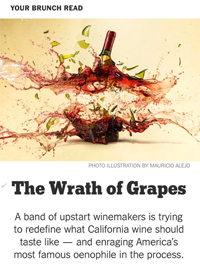 The stylistic clash happening in California has gotten attention in a couple of stories recently, both worth checking out.
The first, “The Wrath of Grapes,” by Bruce Schoenfeld in the NYT magazine, provides an engaging summary of recent goings-on in the Golden State. His narrative follows Raj Parr, a co-founder of In Pursuit of Balance, a group of California producers overtly making wines that favor restraint and elegance over bombast and fruit. He contrasts this with the style of California wines that Robert Parker has championed and ventures to London to attend a tasting with Parker. It’s a good piece; I’ll be adding it to the syllabus of my next NYU wine class.
The second piece is a bit more wonky–get ready for a discussion of grape clones, Vertical Shoot Positioning (*not* something from the Kama Sutra), and yeasts getting more ferocious. In it, David Darlington asks in re: Russian River Valley Pinot Noir: “Why are so many so monstrous?” Good stuff–I won’t offer any spoilers here but he does survey several winemakers and a climate scientists. The story appears in the April issue of Wine & Spirits (available online).
Jun
1
2015
5
Canada’s beef with American wine
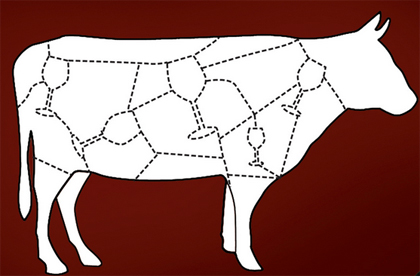
Canada has a beef with the US. They’re pawing the ground and seeing red. Red wine, that is.
Such a dispute is rare for the two NAFTA countries that share the longest undefended border in the world.
The meat of the matter is, well, meat. Canada–and Mexico–complained last year to the World Trade Organization that US regulations were burdensome and discriminatory. The regs require that certain cuts of meat state on the label where the meat was raised (they are known as “country of origin labeling,” or COOL in the language of trade negotiators). They won last year and the US, as is our wont, appealed. Yesterday, the WTO ruled against the US.
This is where the wine comes in: if the US still doesn’t drop the labeling requirements, Canada will levy retaliatory tariffs! And they will be putting US wine in the bull’s eye of their targets! (Oh, and other things like potatoes, chickens and car parts.) Apparently, US wine sales in Canada amount to $1 billion retail according to one commentator–but given Canadian wine retail markups, that probably amounts to $200 million from US wineries. Still, the wine producers represented by the Wine Institute are fighting mad.
“In Canada it has taken decades to build the market for U.S. wine, and it could be irreparably harmed in an instant if Congress does not act [to repeal or amend COOL],” Robert P. Koch, president and CEO of the Wine Institute said in a press statement. Oh. Congress. Good luck with that.
Related on wine tariffs: “Shoppers Could Soon Have Difficulty Finding Meat’s Origin” [nytimes]
“Trade fight could raise tariffs on California wine” [pressdemocrat]
Appellate Body issues report on “United States — Country of origin labelling requirements†[WTO]
May
19
2015
Wonk out with vineyard maps

Have you ever wanted to check out exactly where your favorite domestic wines come from? You can take a look at aerial photos (exciting–grapes!), see block-by-block vineyard maps and get tons of geek-out info about vineyards on the site everyvine.com. Seriously, you can now impress your friends with not only the precise location, grape varieties, and topography, but also the growing degree days vs. the biologically effective growing degree days–oh my, you will be the life of the party!
I searched Rhys Skyline vineyard and found that everyvine even rates vineyards top vineyards with gold, silver and bronze medals–except for Skyline, which they rate platinum! Their algorithms even rate vineyard blocks. They don’t have every vineyard in America in there and I haven’t done a thorough analysis of how their rankings stack up. But it looks impressive and like something you could really get lost in for a few hours.
I read about it today in a post on Wired.com.
May
18
2015
Comments Off on Wonk out with vineyard maps
The wine boom turns 21 – but is acting aged
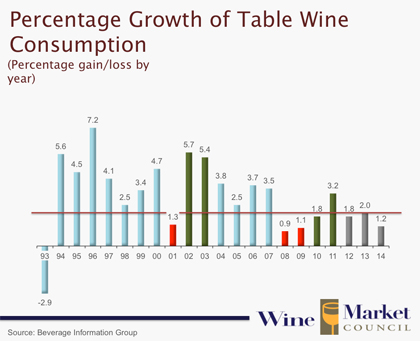
When wine consumption shot higher in 1994, little did wine consumers know that they were uncorking one of the greatest bull markets in recent history. Every year since then, wine consumption has grown making the wine boom now 21 years old–old enough to buy itself a drink, legally, were it a human.
But the growth, which slowed in the wake of the recession, has lost steam but continued to edge higher. Last week in New York City, John Gillespie of the Wine Market Council, a non-profit trade association whose mission is to grow the wine market, presented data on the latest trends. From 1994 – 2007, only one year had less than 2% growth, the recession year of 2001. But since the Great Recession starting in 2008, although every year has seen growth, the growth has been slower with only one year exceeding 2%. Why is growth slowing and what does it portend?
These were the main questions behind the presentations. Growth is slowing because of the rise of craft beer (not exactly hard to see coming), but also, Danny Brager of Nielsen said, because some consumers are trading up, drinking less but more expensive wine. Brager also pointed out that beer consumption is in secular decline having fallen from 60% of the market share of alcoholic beverages in the US in 2000 to 52% last year–and much of the rise of craft beer is at the expense of big, boring beer. He also said that of the 125 packaged goods that Nielsen tracks, growth is sluggish across the board, so wine is outerforming 90% of them.
As to the future, John Gillespie wondered if the wine market is at a tipping point, which could spark a return to strong growth, or a turning point, which would point downward. While he didn’t come down on either side, the sinister organ music playing in the background, releasing a murder of crows into the auditorium and eerie sound of a creaking door slamming all led to a general impression. (Ed. note–dramatization.) We shall see what happens over the next year but if I had to guess, I’d predict more of the same slow growth.
Of course, the best way to really boost consumption would be to lower prices. And the only way that would happen is a legal change, such as eliminating the mandatory three-tier system and its layers of markups. Chance of that happening: infinitesimal.
See more stats from the presentations over on my Twitter feed.
Apr
6
2015
The drought files: Calera edition
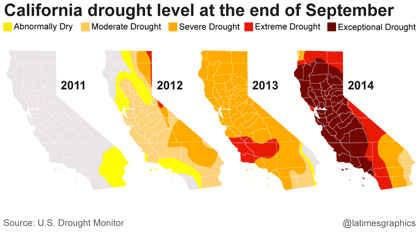
Drought has been wreaking havoc on all of California, including the wine industry. Producers have varied their responses to it, with some irrigating as much as they still can and others calling for “dry farming.â€
 Yesterday, Josh Jensen (right) of Calera Wine told a packed seminar at the In Pursuit of Balance tasting in New York about his approach. He irrigates his 84 acres of hillside vines in the Gabilan Mountains (south of the Santa Cruz Mountains). Initially, when water was more available, he watered three hours at a time, four times a year. Then the increased those durations to six-, 12-, 24-hour “sets†or dousing through the drip irrigation. He finally reached 48 hours, arguing that a prolonged watering saturated the vines to the deepest level, sending the root deeper down.
However, now, with water scarce, he has to truck water up to 1,200 feet to feed the drip lines. He said that for seven months last year, he sent five truckloads of water a day up to fill reservoir tanks to feed the irrigation lines. In total, Calera brought up 1.8 million gallons of water, sourced from a neighbor. And even with that, the vines eked out a yield of 0.6 tons per acre.
Feb
24
2015
The box wine Mark Cuban spent $1 million on
 Box wine made an appearance on ABC’s Shark Tank last Friday. And like blood in the water, this startup had the sharks in a feeding frenzy with all five sharks bidding (or trying to bid).
Before wine enthusiasts get too excited, it’s worth noting that the beverage is more wine-arita than winery. Let’s break it down. Called Beatbox wines, it comes in a box styled as a beatbox. Nice! Two 5-liter boxes sell on their site for $64.99, which comes out to the equivalent of about $5 a bottle. So they’ve got the value pricing covered. And now, the content: this “wine-based” beverage with 11.1% alcohol comes in several flavors including Blue Razzberry Lemonade and Cranberry Limeade. Oh, and these serving instrux: “Try BeatBox on its own, with a mixer, in a cocktail, or as frozen BeatBoxicles!”
Billionaire Mark Cuban put it best on the show: “You’re not selling wine. You’re selling fun.”
Kevin O’Leary tasted it and proclaimed, “This tastes like S**t!” And then he bid on a slice of the company.
But it was Cuban who came out ahead, giving the Austin-based entrepreneurs five times the amount of money they were seeking for a third of the company’s equity–at a 50% higher valuation than they were seeking.
Given the myriad laws governing wine retail and distributing, here’s hoping that BeatBox doesn’t give Mark Cuban a $1 million hangover.
See the whole episode on Hulu Plus or read a blow-by-blow over on BI.
Oct
27
2014
Comments Off on The box wine Mark Cuban spent $1 million on
Wine around $20: Copain Syrah Tous Ensemble
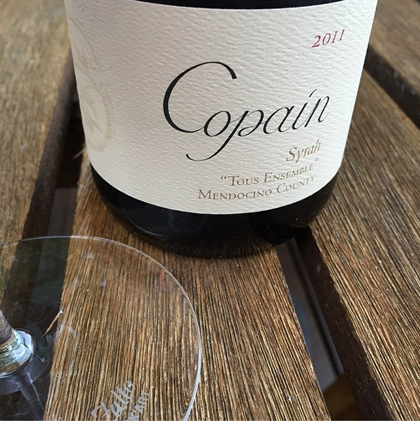
The signature characteristic for syrah from the Northern Rhone is an alluring savory character with a note of black olives. This Copain Syrah, “Tous Ensemble,” 2011, comes from three vineyards in Mendocino County and sees nine months in neutral oak. It’s in the Northern Rhone vein, favoring restraint instead of anything over the top–no “gobs” of anything here. It’s not that California syrah has to ape France; it’s just that Wells Guthrie of Copain favors that style, as do I.
I poured this wine at an event recently and it was very well received; I bought it again for $24 and it was a superb transition to fall with richer foods and cooler weather. And at $21.60 on the case, it is one heckuva a good wine for the price.
Oct
11
2014
Comments Off on Wine around $20: Copain Syrah Tous Ensemble
Sobering: America’s skewed drinking
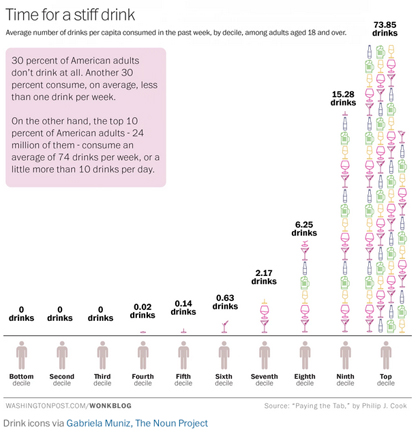
We know that a third of Americans abstain from alcohol. Another third don’t drink too much. But the Wonkblog has a striking graphic showing that the top decile really pound the stuff, drinking an astonishing ten drinks per day. That’s about two bottles of wine a day. Paging Gerard Depardieu! Read more…
Oct
3
2014

Wine Maps
Monthly Archives
Blogroll
Categories
- American wine
- announcements
- Argentine wine
- auctions
- Australian wine
- Beer
- best wines
- Bling
- books
- Bordeaux
- bottled water
- Box wine
- Burgundy
- business of wine
- Celebrity wine
- Champagne
- Chicago
- China
- cocktails
- cognac
- corks
- corkscrews
- dining
- eco wine
- events
- foie gras
- food and wine
- French wine
- German wine
- giveaway
- grapes
- green wine
- guest post
- highlights
- how to
- Italian wine
- leaders and liters
- Mature wine
- meetups
- New York City
- On notice!
- photo captions
- podcasts
- Polls
- Port
- Portuguese wine
- power list
- reader mail
- rose
- sake
- Sommeliers
- South Africa
- Spanish wine
- spirits
- tasting sized pours
- The real wine world
- TV and movies
- Uncategorized
- videos
- vinexpo
- Weather
- wine and health
- wine and sports
- wine and tech
- Wine Blogging Wednesday
- wine blogs
- wine classes
- wine collecting
- wine gifts
- wine in india
- wine labels
- wine picks
- wine politics
- wine quizzes
- wine random
- wine science
- wine scores
- wine shops
- wine technology
- wine travel
- Wine under $10
- wine writing
- winemaking
- winespeak
 Blog posts via email
@drvino on Instagram
@drvino on Twitter
Advertise

quotes
One of the “fresh voices taking wine journalism in new and important directions.” -World of Fine Wine
“His reporting over the past six months has had seismic consequences, which is a hell of an accomplishment for a blog.” -Forbes.com
"News of such activities, reported last month on a wine blog called Dr. Vino, have captivated wine enthusiasts and triggered a fierce online debate…" The Wall Street Journal
"...well-written, well-researched, calm and, dare we use the word, sober." -Dorothy Gaiter & John Brecher, WSJ

Saveur, best drinks blog, finalist 2012.
One of the "seven best wine blogs." Food & Wine,
One of the three best wine blogs, Fast Company
Books for wine geeks
Wine books on Amazon: